
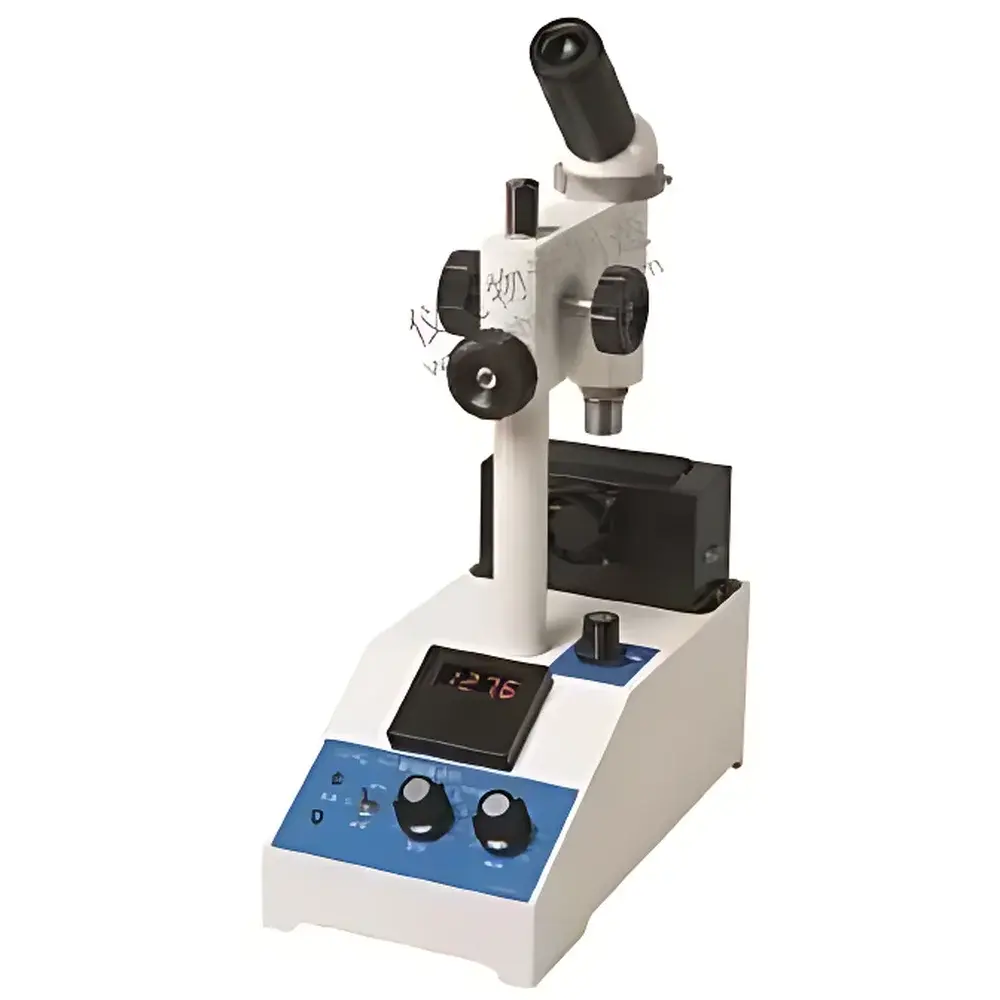
YDWG SGW X-4 / X-4A / X-4B Microscopic Melting Point Apparatus
| Brand | YDWG |
|---|---|
| Origin | Shanghai, China |
| Model | SGW X-4 / SGW X-4A / SGW X-4B |
| Temperature Range | Ambient to 320 °C |
| Heating Rate | 1 °C/min |
| Temperature Repeatability | ±1 °C (≤200 °C), ±2 °C (>200 °C) |
| Temperature Accuracy | ±1 °C (≤200 °C), ±2 °C (>200 °C) |
| Temperature Resolution | 0.1 °C |
| Capillary Dimensions | OD 1.4 mm, ID 1.0 mm, Length 90 mm |
| Sample Capacity | 1 |
| Viewing System | Monocular Microscope (X-4, X-4A) / Binocular Stereo Microscope (X-4B) |
| Magnification | 40× (X-4, X-4A), 40–100× (X-4B) |
| Power Supply | 220 V ± 22 V, 50 Hz ± 1 Hz |
| Dimensions | 300 mm × 220 mm × 440 mm |
| Net Weight | 4.5 kg |
Overview
The YDWG SGW X-4 series is a benchtop microscopic melting point apparatus engineered for precise, visual determination of solid-phase transition temperatures in crystalline organic compounds. Based on the classical capillary tube method and complementary hot-stage microscopy technique, it operates via controlled resistive heating of a calibrated metal block, with real-time observation through an integrated optical microscope. The instrument measures the temperature interval over which a solid sample undergoes phase transition from crystalline to isotropic liquid—defined by the onset of meniscus collapse, bubbling, or complete liquefaction under magnified view. Designed for routine QC laboratories, academic teaching labs, and R&D environments, the SGW X-4 series complies with fundamental principles outlined in pharmacopoeial standards including USP <741>, EP 2.2.17, and JP 2.60, where visual endpoint detection remains a validated and widely accepted methodology for identity and purity assessment.
Key Features
- Three model variants: SGW X-4 (monocular, 40× fixed magnification), SGW X-4A (monocular, 0.1 °C resolution display), and SGW X-4B (binocular stereo microscope with 40–100× zoom optics for enhanced depth perception and ergonomic viewing)
- Programmable linear heating rate of 1 °C/min, optimized for reproducible thermal ramping across the full operating range (ambient to 320 °C)
- Integrated anti-draft shield minimizes convective air currents, improving thermal stability and reducing measurement drift during endpoint observation
- Dual measurement modes supported: capillary tube method (ASTM E324-compliant sample preparation) and hot-stage method using standard glass slides and cover slips
- High-contrast monocular or binocular optical path with achromatic objectives, enabling clear visualization of crystal morphology changes, sintering, and melt front propagation
- Robust aluminum alloy heating block with embedded Pt100 sensor and PID temperature control architecture for stable thermal equilibrium and low hysteresis
Sample Compatibility & Compliance
The SGW X-4 series accommodates standard 1.4 mm OD × 1.0 mm ID × 90 mm capillaries filled with 1–2 mm sample columns—a configuration aligned with ICH Q5C and USP general chapter <741> recommendations for small-molecule APIs. It is routinely employed for melting point verification of pharmaceutical intermediates, dyes, polymers, agrochemicals, and fine chemicals. While not equipped with automated image capture or digital endpoint recognition, its manual visual protocol satisfies GLP-aligned documentation requirements when paired with laboratory notebooks or LIMS-integrated reporting. The instrument’s mechanical design and thermal performance are consistent with ISO/IEC 17025 clause 6.4.3 (equipment suitability) for non-automated thermal analysis tools used in accredited testing facilities.
Software & Data Management
The SGW X-4 series operates as a standalone analog-digital hybrid system with no embedded firmware or proprietary software. Temperature readout is displayed on a high-contrast LED panel with 0.1 °C resolution (X-4A and X-4B models); the base X-4 model displays integer values only. All models support manual data logging via external thermocouple calibrators or digital thermometers traceable to NIST standards. For regulatory environments requiring audit trails, users may integrate the instrument into electronic lab notebook (ELN) workflows by recording observed onset/completion temperatures, operator ID, date/time, and sample ID—fully compliant with FDA 21 CFR Part 11 when ELN systems provide electronic signatures and version-controlled entries.
Applications
- Pharmaceutical quality control: Identity confirmation and purity screening of active pharmaceutical ingredients (APIs) and excipients per USP monographs
- Organic synthesis validation: Monitoring reaction completion and intermediate purity during multi-step syntheses
- Polymer characterization: Determining crystallinity onset in semi-crystalline thermoplastics and copolymers
- Material science education: Teaching solid-state phase transitions, eutectic behavior, and polymorphism in undergraduate chemistry curricula
- Regulatory submissions: Supporting analytical method validation packages where visual melting point remains a compendial specification
FAQ
Is the SGW X-4 series compliant with pharmacopoeial standards such as USP <741>?
Yes—the capillary-based visual method implemented in all three models conforms to the procedural requirements of USP <741>, EP 2.2.17, and JP 2.60, provided operators follow prescribed sample loading, heating rate, and endpoint interpretation guidelines.
Can the instrument be calibrated using NIST-traceable reference standards?
Absolutely. Certified melting point reference materials (e.g., caffeine, indomethacin, potassium ferrocyanide) with documented uncertainties are recommended for periodic verification of accuracy and repeatability per ISO/IEC 17025 Section 6.6.
What is the recommended maintenance schedule for long-term reliability?
Annual inspection of the heating block surface integrity, optical lens cleaning with lens-grade solvent, and verification of capillary holder alignment are advised. No consumables beyond standard capillaries and microscope slides are required.
Does the X-4B model support photomicrography?
The X-4B’s binocular head includes a trinocular port option (sold separately) compatible with C-mount adapters for DSLR or industrial CMOS cameras—enabling documentation of melt progression for training or internal SOP archives.



