
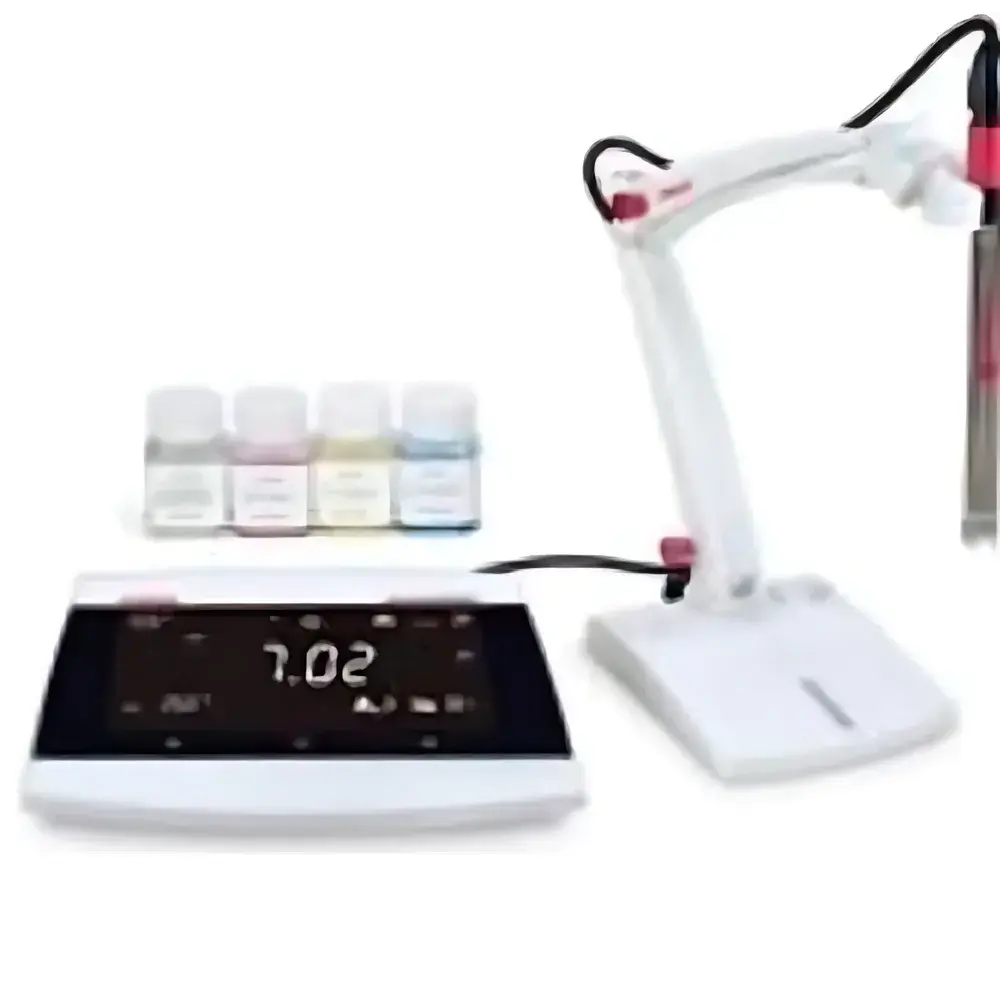
OHAUS AB23PH-F ZH Benchtop pH Meter (formerly ST2100)
| Brand | OHAUS |
|---|---|
| Origin | USA |
| Model | AB23PH-F ZH (formerly ST2100) |
| Instrument Type | Benchtop |
| Parameter Types | Multi-parameter |
| Measurement Accuracy | ±0.01 pH |
| pH Range | 0.00 – 14.00 |
| mV Range | −1999 – +1999 mV |
| Temperature Range | 0 – 100 °C |
| Resolution | 0.01 pH / 1 mV / 0.1 °C |
| Accuracy | ±0.01 pH / ±1 mV / ±0.5 °C |
| Calibration | Up to 3-point, auto-buffer recognition (USA standard buffers) |
| Temperature Compensation | Automatic or manual (NTC 30 kΩ sensor, 0–100 °C) |
| Input Impedance | >10¹² Ω (pH BNC input) |
| Power Supply | 110–240 V AC, 50/60 Hz |
| Dimensions | 220 × 175 × 78 mm (W × D × H) |
| Weight | 0.75 kg |
| Display | LCD with real-time date/time stamp |
| Data Storage | Last calibration record (including timestamp) |
| Housing Material | ABS polymer |
| Compliance | CE, ISO 9001 certified, CMC licensed (China Metrology Certification) |
Overview
The OHAUS AB23PH-F ZH Benchtop pH Meter (formerly ST2100) is a precision electrochemical instrument engineered for routine laboratory pH, mV, and temperature measurements in quality control, academic research, and industrial process support environments. Based on potentiometric measurement principles, it determines hydrogen ion activity via a glass electrode coupled with a reference electrode—generating a Nernstian voltage proportional to pH under controlled thermal conditions. Its dual-input architecture accepts standard BNC pH electrodes and Cinch-type NTC 30 kΩ temperature probes, enabling simultaneous measurement and automatic temperature compensation (ATC) across the full 0–100 °C operational range. Designed for robustness and long-term stability, the unit features an ABS polymer housing, high-input-impedance (>10¹² Ω) circuitry to minimize electrode loading errors, and a DC-powered architecture compatible with global mains voltages (110–240 V AC). As a benchtop instrument, it prioritizes ergonomic usability without compromising metrological integrity—meeting foundational requirements for GLP-aligned workflows where traceability, repeatability, and documented calibration history are essential.
Key Features
- Three-point calibration with auto-buffer recognition for USA-standard pH buffers (4.01, 7.00, 10.01), reducing operator error and accelerating setup.
- Simultaneous display of pH, mV, and temperature values on a high-contrast LCD screen with real-time date/time stamping for audit-ready data logging.
- Dual temperature compensation modes: automatic (via integrated NTC probe) or manual entry—ensuring accuracy across variable ambient and sample conditions.
- Integrated standalone mounting stand enables flexible bench placement, cable management, and stable electrode positioning during static or flow-through measurements.
- Onboard memory stores the most recent calibration event—including buffer IDs, slope (%), offset (mV), and timestamp—supporting internal quality audits and regulatory review.
- Compliance-ready design: CE-marked, ISO 9001-certified manufacturing, and CMC-licensed for use in regulated Chinese laboratories; meets fundamental electrical safety and electromagnetic compatibility (EMC) requirements per IEC 61010-1.
Sample Compatibility & Compliance
The AB23PH-F ZH is optimized for aqueous and low-ionic-strength samples typical in pharmaceutical formulation testing, environmental water analysis, food & beverage QA, and educational labs. It supports all standard combination pH electrodes with BNC connectors and exhibits stable performance with common reference electrolytes (e.g., 3 M KCl). While not intended for highly viscous, non-aqueous, or strongly oxidizing media without electrode-specific validation, its input impedance and noise-rejection architecture ensure reliable readings in buffered solutions, tap water, culture media, and mild chemical process streams. Regulatory alignment includes adherence to general principles of ISO/IEC 17025 for testing laboratories and provides foundational support for FDA 21 CFR Part 11 compliance when paired with validated electronic record systems—though the meter itself does not include electronic signature or audit trail functionality beyond timestamped calibration logs.
Software & Data Management
This model operates as a standalone instrument without proprietary PC software or USB connectivity. All measurement and calibration data reside locally on the device’s non-volatile memory. The LCD interface displays current reading, unit, temperature, calibration status, and battery/power indicator. Calibration records—comprising date/time, selected buffers, measured mV values, calculated slope and offset—are retained until overwritten by the next calibration. For laboratories requiring exportable datasets, external documentation must be performed manually or via third-party digital capture (e.g., camera-based SOP logging or integration with LIMS via human-in-the-loop entry). No firmware updates or configuration changes are supported post-manufacture; calibration parameters are factory-set and user-locked to preserve metrological consistency.
Applications
- Pharmaceutical QC: Monitoring pH of dissolution media, buffer preparations, and final product formulations per USP and EP 2.2.3 guidelines.
- Environmental Testing: Field-deployable verification of surface water, wastewater effluent, and soil extract pH per ASTM D1293 and ISO 10523 protocols.
- Food & Beverage Production: Routine checks of brine solutions, dairy products, fruit juices, and fermentation broths to ensure process consistency and microbial safety limits.
- Academic Instruction: Teaching core concepts of acid-base equilibria, Nernst equation derivation, electrode response kinetics, and calibration theory in undergraduate chemistry and biology labs.
- Industrial Process Support: Verification of cleaning-in-place (CIP) rinse water neutrality, plating bath stability, and bioreactor feedstock preparation prior to inoculation.
FAQ
Does the AB23PH-F ZH support GLP-compliant calibration documentation?
It stores the timestamp, buffer values, slope, and offset of the most recent calibration—providing basic traceability. However, full GLP compliance requires supplementary procedural controls (e.g., written calibration SOPs, analyst sign-off, and periodic review of calibration history), which are lab-managed.
Can I use non-USA buffer standards (e.g., DIN or NIST) with this meter?
Yes, but manual calibration mode must be selected; auto-buffer recognition is limited to USA-standard values (4.01, 7.00, 10.01). Users entering custom buffer values assume responsibility for accuracy verification.
Is the included pH electrode refillable or replaceable?
The AB23PH-F ZH ships with a standard combination pH electrode; OHAUS specifies it as a consumable with finite service life. Refillable versions are not supplied, but replacement electrodes compatible with BNC inputs and 3 M KCl filling solution are commercially available.
What is the recommended recalibration frequency?
Per ISO 7870-2 and general laboratory best practices, recalibrate before each analytical session, after electrode storage, or when measuring samples with large pH shifts. Critical applications may require in-sequence verification using a check standard.
Does the meter meet FDA 21 CFR Part 11 requirements for electronic records?
No—it lacks electronic signatures, audit trails, and system access controls. It may serve as a data source within a broader Part 11–compliant ecosystem, but standalone use does not satisfy regulatory criteria for electronic records.
Related Products





