
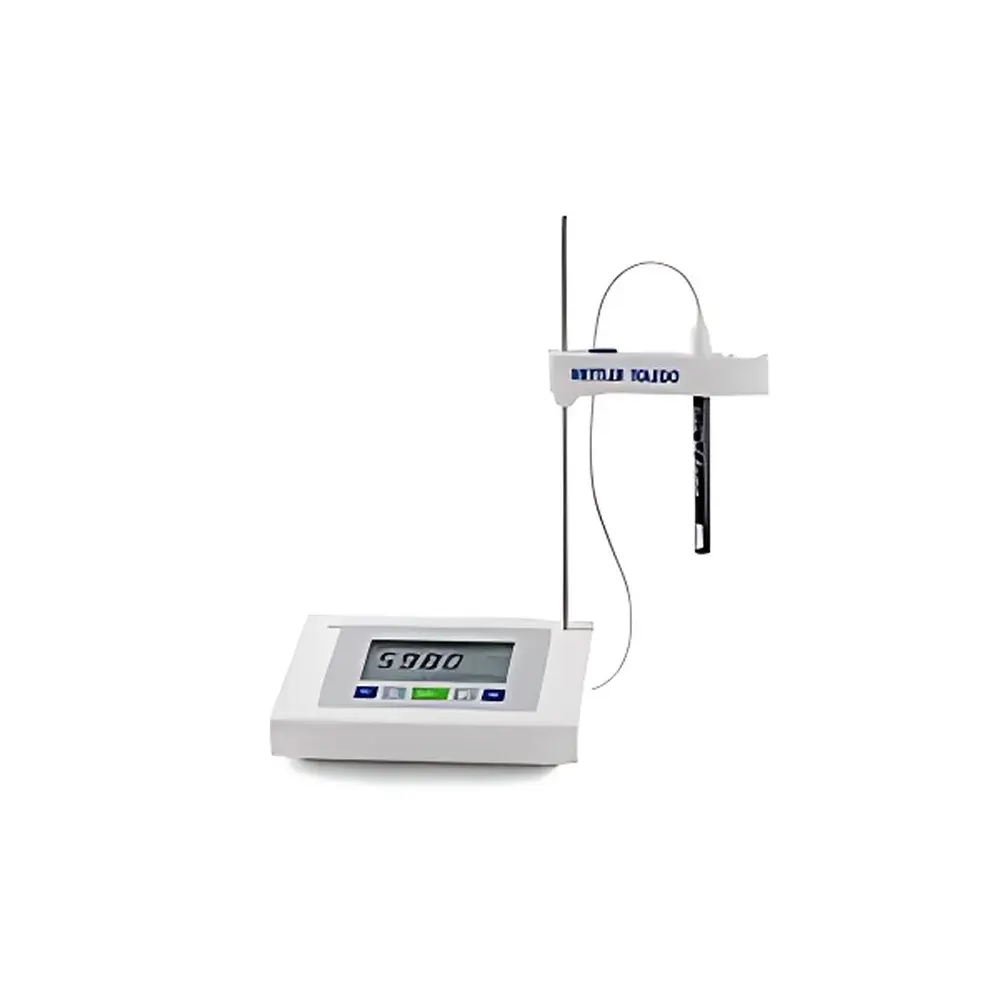
METTLER TOLEDO FiveEasy Plus Benchtop Conductivity Meter FE38-Standard
| Brand | METTLER TOLEDO |
|---|---|
| Origin | Switzerland |
| Model | FE38-Standard |
| Form Factor | Benchtop |
| Application Environment | Laboratory |
| Conductivity Range | 0.01 µS/cm to 500 mS/cm |
| TDS Range | 0.01 mg/L to 300 g/L |
| Salinity Range | 0.00–42 PSU |
| Temperature Range | −5 °C to 105 °C |
| Accuracy | ±0.5% of full scale |
| Minimum Conductivity Resolution | 0.01 µS/cm |
| Temperature Accuracy | ±0.3 °C |
| Temperature Compensation | Linear (0.00–10.00 %/°C), Reference Temp: 20 °C or 25 °C |
| Calibration | 1–3 point, with preset standards and manual cell constant entry |
| Data Storage | 200 measurement records + current calibration data |
| Interfaces | Mini-DIN electrode port, RS232, USB |
| Display | 4.3-inch segmented LCD |
| Dimensions | 227 × 147 × 70 mm |
| Weight | 0.63 kg |
| Housing Material | ABS |
Overview
The METTLER TOLEDO FiveEasy Plus Benchtop Conductivity Meter FE38-Standard is a purpose-engineered electrochemical instrument designed for routine, high-reproducibility conductivity, TDS, salinity, and temperature measurements in regulated laboratory environments. Based on four-electrode or two-electrode AC conductometric principles—depending on the connected sensor—the instrument delivers stable, drift-resistant readings across an exceptionally wide dynamic range (0.01 µS/cm to 500 mS/cm). Its architecture complies with fundamental requirements for traceable, auditable electrochemical analysis, supporting GLP-compliant workflows through secure calibration logging, endpoint detection, and non-volatile data storage. Engineered in Switzerland and built to IEC 61010-1 safety standards, the FE38-Standard integrates precision analog signal conditioning with digital temperature compensation algorithms, enabling accurate conversion of raw conductance into standardized units under variable thermal conditions.
Key Features
- Single-button operation for rapid initiation of conductivity, TDS, salinity, or temperature measurement—minimizing procedural variability in high-throughput labs.
- Intuitive 4.3-inch segmented LCD display with dedicated status icons: real-time endpoint indication, calibration progress bar, and audible confirmation tone upon stabilization.
- Compact benchtop footprint (227 × 147 × 70 mm) optimized for space-constrained analytical workstations; integrated electrode holder stows flush against the instrument’s side panel.
- Auto-ranging resolution adapts dynamically across the full measurement span—0.01 µS/cm at low-conductivity ranges, scaling to 0.1 mS/cm at higher levels—ensuring optimal digitization without manual range selection.
- Dual temperature compensation modes: linear coefficient adjustment (0.00–10.00 %/°C) with user-selectable reference temperatures (20 °C or 25 °C), accommodating both freshwater and high-ionic-strength matrices.
- Robust ABS housing rated for continuous operation in ambient laboratory conditions (15–30 °C, ≤80% RH non-condensing).
Sample Compatibility & Compliance
The FE38-Standard supports standard DIN/ISO-compliant conductivity cells (e.g., K = 0.1, 1.0, or 10 cm⁻¹) via its Mini-DIN electrode interface, enabling seamless integration with METTLER TOLEDO InLab® and other third-party sensors. It is validated for aqueous samples across pharmaceutical, environmental, food & beverage, and academic research applications—including purified water (USP ), wastewater effluents (EPA Method 120.1), and seawater analogs (ASTM D1125). While not certified for hazardous area use, its design conforms to ISO/IEC 17025 documentation requirements for equipment verification, and its calibration traceability aligns with national metrology institute (NMI) standards when used with NIST-traceable KCl standards. The instrument meets CE marking requirements and complies with electromagnetic compatibility directives (2014/30/EU).
Software & Data Management
Data integrity is maintained through embedded 200-entry non-volatile memory that stores timestamped measurements, sensor ID (if encoded), calibration history (including date, standard values, and applied cell constant), and temperature readings. RS232 and USB interfaces support direct export to spreadsheet software or LIMS without proprietary drivers—data formats are plain ASCII CSV or tab-delimited text. No cloud connectivity or firmware-over-the-air updates are implemented, preserving system stability in validated environments. Audit trail functionality satisfies basic FDA 21 CFR Part 11 expectations for electronic records: all stored entries are immutable post-acquisition, and calibration events are time-stamped with operator-entered identifiers (via optional external keyboard or manual annotation).
Applications
- Pharmaceutical water system monitoring (PW, WFI, Purified Water) per USP conductivity acceptance criteria.
- Environmental testing of surface water, groundwater, and wastewater for regulatory reporting (e.g., ISO 7888, EN 27888).
- Quality control of electrolyte solutions in battery R&D and production.
- Salinity determination in aquaculture and marine biology studies using PSU-scale output.
- TDS estimation in food processing (e.g., brine concentration, syrup density correlation) where gravimetric validation is impractical.
- Educational laboratories requiring robust, low-maintenance instrumentation for undergraduate electrochemistry curricula.
FAQ
Does the FE38-Standard support automatic temperature compensation (ATC)?
Yes—it accepts input from integrated or external Pt1000 temperature probes and applies linear compensation based on user-defined β coefficients and reference temperatures.
Can I use non-METTLER TOLEDO conductivity cells?
Yes, provided the cell features a Mini-DIN connector and adheres to standard electrode geometry and cell constant tolerances (±2%). Manual cell constant entry is supported.
Is calibration data exportable?
Calibration metadata (date, standard values, entered cell constant) is stored alongside measurements and exported with the same ASCII file structure.
What is the operating temperature limit for the instrument itself?
The unit is specified for ambient operation between −5 °C and 40 °C; extended-range probe measurements (up to 105 °C) require appropriate high-temp electrodes and thermal shielding.
Does it meet GLP requirements for audit readiness?
It provides essential GLP elements: unique measurement IDs, time/date stamps, calibration traceability, and unalterable storage—though full 21 CFR Part 11 compliance requires complementary procedural controls (e.g., password-protected access, written SOPs).



