
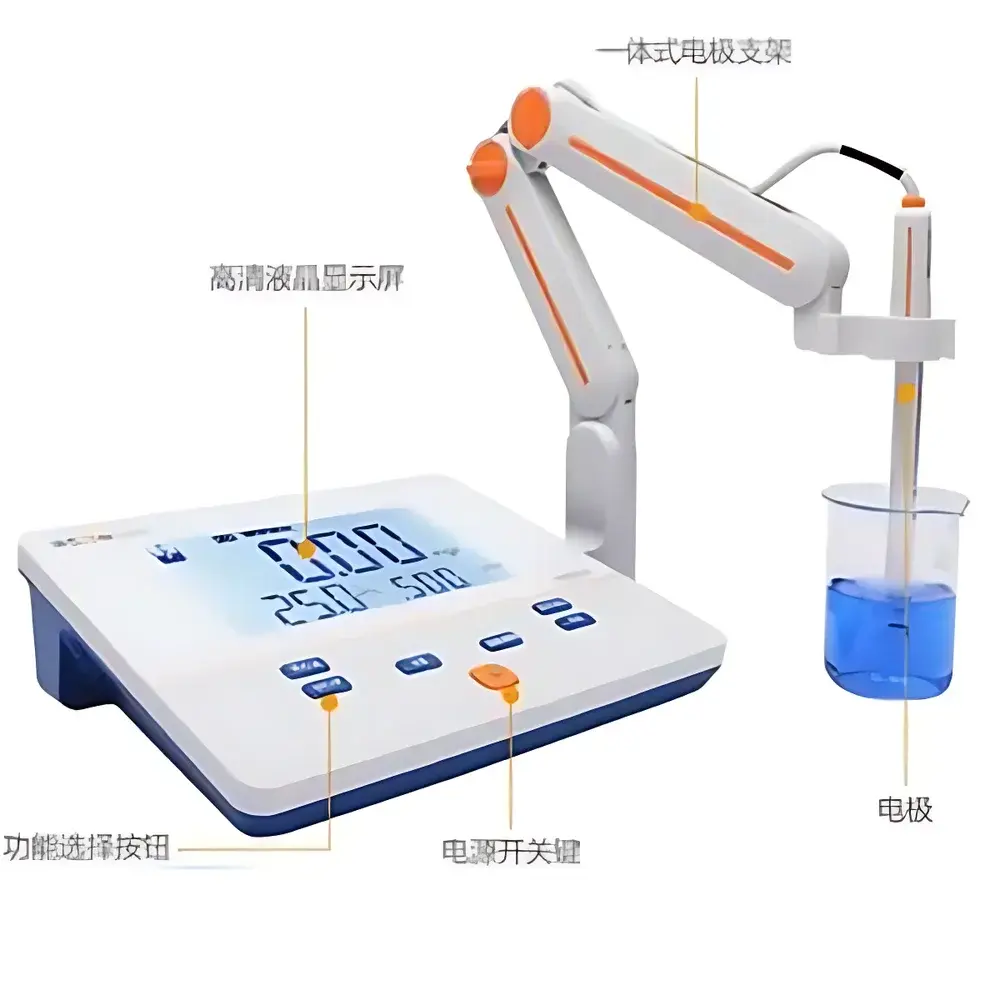
Leici DDS-307 Benchtop Conductivity Meter
| Brand | Leici |
|---|---|
| Origin | Shanghai, China |
| Model | DDS-307 |
| Form Factor | Benchtop |
| Application Environment | Laboratory |
| Conductivity Range | 0.00 µS/cm to 200 mS/cm |
| Accuracy | ±1.0% FS |
| Minimum Resolution | 0.01 µS/cm |
| Temperature Compensation | Manual (15.0–35.0 °C) |
| Temperature Coefficient | Fixed at 2%/°C |
| Display | 3½-digit LED |
| Output Signal | 0–10 mV DC |
| Electrode Compatibility | DJS-1C platinized platinum conductivity cell (cell constant 0.01 cm⁻¹), titanium alloy electrode with sealed measurement chamber |
| Power Supply | AC 220 V ±22 V, 50 Hz ±1 Hz |
| Dimensions (W×D×H) | 290 × 210 × 95 mm |
| Weight | 1.5 kg |
Overview
The Leici DDS-307 Benchtop Conductivity Meter is a precision-engineered electrochemical instrument designed for reliable, repeatable conductivity measurements in controlled laboratory environments. It operates on the principle of two-electrode AC conductometry, applying a low-frequency alternating current across a defined electrode geometry to measure solution conductance while minimizing polarization effects. The instrument is calibrated to meet Chinese national standard JJG 376–2007 and conforms to the general performance requirements of Class 1.0 conductivity meters per GB/T 6682–2008 (equivalent to ISO 3696:1987 for water purity classification). Its fixed 2%/°C temperature compensation coefficient and manual temperature adjustment range (15.0–35.0 °C) are optimized for routine analysis of aqueous samples where ambient thermal stability is maintained—particularly suited for ultrapure water monitoring, boiler feedwater testing, and quality control in pharmaceutical excipient preparation.
Key Features
- High-stability 3½-digit LED display with clear numeric readout and polarity indication
- Manual temperature compensation with dedicated front-panel adjustment dial and visual scale (15.0–35.0 °C)
- Dedicated 0–10 mV DC analog output for integration with chart recorders or data loggers
- Optimized electrode interface supporting Leici DJS-1C platinized platinum conductivity cells (cell constant 0.01 cm⁻¹), enabling accurate measurement down to 0.01 µS/cm in low-conductivity matrices
- Titanium alloy electrode housing with sealed measurement chamber minimizes contamination risk and ensures mechanical robustness during repeated high-purity water handling
- Stable power architecture compliant with IEC 61010-1:2010 safety standards for laboratory electrical equipment
- Compact benchtop footprint (290 × 210 × 95 mm) and lightweight design (1.5 kg) facilitate placement in fume hoods, clean benches, or QC workstations
Sample Compatibility & Compliance
The DDS-307 is validated for use with deionized water, distilled water, reverse osmosis permeate, and low-ionic-strength process streams. Its 0.01 cm⁻¹ cell constant configuration meets ASTM D1125–20 Standard Test Methods for Electrical Conductivity and Resistivity of Water, particularly Section 7.2 for ultrapure water assessment. While not equipped for automatic temperature sensing or multi-parameter reporting, the meter satisfies GLP documentation requirements when used with traceable calibration records and defined SOPs. Its ±1.0% full-scale accuracy aligns with ISO/IEC 17025:2017 clause 7.7 on measurement uncertainty estimation for routine conductivity verification tasks. No TDS, salinity, or resistivity conversion functions are implemented—ensuring metrological transparency and eliminating algorithmic uncertainty sources.
Software & Data Management
The DDS-307 operates as a standalone analog instrument with no embedded microprocessor, firmware, or digital storage capability. All measurements are real-time analog outputs or direct LED readings; no internal memory, USB port, RS-232 interface, or software dependency is present. This architecture eliminates cybersecurity risks, firmware update obligations, and validation overhead associated with computer-linked systems—making it suitable for regulated environments where audit trail simplicity and deterministic behavior are prioritized over data automation. Calibration verification is performed using certified KCl standard solutions (e.g., 1413 µS/cm at 25 °C, traceable to NIST SRM 3194), with documented procedures fulfilling FDA 21 CFR Part 11 “electronic records” exemptions for non-critical, non-GxP endpoint instruments.
Applications
- Monitoring conductivity of purified water (PW) and water-for-injection (WFI) feed streams in pharmaceutical manufacturing
- Verification of deionization efficiency in central water purification systems
- Quality assurance of reagent-grade solvents and buffer stock solutions
- Environmental lab analysis of rainwater, groundwater, and surface water low-conductivity fractions
- Educational laboratories requiring fundamental electrochemical instrumentation with transparent operating principles
- Calibration reference checks for field-portable conductivity meters prior to deployment
FAQ
Does the DDS-307 support automatic temperature compensation (ATC)?
No. It provides manual temperature compensation only, requiring user input of measured sample temperature within the 15.0–35.0 °C range.
Can the DDS-307 measure TDS or salinity?
No. It is a single-parameter conductivity meter with no built-in TDS conversion algorithms or salinity calculation functions.
What electrode is required for optimal low-conductivity measurement?
The Leici DJS-1C platinized platinum electrode (cell constant 0.01 cm⁻¹) is mandatory for measurements below 100 µS/cm to ensure adequate signal-to-noise ratio and minimize polarization error.
Is the instrument compliant with ISO/IEC 17025 or GLP requirements?
Yes—when operated within its specified environmental conditions and supported by documented calibration, traceable standards, and procedural controls, it fulfills technical competence criteria for conductivity verification under ISO/IEC 17025:2017.
What is the recommended calibration frequency?
Daily calibration is advised for critical applications; weekly calibration is acceptable for routine monitoring if stability checks (e.g., drift < ±0.33% FS/3 h) are verified between calibrations.






