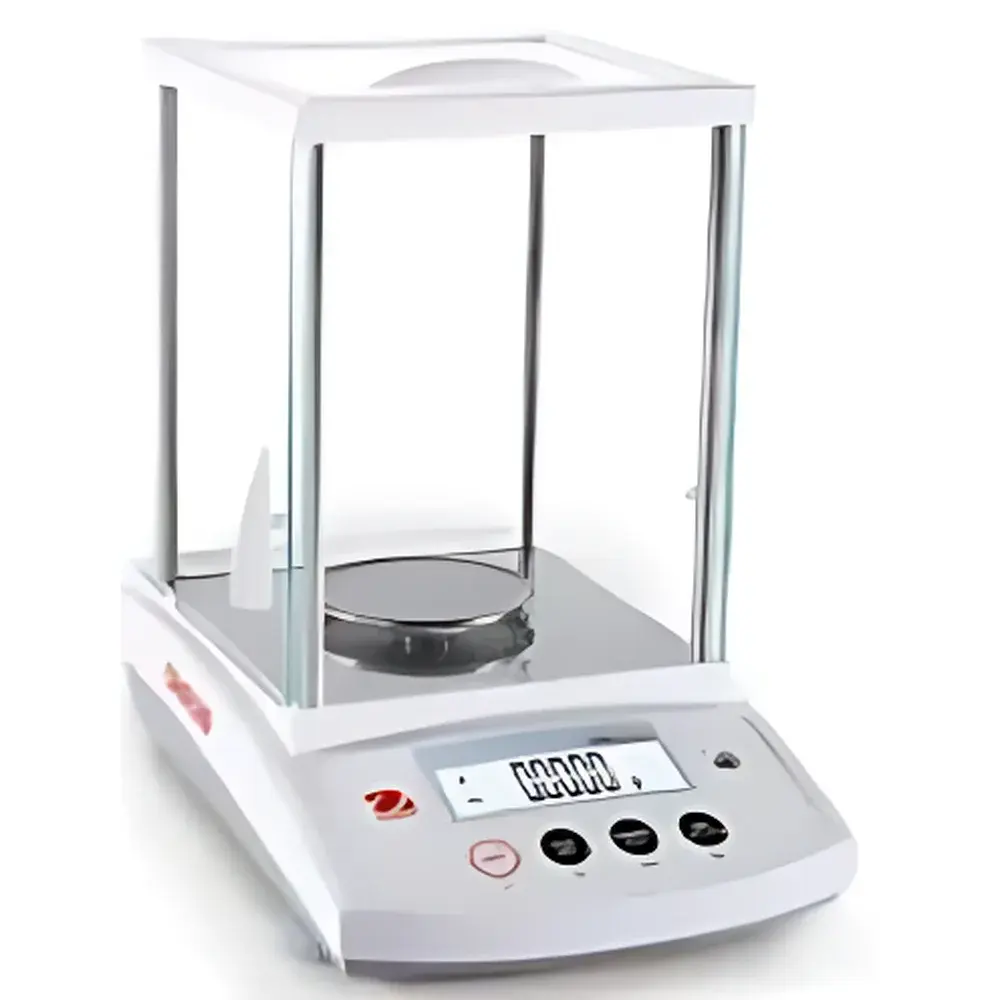
OHAUS PR124ZH/E Analytical Balance (120 g / 0.1 mg)
| Brand | OHAUS |
|---|---|
| Origin | USA |
| Model | PR124ZH/E |
| Max Capacity | 120 g |
| Readability | 0.1 mg |
| Repeatability | 0.1 mg |
| Calibration | External |
| Weighing Modes | Standard, Piece Counting, Percentage |
| Display | Backlit LCD |
| Interface | RS232 |
| Operating Temperature | 10–30 °C |
| Operating Humidity | ≤80% RH (≤30 °C), linearly decreasing to 50% RH at 40 °C |
| Dimensions (W×D×H) | 201 × 317 × 333 mm |
| Net Weight | 4.5 kg |
Overview
The OHAUS PR124ZH/E Analytical Balance is a precision laboratory instrument engineered for routine analytical weighing tasks requiring resolution to 0.1 mg (100 µg) across a 120 g maximum capacity. Built upon OHAUS’s legacy of robust mechanical design and intuitive operational architecture, this balance employs electromagnetic force restoration (EMFR) technology—ensuring high reproducibility, minimal drift, and long-term stability under standard laboratory conditions. Designed as a direct successor to the CP series, the PR platform integrates metrological rigor with practical ergonomics, making it suitable for QC laboratories, academic teaching labs, pharmaceutical formulation support, and industrial quality assurance workflows where traceable, GLP-compliant mass measurement is required but full GMP-grade validation is not mandated.
Key Features
- Compact footprint with recessed leveling feet—optimizes bench space while delivering an unobstructed 90 mm diameter stainless steel weighing pan.
- Durable construction: corrosion-resistant 304 stainless steel pan, impact-resistant ABS housing, and fully removable glass draft shield with top sliding door for rapid sample access and cleaning.
- Backlit monochrome LCD display with high-contrast characters ensures legibility under variable ambient lighting; no operator training required for basic operation.
- Four tactile mechanical keys provide immediate access to core functions—including tare, unit toggle, mode selection, and menu navigation—eliminating reliance on touchscreen interfaces prone to calibration drift or fingerprint interference.
- Configurable environmental compensation: user-adjustable parameters for temperature coefficient (±3 ppm/K), auto-dimming delay, auto-tare threshold, and stabilization time sensitivity.
- Software-level security: password-protected menu lockout, customizable user ID and project naming, overload/underload alerts, and real-time stability indicator.
- Standard RS232 serial interface supports bidirectional communication with LIMS, ELN, or Excel-based data logging systems—enabling audit-ready record generation when paired with compliant software.
Sample Compatibility & Compliance
The PR124ZH/E accommodates a broad range of sample types—from powders and granules to small solid components and pre-weighed vials—within its 90 mm pan geometry and 333 mm overall height (including draft shield). Its external calibration capability allows verification and adjustment using certified Class M1 or M2 weights per ISO/IEC 17025 requirements. While not pre-certified for FDA 21 CFR Part 11 compliance out-of-the-box, the balance supports ALCOA+ data integrity principles when integrated with validated third-party data capture solutions that enforce electronic signatures, audit trails, and change control. It meets ISO 9001 internal calibration process expectations and aligns with USP and guidelines for analytical balance qualification, including repeatability (≤0.1 mg SD), linearity (±0.2 mg), and minimum weight determination (200 mg typical, 82 mg optimal per USP K=2, U=0.10%). Environmental operating limits (10–30 °C, ≤80% RH at ≤30 °C) conform to ASTM E1169 and EURAMET cg-18 recommendations for stable metrological performance.
Software & Data Management
The PR124ZH/E operates without embedded firmware-based data storage; instead, it delivers real-time ASCII-formatted weight output via RS232 to host systems. This architecture avoids internal memory limitations and simplifies regulatory validation by decoupling measurement hardware from data handling logic. Users may configure baud rate (9600 default), parity, stop bits, and termination characters directly through the front-panel menu. When connected to compliant laboratory informatics platforms—such as LabWare LIMS or Thermo Fisher SampleManager—the balance contributes to full traceability: timestamps, operator IDs, sample identifiers, and calibration status are appended to each recorded value. Optional OHAUS Starter software (v3.x+) provides basic print-to-file functionality with CSV export, supporting initial setup verification and periodic performance checks in accordance with ISO/IEC 17025 clause 6.4.2.
Applications
- Pharmaceutical: Active ingredient dispensing, reference standard preparation, excipient ratio verification, and dissolution tablet weight checks.
- Academic Research: Stoichiometric reagent weighing, gravimetric analysis, catalyst loading, and calibration of volumetric glassware.
- Materials Science: Powder density determination, coating mass uniformity testing, and additive manufacturing feedstock verification.
- Food & Beverage QA: Nutrient fortification dosing, moisture loss tracking, and batch consistency auditing.
- Environmental Testing: Filter weighing for particulate matter (PM2.5/PM10) analysis per EPA Method 201A and ISO 12103-1.
FAQ
What is the difference between PR124ZH and PR124ZH/E?
The “E” suffix denotes external calibration capability; the PR124ZH includes internal motorized calibration, whereas the PR124ZH/E requires manual calibration using external weights.
Does this balance support internal calibration?
No—only models ending in “ZH” (without “/E”) feature built-in calibration mechanisms. The PR124ZH/E relies exclusively on external standards.
Is the draft shield included as standard equipment?
Yes—the full-height glass windscreen with top-sliding door is supplied and installed at the factory.
Can I connect this balance to a Windows PC without additional hardware?
Yes, provided the PC has an RS232 port or a certified USB-to-RS232 adapter with proper driver support and matching communication settings.
What is the recommended recalibration frequency?
Per ISO/IEC 17025 and USP , daily verification with calibrated check weights is advised before critical measurements; formal recalibration should occur at intervals determined by risk assessment, usage intensity, and environmental stability—typically every 3–6 months in controlled labs.