
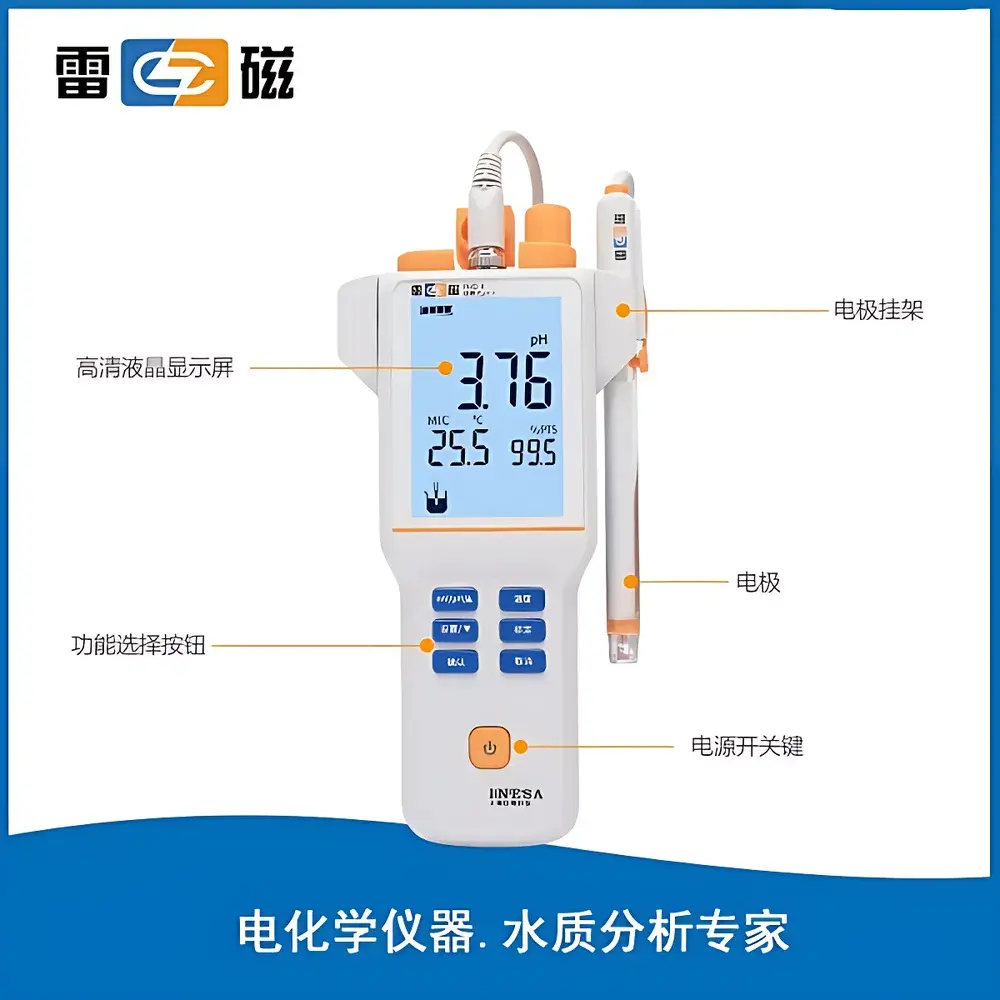
Leici PHB-4 Portable pH Meter
| Brand | Leici |
|---|---|
| Model | PHB-4 |
| Type | Portable pH/ORP Meter |
| Measurement Range | 0.00–14.00 pH / −1400 to +1400 mV |
| Resolution | 0.01 pH / 1 mV |
| Accuracy | ±0.03 pH / ±0.2% FS |
| Temperature Compensation | Manual |
| Calibration | Up to 2-point, auto-recognition of Chinese standard buffers (pH 4.01, 6.86, 9.18) |
| Power | Rechargeable Li-ion battery (DC 5 V adapter included) |
| Dimensions | 80 × 225 × 35 mm |
| Weight | 0.4 kg |
Overview
The Leici PHB-4 Portable pH Meter is a compact, field-deployable electrochemical instrument engineered for reliable and repeatable measurement of hydrogen ion activity (pH) and oxidation-reduction potential (ORP/mV) in aqueous solutions. Based on the potentiometric principle—where a glass pH electrode generates a Nernstian voltage proportional to log[H⁺] relative to a stable reference electrode—the PHB-4 delivers laboratory-grade accuracy in a handheld form factor. Designed for routine quality control, environmental monitoring, educational labs, and field-based water analysis, it complies with fundamental metrological requirements outlined in ISO 7027 (for turbidity-related pH correlation studies) and aligns with general performance expectations defined in ASTM D1293 (Standard Test Method for pH of Water). Its 0.01-pH resolution and ±0.03 pH accuracy meet Class 0.1 instrumentation specifications per IEC 60746-2, making it suitable for applications requiring trace-level consistency without full GLP-compliant audit trails.
Key Features
- High-contrast LCD display with backlight-independent contrast optimization—ensures legibility under variable ambient lighting conditions, including outdoor daylight and low-light field settings.
- Integrated rechargeable lithium-ion battery system providing up to 100 hours of continuous operation on a single charge; includes universal AC/DC adapter (input: 100–240 V AC, output: 5 V DC) for global compatibility.
- Two-point calibration capability with automatic recognition of three standard Chinese buffer solutions (pH 4.01, 6.86, and 9.18 at 25 °C), reducing operator error during setup and minimizing manual entry risks.
- Support for manual calibration using user-defined buffer values—enabling adaptation to non-standard or application-specific reference solutions when required by process validation protocols.
- Manual temperature compensation (MTC) mode allows users to input sample temperature directly, eliminating reliance on integrated temperature probes where probe drift or contamination may compromise measurement integrity.
- Rugged, ergonomic housing (80 × 225 × 35 mm; 0.4 kg) with IP65-rated ingress protection against dust and low-pressure water jets—validated for transport and use in humid or splash-prone environments such as wastewater treatment plants or agricultural runoff sites.
Sample Compatibility & Compliance
The PHB-4 is validated for use with standard combination pH electrodes featuring Ag/AgCl reference systems and low-resistance glass membranes. It accommodates both refillable and gel-filled electrodes compliant with DIN 19263 and ISO 10523. While not certified for intrinsic safety in hazardous locations, its electrical isolation meets IEC 61010-1:2010 safety standards for portable measuring equipment. The instrument does not include built-in data logging or electronic signature functionality; therefore, it is not designed to satisfy FDA 21 CFR Part 11 requirements for regulated pharmaceutical or clinical diagnostics workflows. However, its measurement repeatability and documented calibration traceability support adherence to ISO/IEC 17025:2017 clause 7.7 (Ensuring validity of results) when operated within defined procedural controls.
Software & Data Management
The PHB-4 operates as a standalone, embedded-system device with no proprietary software dependency or USB/Bluetooth connectivity. All configuration, calibration, and measurement functions are executed via tactile membrane keys and visual feedback on the integrated LCD. No firmware updates, remote diagnostics, or cloud synchronization capabilities are provided. Users must manually record readings and calibration logs in accordance with internal SOPs. For laboratories requiring digital audit trails, external documentation systems (e.g., LIMS-integrated notebooks or validated Excel templates) are recommended to maintain ALCOA+ principles (Attributable, Legible, Contemporaneous, Original, Accurate).
Applications
- Environmental field testing: surface water, groundwater, effluent discharge points, and stormwater runoff monitoring per EPA Method 150.1 guidelines.
- Educational laboratories: undergraduate chemistry and environmental science courses requiring robust, low-maintenance pH instrumentation.
- Aquaculture and hydroponics management: real-time pH tracking in recirculating aquaculture systems (RAS) and nutrient film technique (NFT) setups.
- Food & beverage pre-screening: quick verification of rinse water pH, brine solution acidity, or post-sanitization residual alkalinity.
- Industrial maintenance: periodic checks of boiler feedwater, cooling tower makeup, and chemical dosing tank effluents where high portability and rapid deployment are prioritized over automated reporting.
FAQ
Does the PHB-4 support automatic temperature compensation (ATC)?
No. The PHB-4 implements manual temperature compensation only. Users must enter the measured sample temperature prior to reading acquisition.
Can the PHB-4 store calibration data or measurement history?
No. It retains no internal memory for calibration records or past measurements. All data must be transcribed externally.
Is the instrument compatible with international pH buffer standards (e.g., NIST-traceable solutions)?
Yes—though auto-recognition is limited to Chinese standard buffers, manual calibration permits use of any certified reference material (CRM), including NIST SRM 186, NIST SRM 4698, or Merck Titrisol® standards.
What electrode types are recommended for optimal performance?
Leici-compatible combination electrodes with double-junction reference systems and temperature sensors are advised for improved stability in complex matrices; however, the PHB-4 does not power or read from integrated temperature sensors.
Is the PHB-4 suitable for GMP-regulated environments?
It may be used for non-critical in-process checks, but lacks features required for formal GMP compliance—including electronic audit trail, user access control, and secure data export—making it unsuitable for release testing or regulatory submissions.




