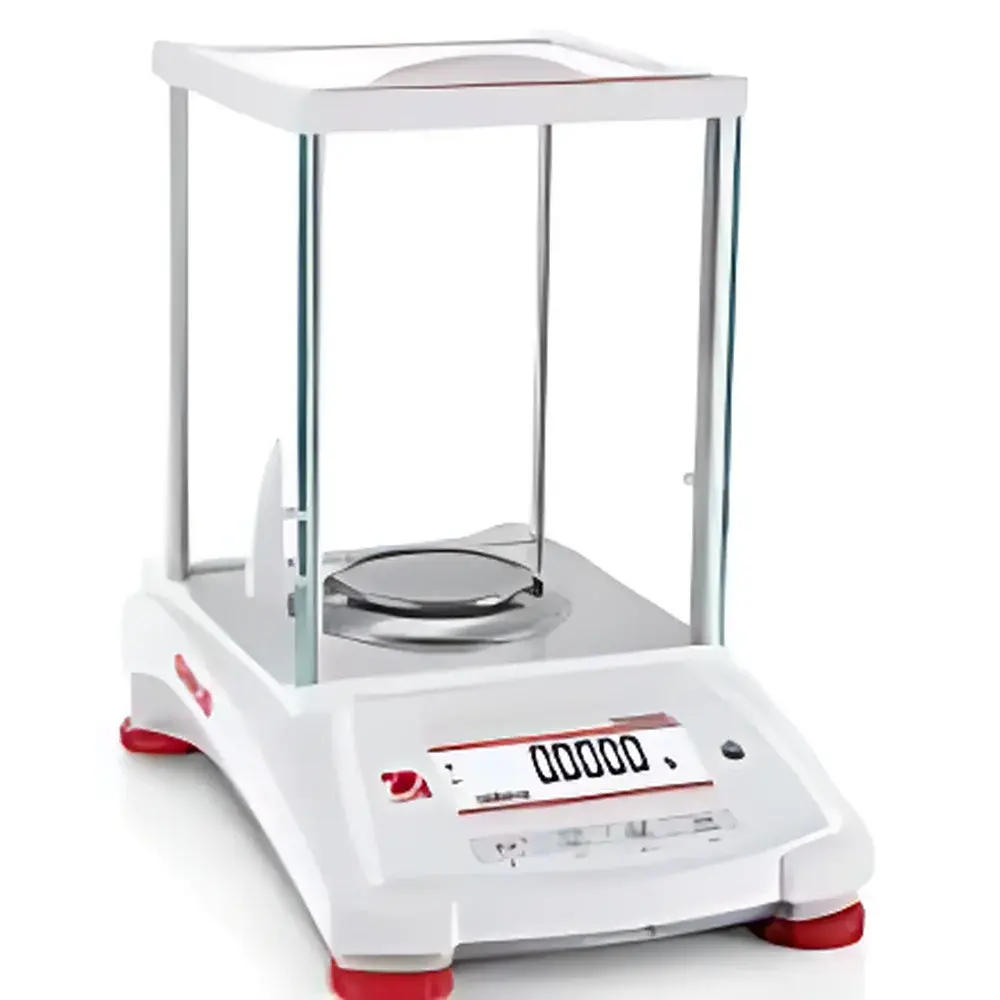
OHAUS PX224ZH/E Precision Analytical Balance
| Key | Brand: OHAUS |
|---|---|
| Origin | USA |
| Model | PX224ZH/E |
| Max Capacity | 220 g |
| Readability | 0.1 mg |
| Repeatability | 0.1 mg |
| Calibration | External |
| Operating Temperature | 10–30 °C |
| Operating Humidity | ≤80% RH (at ≤30 °C), linearly decreasing to 50% RH at 40 °C |
| Display | Backlit dual-line LCD with status indicators and progress bar |
| Connectivity | RS232, USB |
| Compliance | GLP/GMP-ready with real-time clock, audit trail support, and user-accessible calibration logs |
| Weighing Modes | Standard, Counting, Percentage, Checkweighing, Animal Weighing, Density Determination |
| Pan Size | Ø120 mm |
| Power Supply | 12 VDC adapter (100–240 VAC input) |
| Dimensions (W×D×H) | 209 × 321 × 339 mm |
| Net Weight | 4.5 kg |
Overview
The OHAUS PX224ZH/E is a high-performance analytical balance engineered for precision mass measurement in regulated laboratory environments. Designed to replace the legacy AR series, this 220 g / 0.1 mg readability instrument employs electromagnetic force restoration (EMFR) technology—ensuring stable, drift-resistant measurements under controlled ambient conditions. Its 0.1 mg resolution meets the definition of “four-decimal-place” (or “0.0001 g”) analytical capability, satisfying USP minimum weight requirements for quantitative pharmaceutical analysis when operated within specified environmental limits (10–30 °C, ≤80% RH at ≤30 °C). The balance is built around a robust aluminum die-cast base and features a removable stainless-steel weighing pan and tempered glass draft shield—critical for minimizing air-current interference during microgram-level determinations. Integrated ESD mitigation—including a red ESD elimination strip above the weighing chamber—addresses electrostatic charge accumulation on samples or containers, a known source of instability in low-mass measurements.
Key Features
- Electromagnetic force restoration sensor architecture with thermal compensation for consistent repeatability (±0.1 mg standard deviation) across operating temperature range.
- Dual-line backlit LCD display: top line shows net weight and unit; bottom line provides contextual prompts in four selectable languages (English, Spanish, French, Chinese), eliminating reliance on printed manuals.
- Real-time weighing progress bar visualizes load relative to full capacity—enabling rapid assessment of proximity to overload without numeric interpretation.
- Configurable environmental parameters: user-adjustable damping time, auto-zero tracking threshold, and brightness control to optimize performance in variable lab lighting.
- Four tactile mechanical keys provide direct access to core functions—tare, print, menu navigation, and mode selection—reducing workflow interruption during high-throughput operations.
- Integrated GLP/GMP functionality: real-time clock stamps all data outputs; software lock prevents unauthorized configuration changes; audit-ready calibration history is stored internally with timestamped entries.
Sample Compatibility & Compliance
The PX224ZH/E supports a broad range of sample types—from powders and granules to small metallic components and biological specimens—when used with appropriate containment (e.g., weighing boats, vials, or crucibles). Its Ø120 mm stainless-steel pan accommodates standard 100 mL beakers and common volumetric flasks. Draft shield design complies with ISO 9001 and ISO/IEC 17025 metrological best practices for environmental isolation. While not inherently 21 CFR Part 11 compliant, the balance’s USB and RS232 interfaces enable seamless integration with validated LIMS or ELN systems that enforce electronic signature, audit trail, and data integrity protocols. Calibration verification adheres to ASTM E898 and OIML R76 guidelines; external calibration using Class M1 or better weights is recommended per ISO/IEC 17025 clause 6.5.2.
Software & Data Management
Data export is supported via ASCII-formatted serial transmission over RS232 or USB virtual COM port. Output includes weight value, unit, stability flag, date/time stamp (from internal RTC), and optional user ID or project identifier—configurable through the menu system. No proprietary software is required; output is compatible with Microsoft Excel, LabArchives, and most LIMS platforms via simple terminal emulation or custom scripting. All settings—including language, communication baud rate (1200–115200 bps), auto-print trigger, and tare memory—are retained after power cycling. Firmware updates are performed via USB using OHAUS-provided utilities, with version logging accessible in the service menu.
Applications
This balance serves as a primary mass standard in quality control laboratories performing raw material verification, finished product release testing, and stability studies per ICH Q5C. It is routinely deployed in academic research for gravimetric preparation of standard solutions (e.g., HPLC mobile phase calibration), catalyst loading in synthetic chemistry, and sample aliquoting prior to ICP-MS or GC-MS analysis. In manufacturing QA/QC, it supports checkweighing of blister packs, tablet counting by average piece weight, and density determination of polymer pellets using Archimedean displacement. Its animal weighing mode—with dynamic averaging and motion compensation—is validated for small rodent dosing studies where transient movement must not compromise accuracy.
FAQ
What is the minimum weight requirement for reliable measurement per USP ?
For a readability of 0.1 mg and a desired uncertainty of ≤0.10% (k=2), the minimum weight is 200 mg. This value is confirmed by internal calculation using the balance’s repeatability specification.
Does the PX224ZH/E support internal calibration?
No—this model requires external calibration using traceable weights. Internal calibration variants (e.g., PX224ZHP) are available but differ in model suffix and pricing.
Can the balance operate outside the recommended temperature range?
Operation below 10 °C or above 30 °C may increase drift and reduce repeatability. Thermal stabilization time increases significantly outside 18–23 °C, and humidity-induced condensation risks damage to internal electronics.
Is the draft shield removable for cleaning?
Yes—the glass shield and stainless-steel pan are fully detachable for routine decontamination using ethanol or isopropanol, per OHAUS cleaning guidelines.
How is user access controlled for GxP compliance?
The balance supports password-protected menu locking and configurable user IDs. While it does not store biometric credentials, its audit-ready timestamps and immutable calibration logs meet foundational GLP documentation requirements when paired with procedural SOPs.