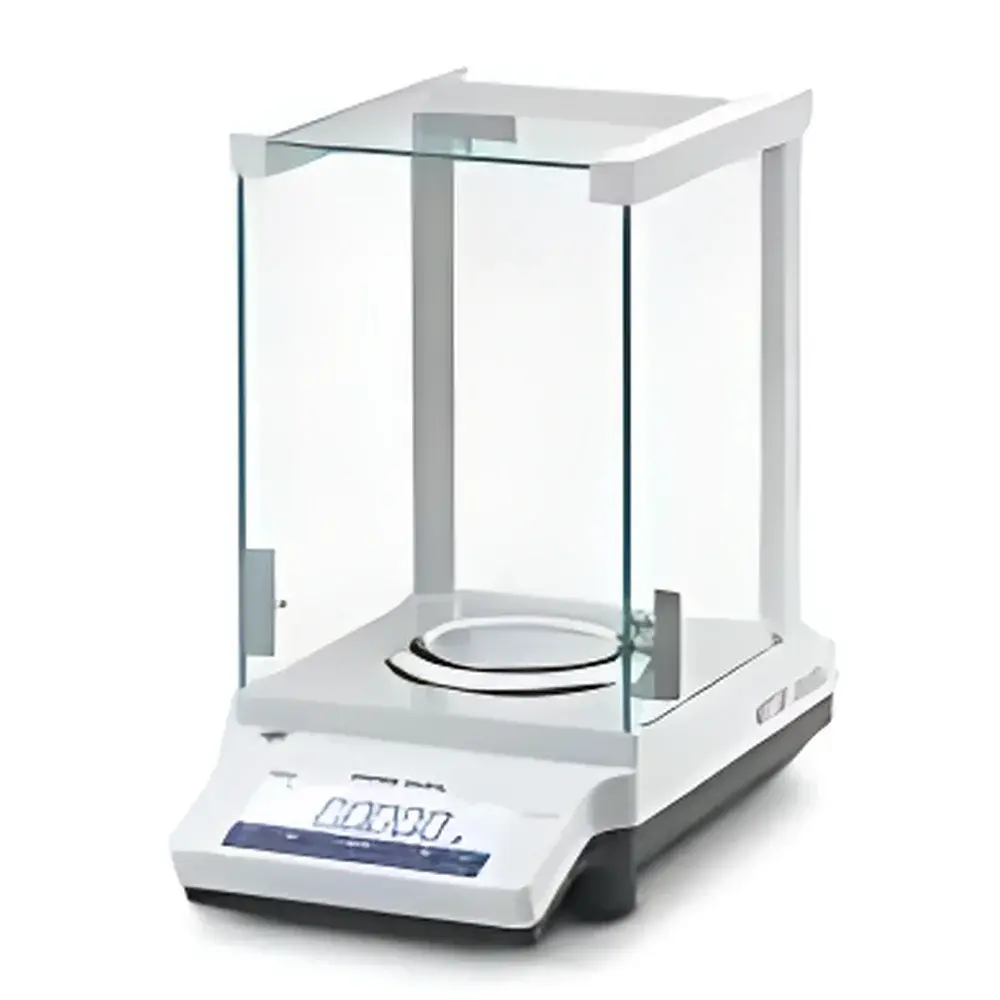
METTLER TOLEDO MA104E Advanced Analytical Balance
| Brand | METTLER TOLEDO |
|---|---|
| Origin | Switzerland |
| Model | MA104E |
| Maximum Capacity | 120 g |
| Readability | 0.1 mg |
| Repeatability | 0.1 mg (at 100 g) |
| Internal Calibration | Yes |
| External Calibration | Supported |
| Minimum Weight (USP, typical) | 0.16 g |
| Weighing Pan Diameter | 90 mm |
| Stabilization Time | 2 s |
| Linearity Error (typical) | ±0.3 mg |
| Temperature Drift | ±2 ppm/°C |
| Display | Backlit LCD |
| Interfaces | USB-A, RS232 |
| Housing | Metal base with PBT top cover |
| Dimensions (H × W) | 354 mm × 209 mm |
Overview
The METTLER TOLEDO MA104E is a high-precision analytical balance engineered for routine laboratory weighing tasks requiring reproducible 0.1 mg resolution across a 120 g maximum capacity. Built upon METTLER TOLEDO’s legacy of Swiss precision engineering, the MA104E employs electromagnetic force compensation (EMFC) technology — the industry-standard principle for analytical balances — to deliver stable, drift-resistant measurements under variable environmental conditions. Its robust mechanical architecture integrates a rigid metal base and reinforced housing capable of withstanding accidental overloads up to 100 kg, ensuring long-term metrological integrity without recalibration drift. Designed for compliance-critical environments, the MA104E supports ISO/IEC 17025, USP , and GLP/GMP workflows through built-in time-stamped results, internal calibration verification logs, and audit-ready data export protocols.
Key Features
- 0.1 mg readability with ≤0.1 mg repeatability (verified at 100 g load), meeting stringent USP minimum weight requirements (typical minimum weighable quantity: 0.16 g)
- Internal calibration system with one-touch activation, supplemented by external calibration compatibility using Class E2 or better weights
- Backlit monochrome LCD display with high-contrast characters and intuitive icon-driven navigation
- Compact footprint (209 mm width) and low-profile design (354 mm height) optimized for benchtop integration in QC labs and research workstations
- Electromagnetic force compensation sensor with temperature-compensated electronics (±2 ppm/°C drift coefficient)
- Dual-interface connectivity: native RS232 for legacy LIMS integration and USB-A for direct PC communication and mass data transfer
- Ergonomic front-access leveling feet and rounded, smooth-surface enclosure for rapid decontamination and compliance with hygiene-sensitive protocols
Sample Compatibility & Compliance
The MA104E accommodates standard 90 mm diameter weighing pans and is compatible with universal labware including aluminum weighing boats, glass vials, and ceramic crucibles. Its sealed sensor chamber and PBT polymer top housing resist chemical splashes and particulate ingress, supporting use in analytical chemistry, pharmaceutical formulation, and quality control laboratories. The balance conforms to international regulatory frameworks: it supports FDA 21 CFR Part 11-compliant data integrity when paired with METTLER TOLEDO LabX software (optional), satisfies ISO 9001 traceability requirements via embedded calibration history, and meets the performance criteria outlined in ASTM E898–21 for analytical balance verification. All internal calibration events are timestamped and stored with operator ID (when linked to LabX), fulfilling GLP audit trail mandates.
Software & Data Management
While the MA104E operates as a standalone instrument with 10 preloaded applications (e.g., parts counting, percentage weighing, density determination), its full data governance potential is realized through integration with METTLER TOLEDO LabX™ software. LabX enables automated result capture, electronic signature workflows, customizable report templates, and centralized instrument management across multi-balance networks. Raw measurement data — including date/time stamps, calibration status, environmental metadata (if connected to optional environment sensors), and user-defined identifiers — exports directly to CSV, PDF, or secure database formats. All exported files retain cryptographic hash signatures for integrity verification, satisfying ALCOA+ principles (Attributable, Legible, Contemporaneous, Original, Accurate) required in regulated industries.
Applications
The MA104E serves as a foundational weighing instrument across multiple technical domains: precise formulation of active pharmaceutical ingredients (APIs) and excipients per ICH Q5C guidelines; gravimetric preparation of standard solutions for HPLC and IC calibration; moisture content analysis via loss-on-drying (LOD) when interfaced with METTLER TOLEDO moisture analyzers; quantitative sample preparation for elemental analysis (ICP-OES/MS); and QC release testing of raw materials against pharmacopoeial monographs (USP, EP, JP). Its stability and repeatability also support method validation studies requiring intermediate precision assessment per ICH Q2(R2).
FAQ
Does the MA104E support internal calibration across its entire weighing range?
Yes — internal calibration is performed automatically at full capacity (120 g) and verified at intermediate points during routine operation.
Is the MA104E compliant with USP requirements for analytical balance qualification?
It meets all performance criteria specified in USP when operated within defined environmental parameters (temperature stability ±2°C, humidity <80% RH non-condensing) and validated using certified reference weights.
Can the MA104E be integrated into a networked laboratory information management system (LIMS)?
Yes — via RS232 or USB-A, the balance supports ASCII-based data streaming compatible with most LIMS platforms; LabX provides certified middleware for seamless two-way integration.
What is the recommended calibration frequency for GLP-compliant operations?
Daily internal calibration is advised prior to first use; external calibration with traceable standards should occur at least once per shift or per batch, depending on risk assessment per ISO/IEC 17025 Clause 6.5.
Does the MA104E include overload protection beyond its rated capacity?
Yes — the mechanical design incorporates passive overload safeguards protecting the EMFC sensor up to 100 kg, preventing permanent damage from accidental overloading.