
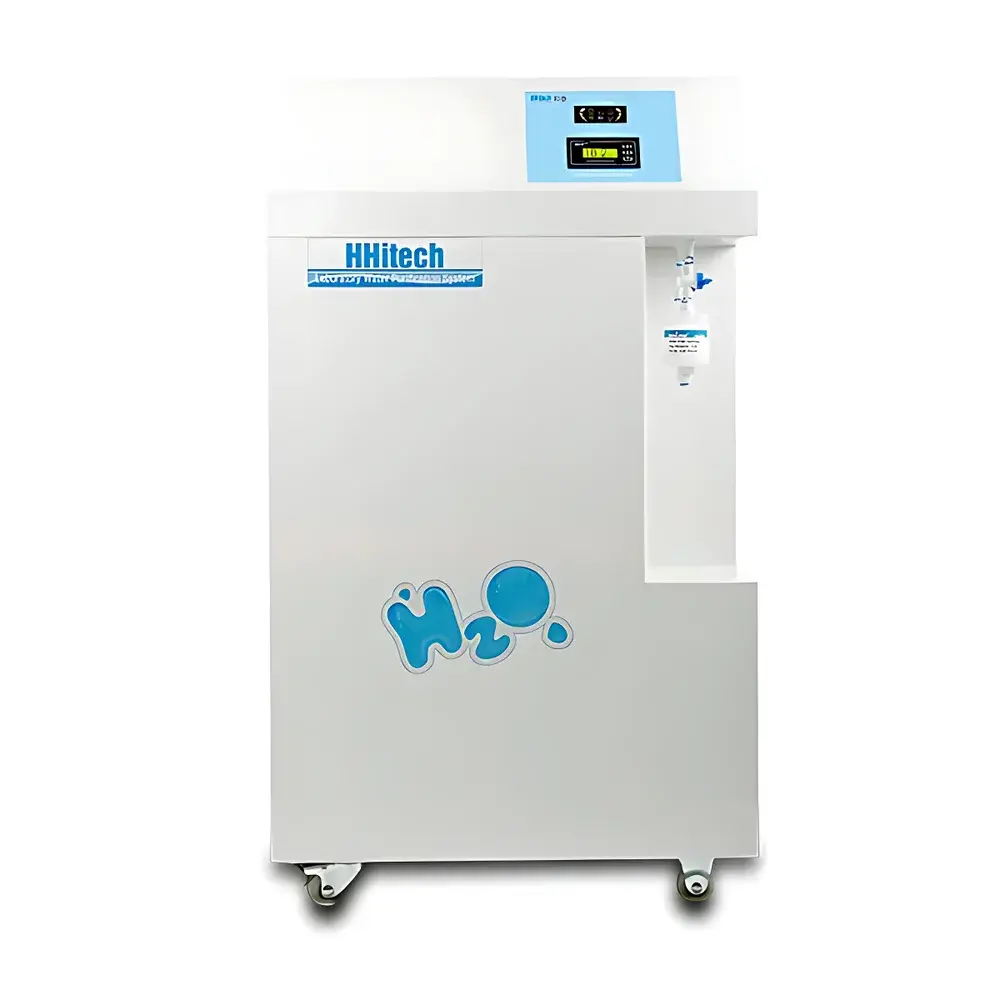
HHitech Pilot-RO Reverse Osmosis Pure Water System
| Brand | HHitech |
|---|---|
| Origin | Shanghai, China |
| Manufacturer Type | Direct Manufacturer |
| Product Category | Domestic |
| Model | Pilot-RO |
| Price Range | USD 1,400 – 4,200 (est.) |
| Purified Water Grade | ASTM Type I RO Water |
| Resistivity | 18.2 MΩ·cm @ 25°C |
| Heavy Metals & Soluble Silica | <0.1 ppb |
| Total Organic Carbon (TOC) | <3 ppb |
| Microbial Count / Endotoxins | <0.001 EU/mL |
| Particles (>0.1 � | m): <1 particle/mL |
| RO Membrane | Dow FilmTec™ FT30 HR (USA) |
| UV Lamp | Dual-Wavelength (185 nm & 254 nm), Imported |
| UF Module | MWCO 5000 Da, Imported |
| Final Filter | 0.2 μm PES Membrane, Imported |
| RO Recovery Rate | >30% |
| Feed Water Requirement | Municipal tap water, TDS <200 ppm, 5–45°C, 0.1–0.4 MPa |
| Flow Rate (25°C) | 45–125 L/h (model-dependent) |
| Integrated Storage | Two 15 L NSF-certified pressurized tanks |
| Power Supply | 220 VAC, 50 Hz, 120–240 W |
| Enclosure | Powder-coated stainless steel chassis |
| Compliance | NSF/ANSI Standard 58, GLP-ready architecture, FDA 21 CFR Part 11–compatible data logging (via optional software module) |
Overview
The HHitech Pilot-RO Reverse Osmosis Pure Water System is an engineered solution for laboratories requiring consistent, high-reliability feed water for downstream purification systems and general lab applications. Designed around a robust multi-stage purification architecture—pre-filtration (PP + activated carbon), high-efficiency reverse osmosis using Dow FilmTec™ FT30 HR membranes, post-carbon polishing, and optional ultraviolet (UV) irradiation and ultrafiltration (UF)—the Pilot-RO delivers Type I-grade RO water per ASTM D1193-20 and ISO 3696:1987 specifications. Its core function is not final-use ultra-pure water generation, but rather the production of low-conductivity, low-TOC, microbe- and endotoxin-controlled RO permeate suitable as feedstock for UPW systems (e.g., EDI or mixed-bed polishers), autoclaves, environmental test chambers, and routine glassware rinsing. The system operates on the principle of cross-flow membrane separation under hydraulic pressure, achieving >97% ionic rejection and >99% organic rejection for compounds with molecular weight >200 Da—critical for minimizing fouling in sensitive downstream instrumentation.
Key Features
- Microprocessor-controlled operation with animated LED LCD interface displaying real-time status: RO membrane flush cycles, production mode, tank full/low-level alerts, leak detection, and service reminders
- Triple-mode RO membrane protection: automatic pre-flush at startup, timed 30-second post-production flush, and scheduled 2-hour cumulative runtime flush to inhibit scaling and biofilm formation
- Integrated dual-wavelength UV chamber (185 nm + 254 nm) with imported quartz sleeves reduces microbial load and photo-oxidizes residual organics, lowering TOC to <3 ppb
- Final-stage 0.2 μm polyethersulfone (PES) sterilizing filter ensures bacterial retention >99.9999% (log 6 reduction); MWCO 5000 Da ultrafiltration module removes endotoxins to <0.001 EU/mL—validated for cell culture and IVF support
- NSF/ANSI 58-certified fluid path: all tubing, quick-connect fittings, and pressure vessels comply with material safety standards for potable water contact
- Modular chassis design with powder-coated stainless steel housing resists corrosion and meets GLP facility requirements for cleanroom-adjacent installation
- Two internal 15 L NSF-certified pressurized storage tanks minimize footprint; optional external reservoir integration supports central distribution architectures
Sample Compatibility & Compliance
The Pilot-RO is validated for use with municipal tap water meeting standard utility parameters (TDS ≤200 ppm, temperature 5–45°C, inlet pressure 0.1–0.4 MPa). It complies with NSF/ANSI Standard 58 for point-of-use RO systems and incorporates design elements aligned with Good Laboratory Practice (GLP) documentation workflows—including timestamped event logging for membrane flushes, alarm triggers, and power interruptions. While not itself a GMP-grade system, its output water meets input specifications for Class A autoclaves (EN 285), environmental test chambers (IEC 60068-2), and upstream ultra-pure water generators compliant with USP , EP 2.2.43, and JP 17. Optional software modules enable audit-trail-enabled data export compatible with FDA 21 CFR Part 11 requirements when paired with secure user authentication and electronic signature protocols.
Software & Data Management
The embedded controller records operational events—including start/stop timestamps, cumulative RO runtime, alarm history (low pressure, high TDS, leak detection), and manual flush initiation—with non-volatile memory retention. Data export is supported via USB port to CSV format for integration into LIMS or QA databases. An optional PC-based monitoring suite provides remote status visualization, configurable alert thresholds (e.g., conductivity >5 µS/cm), and automated report generation for maintenance scheduling and regulatory review. All logged parameters are time-stamped and immutable unless cleared via administrative access—supporting traceability during internal audits or regulatory inspections.
Applications
- Feed water supply for laboratory ultra-pure water systems (e.g., EDI or mixed-bed polishers)
- Routine rinsing of volumetric glassware, pipettes, and analytical sample containers
- Make-up water for steam autoclaves, stability chambers, and humidity-controlled environmental test enclosures
- Preparation of buffers and reagents where low ionic background and minimal organic interference are required
- Support water for cell culture media preparation when combined with endotoxin-removing UF and sterile filtration
- Calibration and verification water for conductivity/TDS meters and TOC analyzers
FAQ
What feed water quality is required for optimal Pilot-RO performance?
Municipal tap water with TDS ≤200 ppm, free chlorine <1 ppm, and turbidity 200 ppm, external softening or antiscalant dosing is advised to extend membrane life.
Can the Pilot-RO be integrated into a central purified water network?
Yes—the unit includes internal mounting space and dedicated ports for recirculation pump integration and loop-based distribution, supporting up to 30 m of 1/4″ PE tubing with ≤15% pressure drop.
How often must the RO membrane be replaced?
Under typical municipal feed conditions and proper maintenance (including scheduled flushes), Dow FT30 HR membranes maintain ≥95% rejection for 24–36 months; replacement is triggered by sustained conductivity >10 µS/cm or flux decline >20%.
Is validation documentation available for IQ/OQ protocols?
Factory-issued DQ/IQ templates and OQ checklists—including conductivity verification, flow rate calibration, and UV intensity measurement procedures—are provided with each unit and align with ISO/IEC 17025 and ASTM E2500 guidance.
Does the system meet pharmaceutical water standards?
The Pilot-RO produces RO water suitable as feed for USP Purified Water (PW) generation systems; it does not directly meet USP PW or WFI specifications but satisfies critical pretreatment criteria outlined in USP .



