
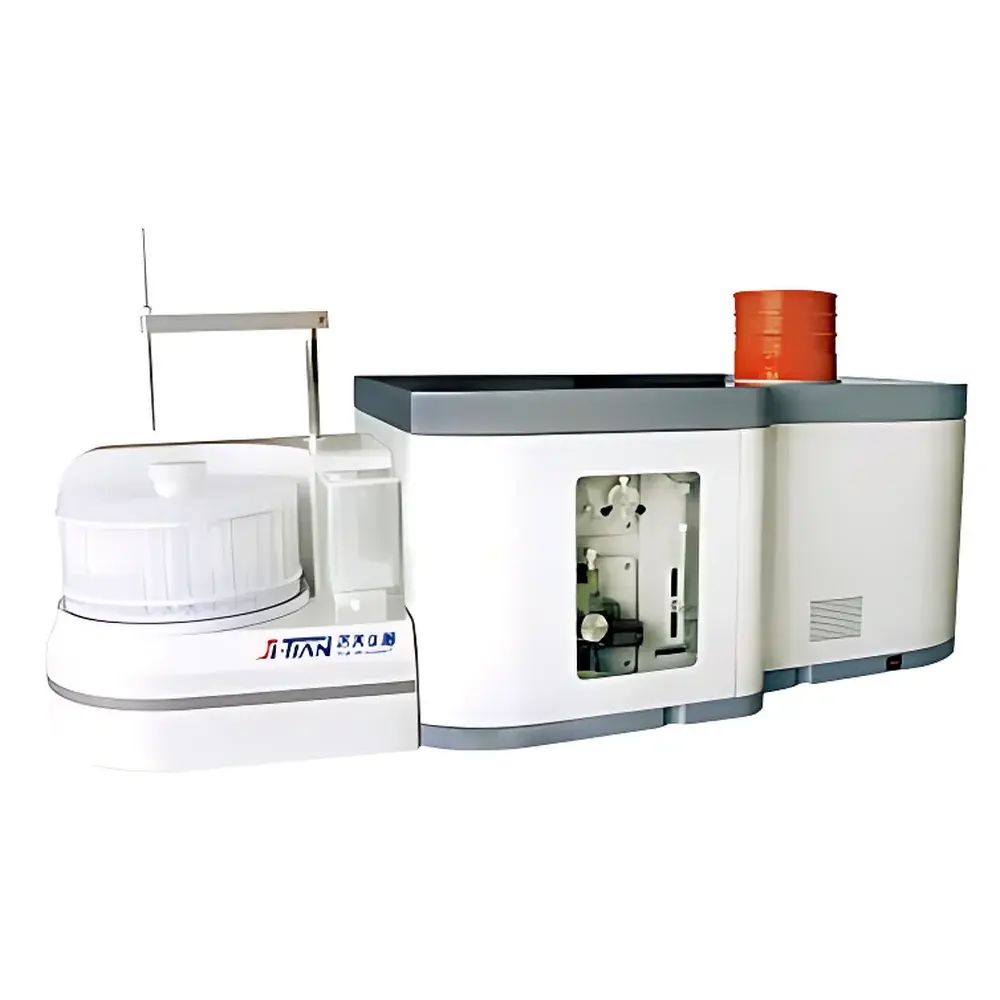
Titan Instruments AFS-9130 Fully Automated Dual-Flow Sequential Injection Atomic Fluorescence Spectrometer
| Brand | Titan Instruments |
|---|---|
| Origin | Beijing, China |
| Manufacturer Type | Direct Manufacturer |
| Instrument Type | Multi-channel Atomic Fluorescence Spectrometer |
| Sample Introduction | Dual Sequential Injection Pumps |
| Waste Disposal | Peristaltic Pump Extraction |
| Hydride Generation Mode | Vapor Generation / Hydride Generation |
| Gas Control System | Valve Island |
| Detectable Elements | As, Se, Bi, Hg, Te, Sn, Ge, Pb, Zn, Cd, Au |
| RSD | < 0.8% |
| Linear Dynamic Range | > 3 orders of magnitude |
| Detection Limits | As, Bi, Sb < 0.01 µg/L |
| PMT Wavelength Range | 160–320 nm |
| Atomizer Temperature Control Range | Ambient to 1,000 °C (programmable) |
Overview
The Titan Instruments AFS-9130 is a fully automated, dual-channel sequential injection atomic fluorescence spectrometer engineered for high-sensitivity, trace-level quantification of hydride-forming and cold-vapor elements in complex matrices. Based on the principle of atomic fluorescence spectroscopy (AFS), the instrument excites ground-state atoms—generated in situ via chemical vapor generation (CVG) or cold vapor atomic fluorescence (CVAFS)—using element-specific hollow cathode lamps (HCLs), then measures the intensity of characteristic fluorescent emission at wavelengths between 160 nm and 320 nm. Its dual-beam, dual-detector optical architecture continuously monitors lamp intensity drift and background fluctuations in real time, enabling exceptional long-term stability and measurement reproducibility. Designed for compliance with ISO/IEC 17025 laboratory accreditation requirements, the AFS-9130 delivers robust performance across regulated environments—including food safety testing, environmental monitoring, clinical toxicology, and geological resource analysis—where sub-part-per-trillion detection sensitivity and rigorous method traceability are mandatory.
Key Features
- Dual-channel simultaneous measurement capability for two elements (e.g., As and Se, or Hg and Cd), significantly improving throughput without cross-channel interference.
- Six-position automated lamp turret with software-controlled lamp selection and alignment, supporting rapid method switching and multi-element workflow optimization.
- Integrated dual sequential injection pump system with precise volumetric dispensing (±0.2% precision), enabling full automation of standard dilution, reagent addition (e.g., KBH4, masking agents), and online bubble removal during hydride generation.
- Valve island-based pneumatic control system with mass flow meter integration ensures stable, programmable, and repeatable carrier gas (Ar/H2) delivery; automatic gas shutoff upon shutdown enhances operational safety and gas economy.
- Shielded quartz tube atomizer with programmable temperature control (ambient to 1,000 °C) and low-power argon-hydrogen flame ignition minimizes oxide interference and improves atomization efficiency for volatile species.
- Hermetically sealed light source compartment optimized for mercury analysis, reducing ambient light leakage and thermal drift—critical for achieving sub-pg/mL detection limits in CVAFS mode.
- Bundled pulsed power supply for HCLs extends lamp lifetime by up to 3× while enhancing signal-to-noise ratio and spectral line sharpness.
- 160-position polar-coordinate autosampler with vial recognition and collision avoidance logic supports unattended overnight operation and large-batch regulatory sample sets.
- Integrated gas-liquid separator with real-time KBH4 foam suppression and post-measurement hazardous vapor trapping (e.g., Hg, AsH3) meets OSHA and EU CLP occupational exposure guidelines.
Sample Compatibility & Compliance
The AFS-9130 accommodates aqueous digests (microwave- or hot-block-assisted), filtered environmental waters, acid-extracted soils/sediments, enzymatically hydrolyzed biological tissues, and diluted pharmaceutical extracts. It is validated for use in accordance with multiple internationally recognized standards, including GB 5009.11–2014 (total/inorganic As in food), GB 5009.17–2014 (total/organic Hg), HJ 694–2014 (As, Hg, Se, Sb, Bi in water), HJ 680–2013 (soil and sediment analysis), and ISO 17294-2:2016 (water quality—elemental determination by ICP-MS/AFS). The system’s hardware architecture and firmware support audit-ready data integrity features aligned with FDA 21 CFR Part 11 requirements—including electronic signatures, immutable audit trails, and user-access tiering—facilitating GLP/GMP-compliant deployment in contract testing laboratories and national reference labs.
Software & Data Management
The Titan AFS Control Suite is a bilingual (English/Chinese), Windows-based platform featuring intuitive wizard-driven method setup, real-time spectral visualization, and integrated diagnostics. It supports multiple calibration strategies—single-point standard addition, multi-point linear/non-linear curve fitting, and bracketed standard verification—with automatic outlier rejection and residual error reporting. All raw data, method parameters, and instrument logs are stored in a relational database with timestamped metadata. Export options include CSV, PDF analytical reports (with customizable templates), and XML-compatible outputs for LIMS integration. An embedded expert system provides context-aware guidance on optimal lamp current, reaction coil length, delay time, and KBH4 concentration based on analyte and matrix type—reducing method development time and operator dependency.
Applications
The AFS-9130 serves as a primary analytical tool in accredited food safety laboratories performing routine surveillance of arsenic in rice products and mercury in seafood per Codex Alimentarius limits. Environmental agencies deploy it for monitoring ultra-trace Hg in atmospheric particulates (HJ 542–2010) and As/Bi/Sb in mine-impacted groundwater. Clinical toxicology units apply it to quantify urinary inorganic arsenic speciation metabolites following derivatization. In agricultural research, it enables rapid screening of Cd and Pb bioavailability in fertilizers and animal feedstuffs per GB/T 23349–2020. Its modularity supports expansion into elemental speciation (via optional HPLC-AFS coupling) and direct solid sampling (with mercury/cadmium dual-detection module), extending utility beyond conventional wet-chemistry workflows.
FAQ
What hydride-forming elements can be measured simultaneously on the AFS-9130?
As, Se, Bi, Sb, Te, Sn, and Pb can be measured in dual-channel hydride generation mode; Hg is measured separately in cold vapor mode, though optional configurations support Hg/Cd co-detection.
Does the system comply with FDA 21 CFR Part 11 requirements?
Yes—the software includes role-based user authentication, electronic signatures, audit trail logging, and data immutability controls required for regulated pharmaceutical and clinical testing environments.
Can the AFS-9130 be coupled with an HPLC system for speciation analysis?
Yes—optional HPLC-AFS interface modules are available for As(III)/DMA/MMA, Se(IV)/Se(VI), and Hg(II)/MeHg separation and quantification, with dual-channel detection enabling concurrent species monitoring.
What maintenance intervals are recommended for the sequential injection pumps and gas control system?
Pump tubing should be replaced every 3–6 months depending on usage frequency; valve island actuators and mass flow sensors require annual calibration verification using NIST-traceable standards.
Is method validation support provided for regulatory submissions?
Titan Instruments supplies application notes, certified reference material (CRM) compatibility data, and IQ/OQ documentation templates aligned with ISO/IEC 17025 and USP guidelines.
Related Products




