
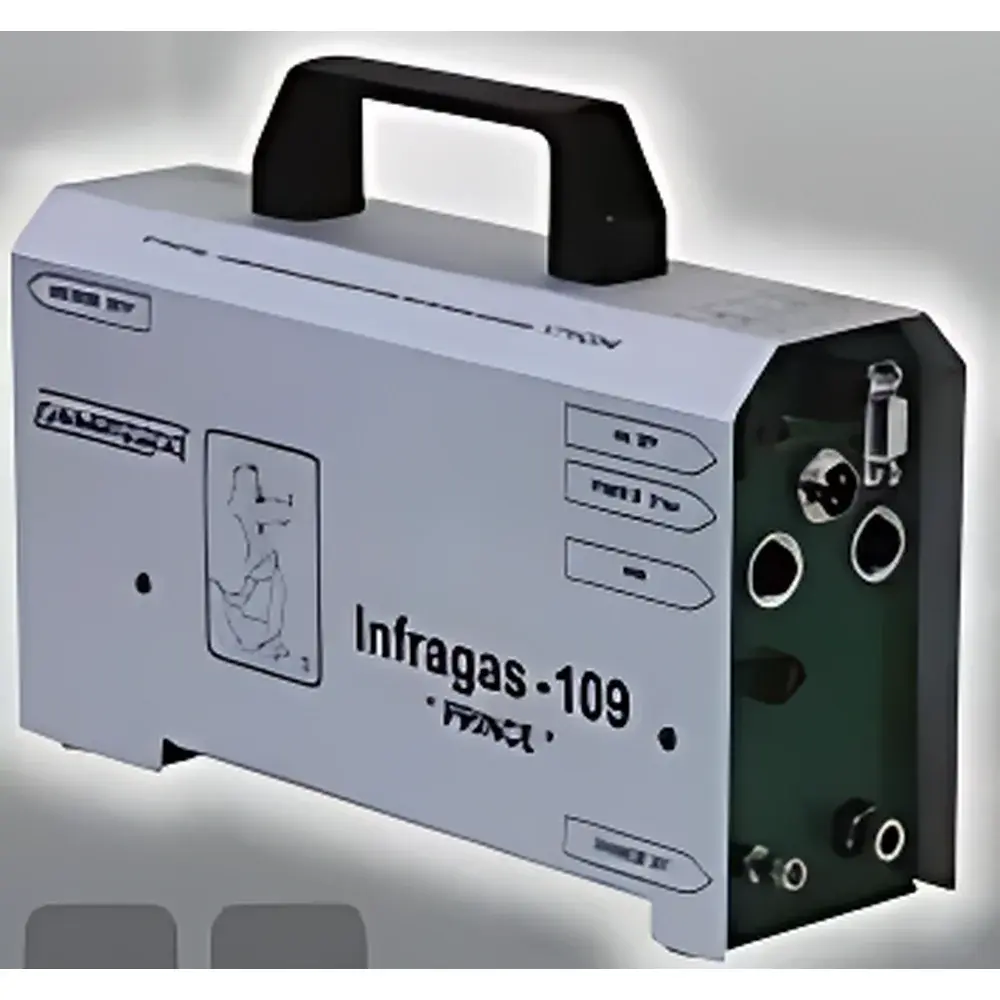
Assemblad INFRAGAS109 Portable Automotive Exhaust Gas Analyzer
| Brand | Assemblad |
|---|---|
| Origin | Italy |
| Model | INFRAGAS109 |
| Instrument Type | Portable |
| Detection Principle | Non-Dispersive Infrared (NDIR) Absorption |
| Max. Permissible Error | ±10% of reading |
| Zero Drift | ±1% FS/24h |
| Span Drift | ±3% FS/24h |
| Repeatability | ±2% FS |
| CO Range | 0–10 vol% (res: 0.001 vol%) |
| CO₂ Range | 0–20 vol% (res: 0.01 vol%) |
| HC Range | 0–15,000 ppm (res: 1 ppm) |
| O₂ Range | 0–25 vol% (res: 0.01 vol%) |
| True CO Range | 0–15 vol% (res: 0.01 vol%) |
| NOₓ Range (optional) | 0–5,000 ppm (res: 1 ppm) |
| AFR | 7–23 (res: 0.1) |
| λ (Lambda) | 0.5–1.5 (res: 0.01) |
| RPM | 0–9,999 rpm (res: 1 rpm) |
| Oil Temperature | 0–150 °C (res: 0.1 °C) |
| Internal Temp | 0–50 °C (res: 0.1 °C) |
| Ambient Pressure | 800–1,600 mbar (res: 1 mbar) |
| Interface | RS-232/USB PC port, OPA 105 smoke meter interface, LCD display |
| Net Weight | 3 kg |
| Dimensions | 290 × 198 × 85 mm |
Overview
The Assemblad INFRAGAS109 Portable Automotive Exhaust Gas Analyzer is a field-deployable, NDIR-based multi-gas measurement system engineered for precision diagnostics of internal combustion engine emissions during vehicle inspection, roadside enforcement, and workshop maintenance. Utilizing dual-beam non-dispersive infrared absorption spectroscopy, the instrument simultaneously quantifies carbon monoxide (CO), carbon dioxide (CO₂), hydrocarbons (HC), oxygen (O₂), and optionally nitrogen oxides (NOₓ) in real time—without cross-sensitivity interference between target gases. Its optical architecture incorporates temperature-stabilized IR sources, narrow-band interference filters matched to fundamental vibrational absorption bands (e.g., 4.6 µm for CO, 4.26 µm for CO₂, 3.4 µm for HC), and thermopile detectors with active reference compensation. The analyzer calculates derived parameters—including air-fuel ratio (AFR), equivalence ratio (λ), true CO concentration (corrected for dilution effects), and exhaust gas temperature-corrected volumetric flow estimates—enabling compliance verification against EU Directive 2014/45/EU, U.S. EPA Method 27, and ISO 8178-4 for mobile source emissions testing.
Key Features
- Automatic zero and span calibration routines executed via integrated reference gas valves and dual-channel optical referencing—reducing manual intervention and drift-related uncertainty.
- Two-minute warm-up time enabled by low-thermal-mass NDIR cells and adaptive heater control, meeting ISO 16183:2019 requirements for rapid-response portable analyzers.
- Simultaneous real-time acquisition of up to 12 parameters: CO, CO₂, HC, O₂, true CO, λ, AFR, NOₓ (optional), RPM (via inductive pickup or optical sensor input), oil temperature (PT100 input), internal unit temperature, and ambient barometric pressure.
- Ruggedized aluminum chassis with IP54-rated enclosure, designed for operation across –10 °C to +50 °C ambient conditions and vibration profiles compliant with MIL-STD-810G Method 514.6.
- Onboard data logging (10,000+ records) with timestamp, GPS-tagged location metadata (when paired with external module), and automatic pass/fail flagging per configurable emission thresholds.
Sample Compatibility & Compliance
The INFRAGAS109 interfaces directly with standard exhaust sampling probes (1.5 m heated line, Teflon-lined) and supports both raw and diluted exhaust sampling configurations per ISO 8178-1 Annex B. It accommodates gasoline, diesel, LPG, and CNG-powered vehicles—including Euro 6d, Tier 3, and China 6b certified powertrains. All measurement algorithms adhere to EN 15118-4:2021 for lambda calculation traceability and incorporate humidity compensation per ISO 16183 Annex C. The device meets CE marking requirements under the EMC Directive 2014/30/EU and RoHS 2011/65/EU. For regulatory audit readiness, it supports GLP-compliant operation with full electronic audit trail (user logins, calibration history, test session metadata) when connected to Assemblad’s optional EmissionLink™ desktop software.
Software & Data Management
The analyzer communicates via USB 2.0 or RS-232 serial interface to Windows-based EmissionLink™ v4.x software, which provides FDA 21 CFR Part 11-compliant user authentication, role-based access control, and immutable electronic records. Raw analog and digital sensor outputs are logged at 10 Hz with synchronized timestamps. Export formats include CSV, XML (for integration with national vehicle inspection databases), and PDF reports pre-formatted to national type-approval templates (e.g., German KBA Form 20, UK DVSA VOSA-3). Firmware updates are delivered via signed .bin packages with SHA-256 hash verification to ensure integrity.
Applications
- Periodic technical inspections (PTI) conducted by authorized testing stations under national road traffic regulations.
- Pre-delivery inspection (PDI) and post-repair verification in OEM-certified service centers.
- Mobile enforcement units performing roadside emissions screening in urban low-emission zones (LEZs).
- Research and development laboratories evaluating aftertreatment system efficiency (e.g., three-way catalyst conversion rates, SCR ammonia slip).
- Educational use in automotive engineering curricula for hands-on training in combustion stoichiometry and exhaust diagnostics.
FAQ
What calibration gases are required for routine verification?
A certified 4-gas mixture (CO 2.0%, CO₂ 12.0%, HC 1000 ppm as propane, O₂ 12.0% in N₂) traceable to NIST SRM 1622 is recommended for daily span checks; zero verification uses medical-grade nitrogen (≥99.999%).
Does the INFRAGAS109 support remote firmware updates over cellular networks?
No—firmware updates require local USB connection and administrator-level credentials to prevent unauthorized modification of metrological parameters.
Can the device measure particulate matter (PM) or PN directly?
No—PM/PN measurement requires integration with a certified condensation particle counter (e.g., CPC 3022A) via analog voltage output; the INFRAGAS109 provides synchronized trigger signals and time-aligned data streams.
Is the NOₓ option factory-installed or field-upgradable?
The NOₓ channel is factory-integrated with dedicated electrochemical sensor and thermal management; field retrofitting is not supported due to optical path recalibration requirements.
How is measurement uncertainty quantified per ISO/IEC 17025?
Expanded uncertainty (k=2) is stated as ±(2.5% of reading + 0.02 vol% for CO; ±(1.8% + 0.03 vol%) for CO₂) based on inter-laboratory validation studies per ISO 5167-4 Annex D protocols.







