
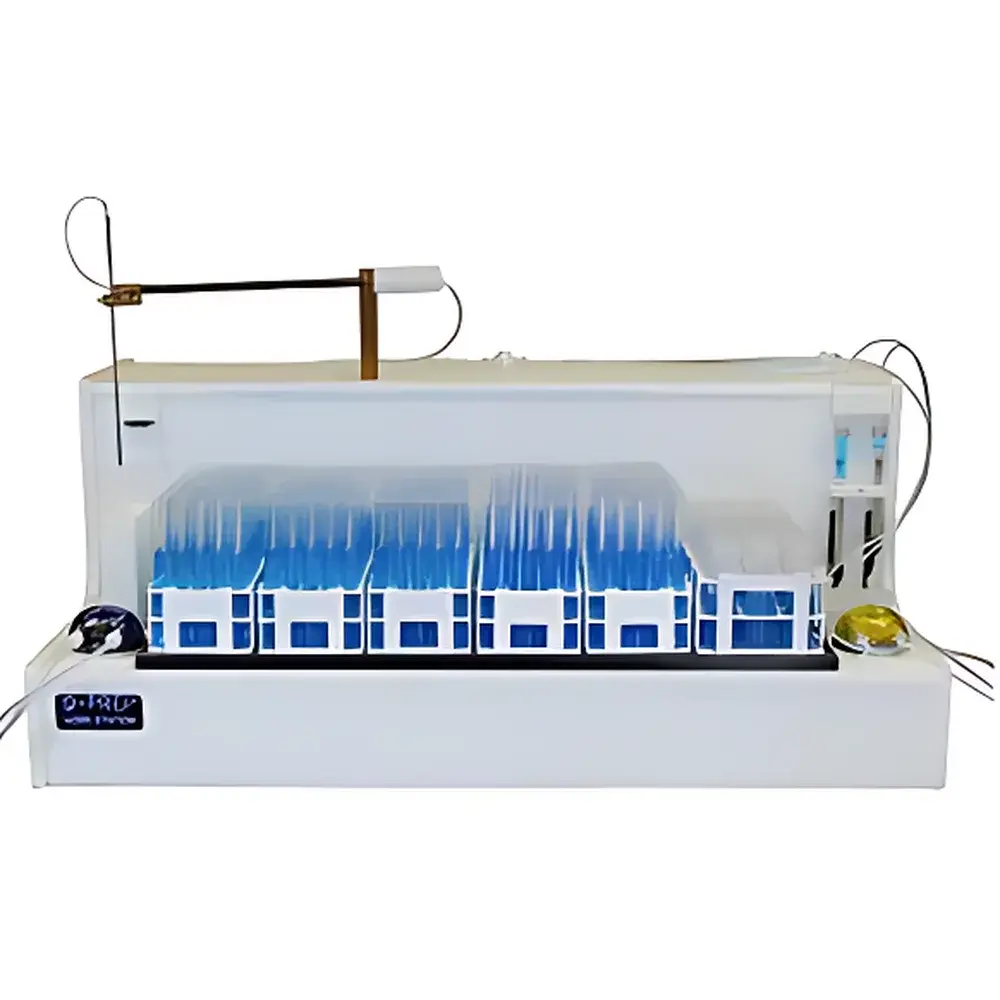
Qtechcorp QPrep Continuous Flow Injector
| Brand | Qtechcorp |
|---|---|
| Origin | Canada |
| Manufacturer Type | Authorized Distributor |
| Origin Category | Imported |
| Model | DIAPBR |
| Instrument Type | Laboratory Water Quality Analyzer |
| Detection Function | Automated Sample Introduction & Reagent Dispensing |
| Injection Accuracy | ±0.02 mL |
| Syringe Volumes Available | 5–25 mL |
| Peristaltic Pump Flow Rate | 0.5–2 mL/sec |
| Sample Rack Capacity | 6 standard racks (360 × 12-mL vials) |
| Probe Positioning Resolution | 0.3 mm (encoder-driven stepper motor) |
| Wetted Materials | PTFE (standard) |
| Power Supply | 100–240 VAC, 50/60 Hz, 3 A |
| PC Requirements | Windows 7 or 8, USB port |
| Weight | 35 kg |
| Dimensions (W×D×H) | 92 × 48 × 48 cm |
Overview
The Qtechcorp QPrep Continuous Flow Injector (Model DIAPBR) is a precision-engineered laboratory automation platform designed for high-integrity sample introduction and reagent handling in water quality analysis workflows. Operating on a dual-mode fluidics architecture—integrating programmable syringe injection with peristaltic pumping—the QPrep delivers traceable, repeatable liquid transfer across complex multi-step analytical protocols. Its core function is not limited to automated sampling; rather, it serves as a modular fluidic interface between sample preparation, calibration standardization, and instrumental analysis (e.g., ICP-MS, IC, UV-Vis spectrophotometry). The system employs encoder-synchronized stepper motor actuation for probe positioning (±0.3 mm resolution), ensuring positional reproducibility critical for vial-to-vial consistency in regulated environments. All wetted surfaces—including the rigid graphite probe with PTFE coating—are chemically inert to aggressive matrices, including hydrofluoric acid (HF)-containing digestates, thereby supporting EPA Method 6020B and ISO 17294-2 compliant analyses.
Key Features
- Dual-fluidics architecture: Independently controllable syringe pump (5–25 mL selectable volume) and peristaltic pump (0.5–2 mL/sec flow range) enable method-flexible dispensing, dilution, and transfer sequences.
- High-precision liquid handling: Injection accuracy of ±0.02 mL across full syringe stroke, validated per ISO 8655-6 for gravimetric performance assessment.
- Corrosion-resistant fluid path: PTFE-coated rigid graphite probe ensures mechanical stability during repeated penetration of crimp-top vials and compatibility with HF, HNO₃, and aqua regia solutions.
- Modular rack compatibility: Accepts six standard 60-position racks (total 360 × 12-mL vials); rack geometry is user-configurable via software-defined coordinate mapping.
- Encoder-based motion control: Closed-loop stepper motor system provides deterministic probe positioning without reliance on homing routines—essential for GLP audit trails.
- Full-system integration readiness: Native USB communication protocol supports synchronization with third-party instruments and LIMS via ASCII command set (SCPI-compliant syntax).
Sample Compatibility & Compliance
The QPrep accommodates standard 12-mL borosilicate glass vials (with polypropylene screw caps or crimp seals), as well as custom tube formats up to 30 mm diameter and 100 mm height. Its PTFE-wetted construction meets USP material classification requirements for Class VI plastics, while optional TFM syringes provide enhanced thermal and chemical resistance per ASTM D1711. The system supports compliance with EPA guidance documents for automated sample introduction (e.g., EPA 200.8, 200.9, and 6020B), and its deterministic motion control architecture satisfies FDA 21 CFR Part 11 requirements for electronic record integrity when paired with audit-trail-enabled software configurations.
Software & Data Management
Controlled exclusively via Windows-based QPrep Method Studio (v4.x), the system enables graphical method building using drag-and-drop sequence blocks—including aspiration, dispense, rinse, delay, and conditional branching. Each executed step logs timestamped metadata (including syringe position, volume delivered, pump RPM, and error flags) into a SQLite database with SHA-256 checksum validation. Raw log files are exportable in CSV and XML formats for integration into ELN systems. Software validation packages—including IQ/OQ documentation templates and test scripts aligned with GAMP5 principles—are available upon request for regulated laboratories operating under ISO/IEC 17025 or CLIA frameworks.
Applications
- Automated calibration curve generation for trace metal analysis (ICP-MS/OES) with serial dilution capability.
- Sequential injection of preservation agents (e.g., HNO₃, HgCl₂) into field-collected water samples prior to storage.
- Reagent addition in colorimetric methods (e.g., APHA Standard Methods 4500-NO₂⁻, 4500-PO₄³⁻) with sub-milliliter precision.
- Multi-analyte sample splitting for parallel analysis across discrete instrumentation platforms.
- Method development support for EPA 1631E (mercury) and 1640 (perchlorate) where precise low-volume reagent delivery is mandated.
FAQ
Does the QPrep support remote operation over a LAN or Ethernet network?
No—the QPrep communicates exclusively via USB 2.0; networked operation requires an external USB-over-IP server (not supplied).
Can the system be validated for use in a GMP-regulated pharmaceutical water testing lab?
Yes—when deployed with QPrep Method Studio’s audit-trail mode enabled and integrated into a validated LIMS, it meets Annex 11 and ALCOA+ data integrity criteria.
Is cleaning validation data provided for the PTFE-coated probe?
Residue recovery studies for common analytes (e.g., Pb²⁺, As³⁺, Cr⁶⁺) are documented in Application Note AN-QP-017, available under NDA.
What maintenance intervals are recommended for the peristaltic pump tubing?
Tubing replacement is scheduled every 500 hours of cumulative operation or after 2,000 dispense cycles—whichever occurs first—as defined in Maintenance Manual MM-QP-003.
Are firmware updates backward-compatible with existing method files?
Yes—all firmware revisions maintain binary compatibility with legacy .qpm method files; version migration is fully transparent to end users.







