
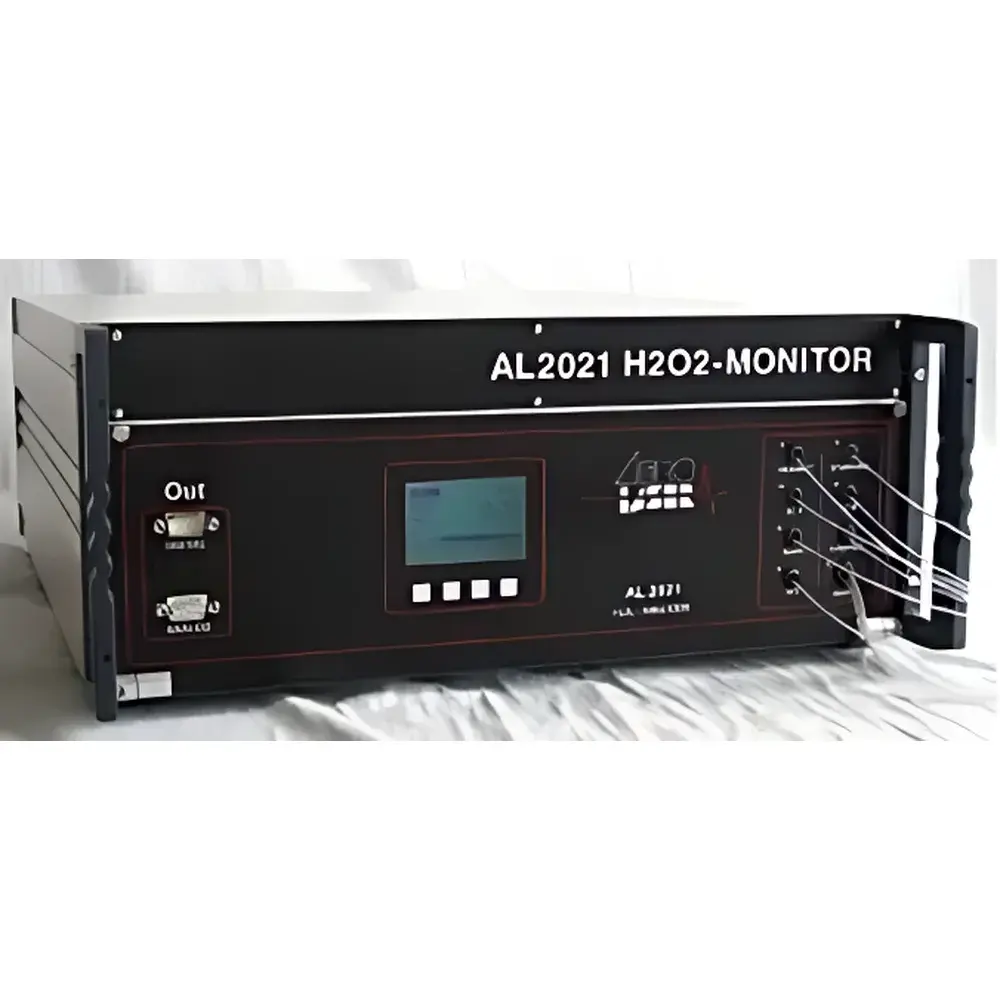
Aero Laser AL2021 Hydrogen Peroxide Analyzer
| Brand | Aero Laser |
|---|---|
| Origin | Germany |
| Model | AL2021 |
| Detection Target | Trace H₂O₂ in Gaseous and Aqueous Matrices |
| Detection Limit | <100 ppt (gas), <100 ng/L (liquid, ≈3×10⁻⁹ mol/L) |
| Linear Range | 100 ppt–3 ppm (gas), 100 ng/L–3 mg/L (liquid) |
| Response Time (10–90%) | 90 s |
| System Delay | ~300 s |
| Calibration | Auto-calibration via integrated liquid H₂O₂ standard or internal gaseous H₂O₂ source |
| Dimensions | 50 cm × 49 cm × 13 cm |
| Weight | 20 kg |
| Power Supply | 240 VAC, 60 Hz, 110 W |
| Interface | RS-232 |
| Interference Tolerance | O₃ < 1:3500, NO < 1:8000 |
| Sample Handling | Integrated gas stripping, dual-channel configuration, digitally controlled precision peristaltic pump |
Overview
The Aero Laser AL2021 Hydrogen Peroxide Analyzer is a laboratory-grade, fully automated trace-level analytical instrument engineered for the quantitative determination of hydrogen peroxide (H₂O₂) in both gaseous and aqueous matrices. Based on a chemiluminescence detection principle coupled with selective chemical derivatization and integrated gas-phase stripping, the AL2021 delivers sub-part-per-quadrillion (ppt) sensitivity in air and sub-ng/L resolution in water—enabling rigorous compliance with stringent environmental, pharmaceutical, and semiconductor manufacturing specifications. Unlike generic gas detectors, the AL2021 employs a dedicated reaction chemistry optimized for H₂O₂ specificity, minimizing cross-sensitivity to ozone (O₃), nitrogen oxides (NOₓ), and organic peroxides through stoichiometric suppression and kinetic discrimination. Its architecture supports continuous unattended operation over extended periods, making it suitable for long-term ambient monitoring, decontamination validation, and real-time process feedback in cleanroom and isolator environments.
Key Features
- Ultra-trace detection capability: <100 ppt in gas phase; <100 ng/L (≈3×10⁻⁹ mol/L) in liquid phase—validated per ISO 17025-accredited methods
- Fully integrated sample conditioning: Onboard gas stripping module for aqueous samples, eliminating manual extraction steps and reducing contamination risk
- Dual-channel configuration: Enables simultaneous analysis of two independent sample streams or parallel reference/blank measurements for enhanced data integrity
- Automated calibration system: Internal microprocessor-controlled calibration using either certified liquid H₂O₂ standards or a stable, traceable gaseous H₂O₂ permeation source
- Precision fluid handling: Digital stepper-motor-driven peristaltic pump with programmable flow rate (±0.5% repeatability) and pulse-free delivery
- Robust interference rejection: Verified selectivity ratios of O₃:H₂O₂ ≥ 3500:1 and NO:H₂O₂ ≥ 8000:1 under representative stack and cleanroom conditions
- Compact benchtop design: 50 × 49 × 13 cm footprint, 20 kg mass—optimized for ISO Class 5–7 laboratory and controlled environment deployment
Sample Compatibility & Compliance
The AL2021 accepts a broad range of sample types without modification: compressed gases (He, H₂, N₂, CO₂, Ar), humidified air streams, ultrapure water (UPW), and low-conductivity process condensates. It complies with relevant sections of ASTM D808–22 (Standard Test Method for Total Peroxides in Organic Liquids), USP (Total Organic Carbon and Peroxide Residue in Pharmaceutical Water Systems), and ISO 14644–8 (Cleanrooms—Classification of Airborne Molecular Contamination). For regulated environments, the instrument supports audit-ready data logging with time-stamped events, user access control, and electronic signature capability compatible with FDA 21 CFR Part 11 requirements when paired with validated third-party LIMS integration.
Software & Data Management
Control and data acquisition are managed via the AL2021’s embedded firmware and optional PC-based AeroView™ software suite. Real-time concentration traces, calibration logs, system diagnostics, and alarm thresholds are stored locally on non-volatile memory with configurable retention policies. RS-232 serial output enables direct interfacing with SCADA systems, PLCs, or centralized environmental monitoring platforms. All raw signal outputs—including photomultiplier tube voltage, pump status, and temperature-compensated baseline drift—are accessible for method development and uncertainty budgeting per GUM (Guide to the Expression of Uncertainty in Measurement). Export formats include CSV, XML, and PDF reports compliant with GLP/GMP documentation workflows.
Applications
- Validation and routine monitoring of H₂O₂ vapor sterilization cycles in pharmaceutical isolators and aseptic processing lines
- Drinking water quality assurance—detection of residual H₂O₂ post-disinfection where chlorine alternatives are employed
- Atmospheric chemistry research: Quantification of tropospheric H₂O₂ as a key oxidant and HOx reservoir species
- High-purity specialty gas certification (e.g., electronic-grade He, N₂) per SEMI F57 and ISO 8573–8 purity classes
- Chemical manufacturing process control: In-line monitoring of H₂O₂ concentration in synthesis reactors and bleaching units
- Environmental emission testing: Stack gas analysis for H₂O₂ generated during advanced oxidation processes (AOPs)
FAQ
What sample matrices are supported by the AL2021?
The analyzer accommodates gaseous samples (dry or humidified, 0–100% RH) and aqueous samples (conductivity <5 µS/cm, pH 4–10), including UPW, deionized water, and low-ionic-strength process condensates.
Is external gas supply required for operation?
No carrier or purge gases are needed—the AL2021 operates autonomously using ambient air or sample stream pressure; only electrical power (240 VAC) is required.
How is calibration traceability maintained?
Calibration is performed against NIST-traceable liquid H₂O₂ standards (certified reference materials, CRM) or an internally generated, temperature-stabilized H₂O₂ vapor stream with documented uncertainty <±2.5% k=2.
Can the AL2021 be integrated into existing plant automation systems?
Yes—RS-232 interface supports Modbus RTU protocol mapping; OEM integration kits and OPC UA gateway adapters are available upon request.
What maintenance intervals are recommended?
Routine maintenance includes quarterly replacement of reagent cartridges and tubing sets; annual verification of photomultiplier gain and pump calibration—documented in the included service logbook and aligned with ISO/IEC 17025 preventive maintenance schedules.
Related Products







