
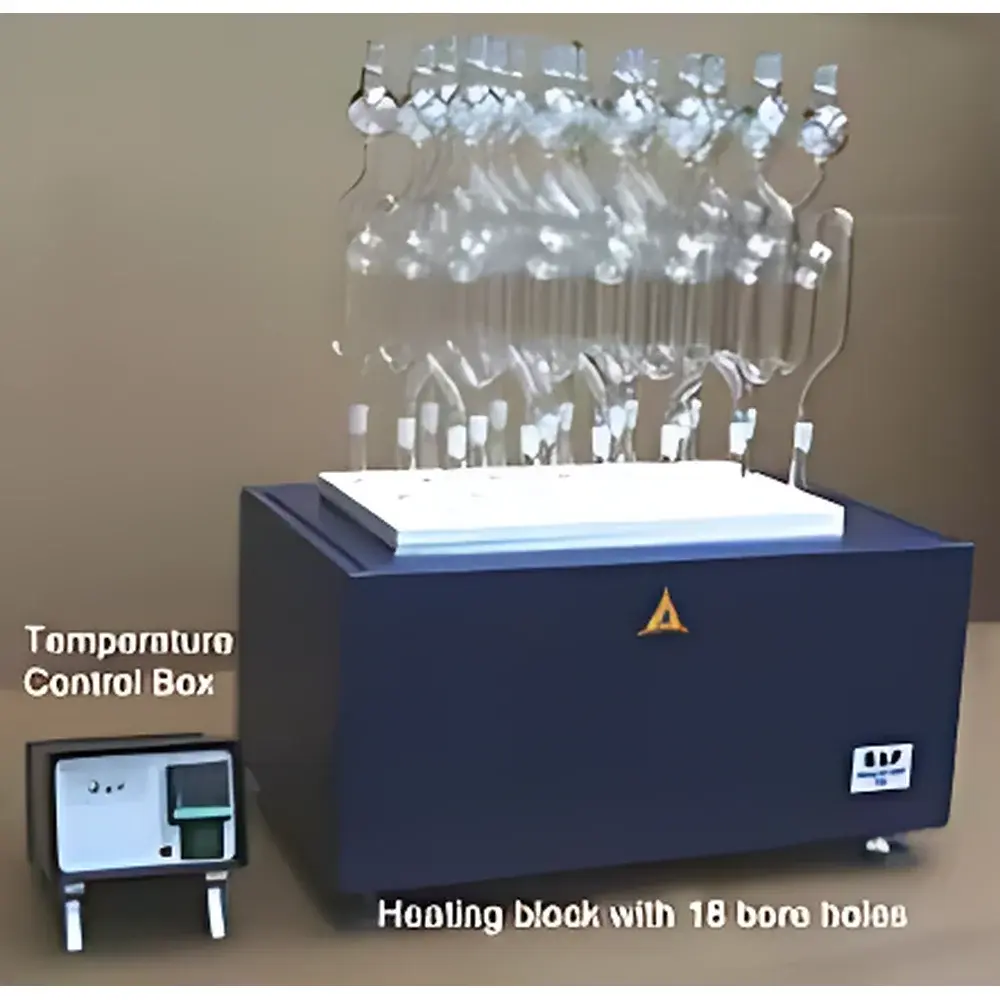
R&P Nitro Compound Thermal Stability Tester (Bergmann-Junk Method)
| Brand | R&P |
|---|---|
| Origin | Germany |
| Model | Nitro |
| Temperature Range | RT–135 °C |
| Control Accuracy | ±0.1 °C |
| Heating Method | Electronic PID-controlled aluminum block heater |
| Sample Capacity | 18 parallel tubes |
| Tube Dimensions | Ø19.0 ± 0.5 mm × 270 ± 2 mm |
| Well Diameter | Ø19.75 ± 0.2 mm, Depth: 200 ± 0.2 mm |
| Sensor | PT100 platinum resistance thermometer |
| Overtemperature Cut-off | 150 °C |
| Illumination System | Dedicated low-glare fluorescent lamp for NO₂ vapor detection |
| Power Supply | 230 V, 50–60 Hz |
| Power Consumption | 2400 VA |
| Compliance | ISO-insulated heating plate, Bergmann-Junk test method per DIN 55507-1 / STANAG 4147 |
Overview
The R&P Nitro Compound Thermal Stability Tester is a precision-engineered instrument designed for the standardized thermal stability assessment of nitrocellulose, nitroglycerin-based propellants, and other energetic nitro compounds in accordance with the Bergmann-Junk test method. This gravimetric, time-resolved decomposition assay quantifies the rate of nitrogen oxide (NOx) evolution under controlled isothermal conditions—typically at 120 °C or 132 °C—as specified in DIN 55507-1 and NATO STANAG 4147. The system operates on the principle that thermally unstable nitro compounds undergo autocatalytic decomposition, releasing gaseous nitrogen oxides detectable via visual colorimetric response under calibrated illumination. Unlike differential scanning calorimetry (DSC) or TGA, this method provides direct functional validation of long-term storage safety and batch consistency for single-base and double-base propellants used in military and aerospace applications.
Key Features
- 18-position heated aluminum block with ISO-certified thermal insulation, ensuring uniform temperature distribution and minimal inter-well thermal drift
- PID-controlled electronic heating system with real-time digital display of both setpoint and actual block temperature (resolution: 0.01 °C; accuracy: ±0.1 °C)
- PT100 Class A platinum resistance sensor embedded directly into the heating block for traceable, high-stability temperature feedback
- Dedicated low-intensity fluorescent lamp assembly mounted on rigid solid支架, optimized for NO2 vapor detection without glare-induced observer fatigue or spectral interference
- Integrated overtemperature protection circuitry with independent mechanical cut-off set at 150 °C—fully compliant with IEC 61000-6-2 EMC and IEC 61010-1 safety standards
- Modular control cabinet housing programmable PID controller, isolated from the heating unit to minimize electromagnetic interference and facilitate calibration access
- Test tube holders with precision-machined spherical top geometry and frosted necks to standardize condensate formation and vapor diffusion kinetics during testing
Sample Compatibility & Compliance
This tester accommodates standard 18-mm-diameter glass test tubes conforming to DIN 55507-1 dimensional tolerances (Ø19.0 ± 0.5 mm × 270 ± 2 mm), enabling direct interoperability with legacy Bergmann-Junk workflows. The 18-well configuration supports parallel evaluation of multiple batches or formulation variants under identical thermal history—critical for statistical process control in propellant manufacturing. The instrument meets requirements for GLP-compliant laboratories conducting stability studies under MIL-STD-810, STANAG 4147 Annex A, and EU Directive 2013/29/EU (Pyrotechnic Articles). Its design incorporates fail-safe electrical isolation and grounding per IEC 61010-1 Edition 3, and all temperature-critical components are supplied with individual calibration certificates traceable to DKD/DAkkS-accredited standards.
Software & Data Management
While the base configuration operates via analog PID control with manual data recording, optional digital upgrade modules support RS-485 Modbus RTU interface for integration into centralized LIMS or MES platforms. Temperature logging at user-defined intervals (1–60 s) enables post-test analysis of thermal equilibration dynamics and deviation trends across wells. All recorded thermal profiles are timestamped and stored with operator ID, sample ID, and environmental ambient metadata—supporting audit readiness for FDA 21 CFR Part 11-compliant environments when paired with validated electronic signature software. Raw temperature data exports in CSV format for statistical evaluation using JMP, Minitab, or Python-based SciPy pipelines.
Applications
- Batch release testing of nitrocellulose and NG-gelatinized propellants prior to munitions loading
- Accelerated aging studies to model shelf-life degradation kinetics under elevated temperature stress
- Formulation development for low-signature propellants where NOx evolution correlates with smoke signature and barrel erosion potential
- Root cause analysis of field failures linked to thermal instability or contamination-induced catalysis
- Qualification testing of new stabilizers (e.g., diphenylamine, ethyl centralite) against established reference materials
- Supporting hazard classification under UN Transport Regulations (UN 0210, UN 0211) and GHS Category 1 explosives criteria
FAQ
What standards does this instrument comply with?
It conforms to DIN 55507-1 (German standard for nitrocellulose stability), STANAG 4147 (NATO standard for propellant thermal stability), and supports testing protocols referenced in MIL-STD-2105D and EU Regulation (EC) No 1907/2006 (REACH Annex XVII).
Can the instrument be validated for GMP environments?
Yes—when equipped with the optional digital logging module and operated under documented IQ/OQ/PQ protocols, it satisfies core requirements for equipment qualification in regulated defense and aerospace supply chains.
Is calibration traceability provided?
Each unit ships with DKD/DAkkS-traceable calibration certificates for the PT100 sensor and block temperature uniformity mapping report across all 18 wells.
What maintenance is required?
Annual verification of temperature uniformity, lamp spectral output, and overtemperature cut-off functionality is recommended; no consumables beyond standard laboratory-grade test tubes are required.




