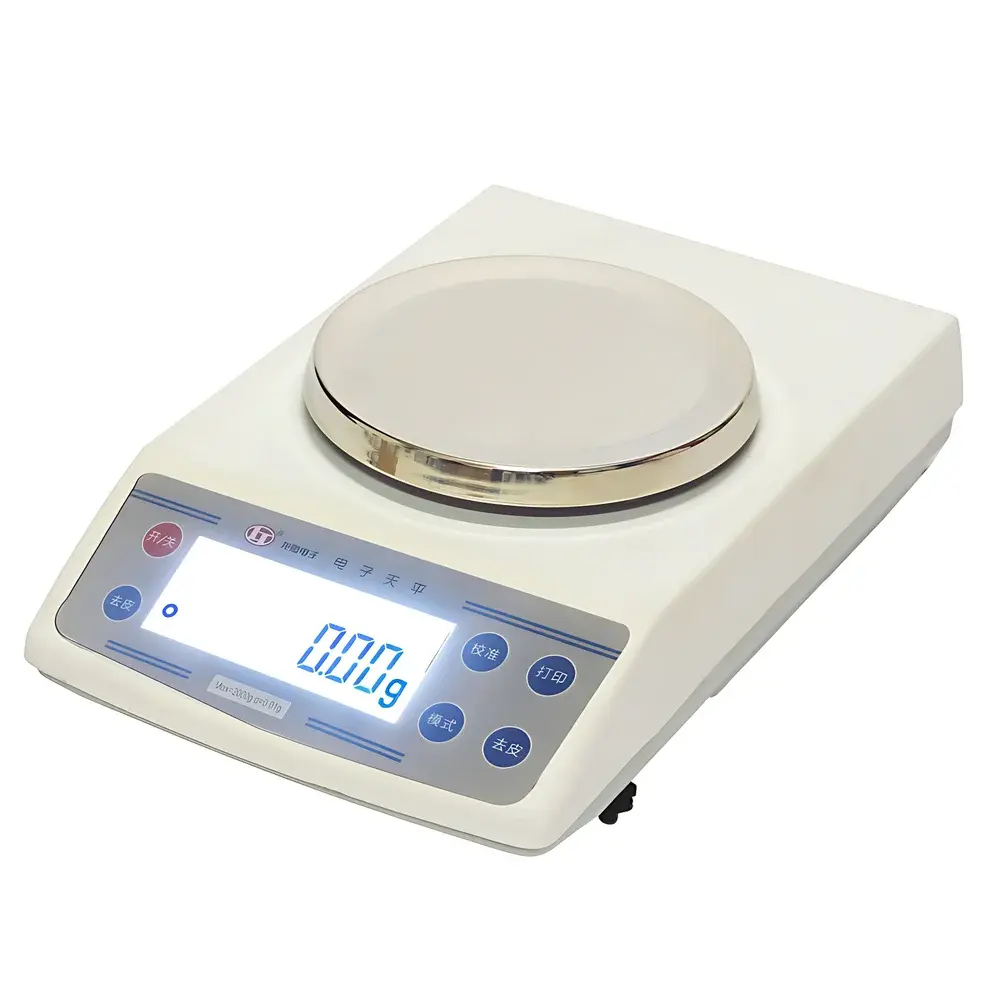
Longteng JD-2 Series Precision Electronic Analytical Balance
| Brand | Longteng |
|---|---|
| Origin | Liaoning, China |
| Manufacturer Type | Authorized Distributor |
| Origin Category | Domestic (China) |
| Model | JD-2 Series |
| Price Range | USD 560–700 (est.) |
| Instrument Type | Analytical Balance |
| Maximum Capacity | 6000 g |
| Readability | 0.01 g |
| Calibration Method | Automatic External Calibration |
| Repeatability | ±0.01 g |
| Pan Diameter | Φ160 mm |
| Net Weight | 3.2 kg |
| Dimensions (W×D×H) | 335 × 205 × 100 mm |
| Interface | RS232 |
| Display | Backlit LCD |
| Environmental Compensation | Temperature & Drift Compensation |
| Optional Accessories | Density Kit, Hook Weighing Module, Calibration Weights |
Overview
The Longteng JD-2 Series Precision Electronic Analytical Balance is engineered for routine mass measurement tasks in quality control laboratories, educational institutions, and light industrial environments where high repeatability and operational efficiency are prioritized over microgram-level resolution. Unlike ultra-micro or semi-micro analytical balances, the JD-2 series operates on electromagnetic force compensation (EMFC) principle with a bottom-mounted sensor architecture—optimized for stability under ambient thermal fluctuations and mechanical vibration. Its 0.01 g readability (10 mg) and up to 6000 g maximum capacity place it at the upper end of the precision balance category, bridging the functional gap between standard analytical balances and compact top-loading precision scales. Designed for ISO/IEC 17025-aligned workflows, the instrument supports traceable calibration via external weights and integrates drift and temperature compensation algorithms to maintain measurement consistency across diurnal environmental shifts—critical for multi-shift production labs or teaching labs lacking climate-controlled rooms.
Key Features
- Bottom-mounted electromagnetic force compensation (EMFC) sensor delivering enhanced long-term stability and reduced sensitivity to air currents compared to top-suspended designs.
- Stainless steel weighing pan (Φ160 mm) offering corrosion resistance and sufficient surface area for bulk samples, irregular geometries, or container-based weighing protocols.
- Backlit LCD display with adjustable contrast—ensuring legibility under low-light conditions or high-ambient-brightness settings without eye strain.
- Automatic external calibration with built-in temperature and drift compensation—minimizing manual recalibration frequency while maintaining compliance with internal QA procedures.
- Comprehensive overload/underload detection with audible and visual alerts, full-range tare functionality, and cumulative addition/subtraction modes for batch processing.
- Multi-unit support including grams (g), carats (ct), ounces (oz), and percent mode—enabling direct relative mass reporting without post-processing.
- RS232 serial interface compliant with standard ASCII data output protocol—compatible with laboratory information management systems (LIMS), statistical process control (SPC) software, and dot-matrix or thermal label printers.
Sample Compatibility & Compliance
The JD-2 series accommodates solid, granular, and powder samples within its 6000 g capacity limit. Its open design—lacking an integrated draft shield—makes it unsuitable for volatile, hygroscopic, or electrostatically sensitive materials requiring inert atmosphere or static-dissipative handling. However, optional hook attachment enables below-pan suspension for density determination (with accessory density kit) or magnetic sample weighing. The balance meets general-purpose metrological requirements per OIML R 76-1 (Class II) for non-automatic weighing instruments and supports GLP documentation through timestamped RS232 data logging when interfaced with compliant software. While not certified for FDA 21 CFR Part 11 electronic records, its deterministic output format allows integration into validated systems with appropriate audit trail configuration.
Software & Data Management
No proprietary software is bundled; the JD-2 outputs raw ASCII-formatted weight data via RS232 at standard 9600 bps, 8N1 configuration. This enables seamless ingestion into Excel, LabVIEW, MATLAB, or custom LIMS platforms using generic serial drivers. Each transmission includes weight value, unit code, stability flag (“S” for stable), and optional time stamp (if host system provides real-time clock). For regulated environments, users may implement third-party validation packages to establish electronic signature, audit trail, and data integrity controls—consistent with ALCOA+ principles (Attributable, Legible, Contemporaneous, Original, Accurate, Complete, Consistent, Enduring, Available).
Applications
- Raw material receipt inspection in food, pharmaceutical, and chemical manufacturing facilities.
- Formulation batching in R&D labs where ±0.01 g tolerance satisfies process capability indices (e.g., Cp ≥ 1.33).
- Student laboratory exercises in physics, chemistry, and materials science curricula—emphasizing measurement uncertainty, repeatability assessment, and unit conversion fluency.
- Inventory counting by weight (piece-counting mode) for standardized components such as fasteners, tablets, or capsules.
- Density determination of solids (via Archimedes’ principle) when paired with optional density kit and calibrated sinker.
- Calibration verification of lower-capacity balances using mass comparison methodology.
FAQ
What is the recommended calibration frequency for the JD-2 Series?
Calibration should be performed before first use, after relocation, following significant ambient temperature changes (>5 °C), and at least once per shift in production environments—per ISO 9001:2015 clause 7.1.5.1.
Does the balance support internal calibration?
No—the JD-2 Series relies exclusively on external calibration using certified weights traceable to national standards (e.g., NIST, NIM).
Can this balance be used in a fume hood?
Yes, provided airflow is minimized and the unit is mounted on a vibration-isolated surface; however, absence of a draft shield limits suitability for highly volatile or low-mass samples.
Is the RS232 interface compatible with modern Windows/macOS systems?
Yes—using a USB-to-serial adapter and standard COM port drivers; no proprietary drivers required.
What is the warranty coverage?
Standard 24-month limited warranty covering parts and labor for defects in materials and workmanship under normal laboratory use conditions.