
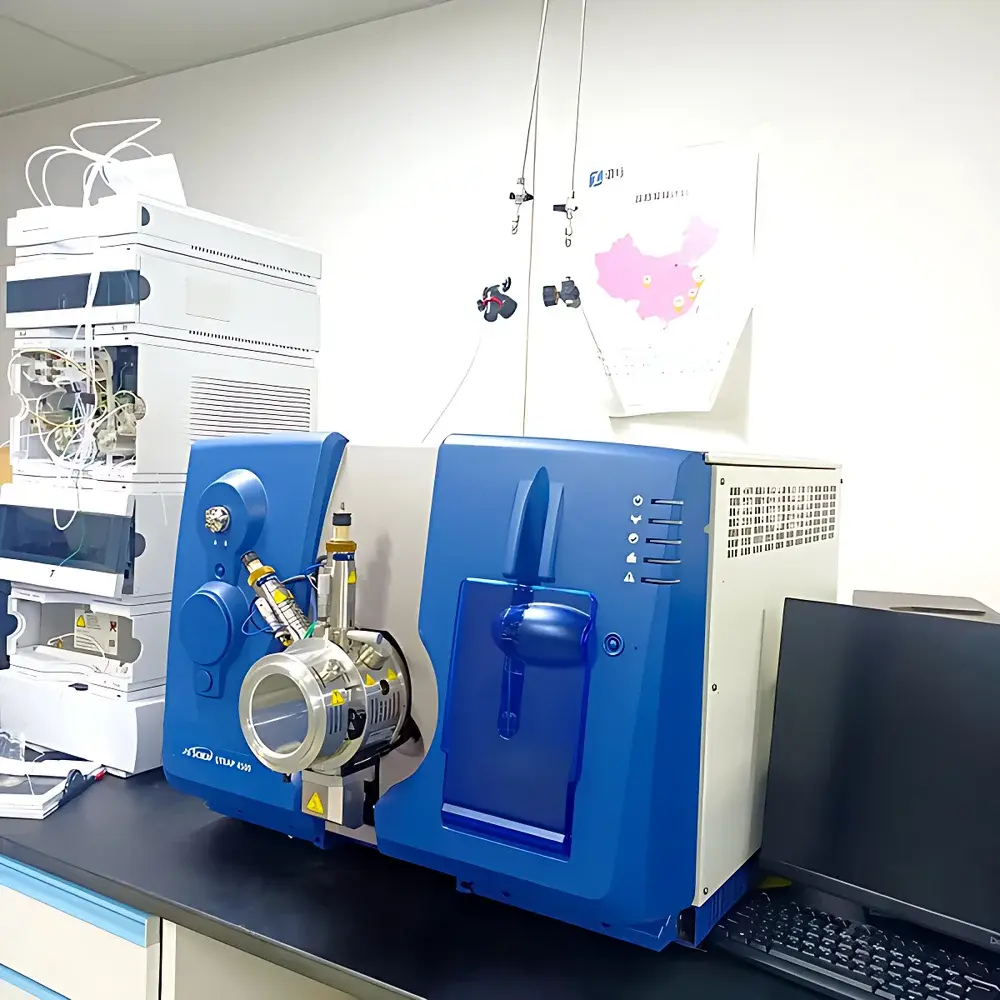
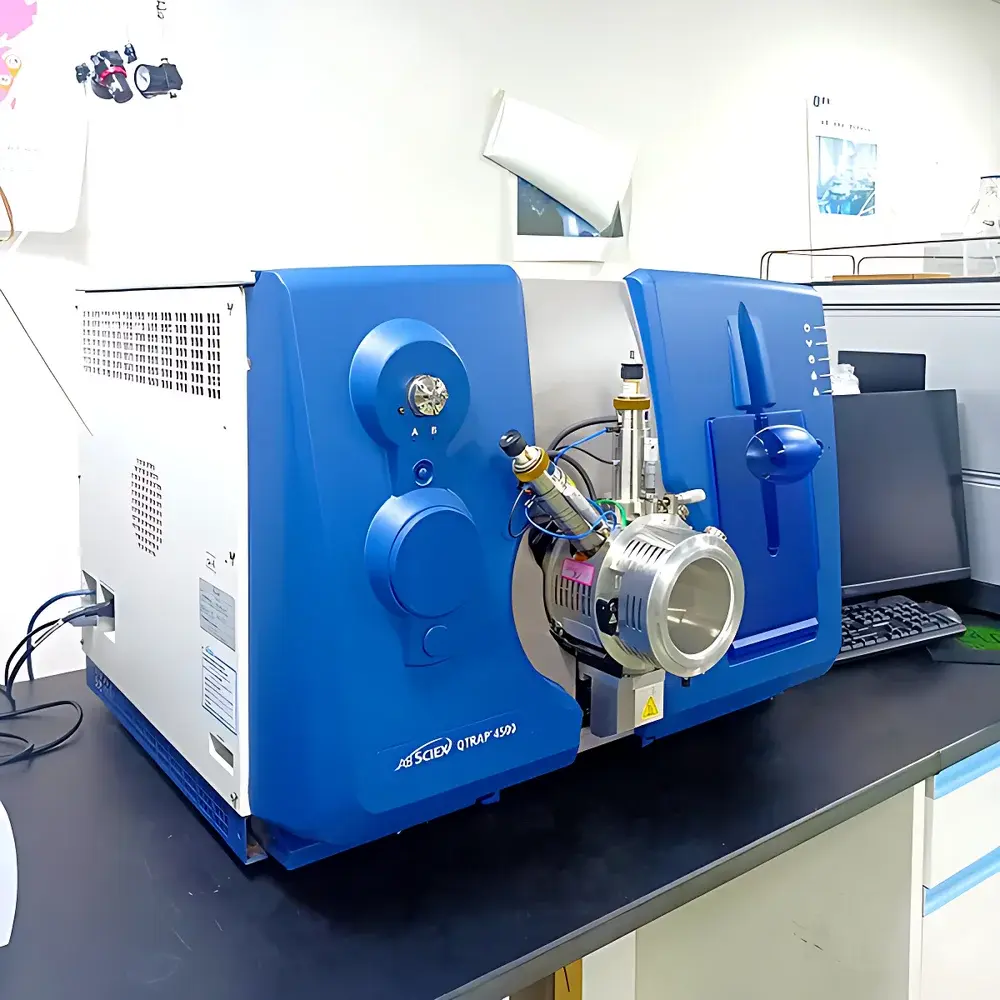
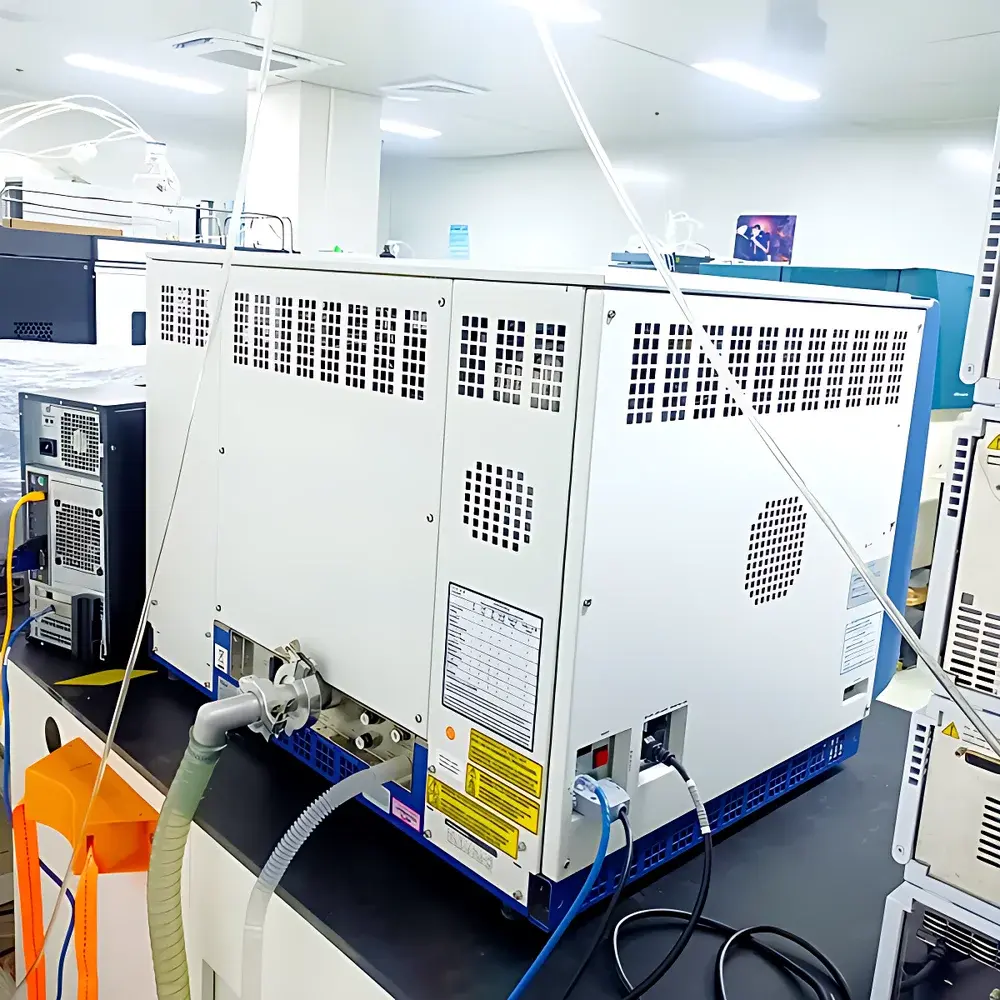
AB SCIEX Triple Quad 4500 Liquid Chromatography Tandem Mass Spectrometer
| Brand | AB SCIEX |
|---|---|
| Origin | USA |
| Manufacturer Type | Authorized Distributor |
| Import Status | Imported |
| Model | 4500 |
| Instrument Type | Triple Quadrupole Mass Spectrometer |
| Application Scope | General-Purpose LC-MS/MS |
| Mass Range | 1000 Da |
| Sensitivity (MRM) | 100:1 (S/N) |
| Resolution | 0.5 Da (FWHM) |
| Mass Accuracy | 0.1 Da |
| Operating Pressure Range | 600 Torr (vacuum system) |
| Scan Speed | 12,000 Da/sec |
| Mass Stability | <0.1 Da/24 h |
| Dynamic Linear Range | 5 orders of magnitude |
| MRM Dwell Time | 1 ms |
| Ion Source | Turbo V™ with ESI and APCI capability |
Overview
The AB SCIEX Triple Quad 4500 is a high-performance liquid chromatography tandem mass spectrometry (LC-MS/MS) system engineered for precision quantitative analysis in regulated and high-throughput laboratory environments. Based on triple quadrupole (QqQ) architecture, it employs collision-induced dissociation (CID) in the second quadrupole (Q2) to generate structurally informative product ions, enabling highly selective multiple reaction monitoring (MRM) detection. This configuration delivers exceptional specificity in complex matrices—such as plasma, urine, tissue homogenates, and environmental extracts—where co-eluting interferences are common. Designed for clinical diagnostics, pharmaceutical development, food safety testing, and environmental monitoring, the system meets the rigorous demands of GLP, GMP, and CLIA-compliant laboratories. Its robust vacuum architecture, stable mass calibration, and low-drift electronics ensure reproducible performance across multi-day analytical runs.
Key Features
- QJet™-2 ion guide technology: Enhances ion transmission efficiency and improves vacuum distribution between source and analyzer regions, contributing to sustained sensitivity over extended operation.
- Bent LINAC® collision cell: Optimizes ion residence time and kinetic energy transfer during CID, increasing fragment ion yield while minimizing cross-talk and carryover between sequential MRM transitions.
- Q3 linear acceleration: Enables rapid scanning across wide mass ranges without sacrificing duty cycle or signal fidelity—critical for high-multiplexing MRM assays.
- MRM-IDA-EPI acquisition mode: Supports intelligent data-dependent acquisition (IDA) triggered from predefined MRM events, followed by enhanced product ion (EPI) scans for structural confirmation and spectral library generation.
- AcQuRate™ pulse-counting detector: Delivers high dynamic range and sub-percent relative standard deviation (RSD) in replicate injections, ensuring trace-level quantitation reliability.
- eQ™ electronics platform: Facilitates sub-50-ms polarity switching and fast dwell-time modulation, essential for simultaneous positive/negative ion mode analysis in single-injection workflows.
- Gas curtain interface: Reduces neutral background and non-volatile residue deposition at the orifice, extending maintenance intervals and improving long-term signal stability.
- Turbo V™ ion source: Compatible with electrospray ionization (ESI) and atmospheric pressure chemical ionization (APCI); supports flow rates from 5 µL/min to 2 mL/min; incorporates self-cleaning probe functionality to mitigate ion suppression and matrix effects.
Sample Compatibility & Compliance
The Triple Quad 4500 interfaces seamlessly with UHPLC and HPLC systems from major vendors (e.g., Waters, Thermo Fisher, Agilent), supporting reversed-phase, HILIC, and ion-pairing separations. It accommodates diverse sample types—including biological fluids, plant extracts, polymer leachables, and pesticide residues—without requiring derivatization in most cases. The system complies with key regulatory frameworks: data integrity features align with FDA 21 CFR Part 11 requirements (audit trail, electronic signatures, user access controls); method validation protocols conform to ICH Q2(R2), USP , and ISO/IEC 17025 standards; and instrument qualification follows ASTM E2656-20 guidelines for mass spectrometric performance verification.
Software & Data Management
Controlled via Analyst® MD Software (v1.6), the platform provides integrated tools for method development, acquisition optimization, peak integration, and report generation. The s-MRM (scheduled MRM) algorithm dynamically allocates dwell time based on retention window predictions, maximizing sensitivity per transition without compromising cycle time. All raw data are stored in .wiff format, compatible with third-party processing engines (e.g., Skyline, MultiQuant™, OpenMS). Audit trails log every parameter change, user action, and calibration event with timestamp and operator ID. Export options include CSV, PDF, and XML formats compliant with LIMS integration requirements.
Applications
- Clinical toxicology: Simultaneous quantification of opioids, benzodiazepines, stimulants, and metabolites in serum or whole blood.
- Pharmaceutical bioanalysis: PK/PD studies supporting IND/NDA submissions, including small-molecule ADME profiling and impurity identification.
- Food safety: Detection of mycotoxins, veterinary drug residues, and allergenic proteins at EU MRL or FDA action limit levels.
- Environmental analysis: Screening of PFAS, pharmaceuticals in wastewater, and endocrine disruptors in soil extracts.
- Forensic chemistry: Confirmatory identification of novel psychoactive substances (NPS) using EPI spectral matching against NIST and mzCloud libraries.
FAQ
What regulatory standards does the Triple Quad 4500 support for data integrity?
It implements full 21 CFR Part 11 compliance through role-based access control, electronic signature capture, immutable audit trails, and secure data archiving.
Can the system operate in both ESI and APCI modes within a single run?
Yes—the eQ™ electronics enable automatic, rapid polarity switching and dual-source compatibility without hardware reconfiguration.
Is method transfer from older AB SCIEX instruments feasible?
MRM methods developed on API 4000™ or 5500™ systems can be migrated with minimal optimization due to consistent QqQ geometry and ion optics design.
What maintenance intervals are recommended for routine operation?
Ion source cleaning every 72–96 hours under heavy use; turbomolecular pump service every 18–24 months; annual preventive maintenance by certified SCIEX Field Service Engineers.
Does the system support isotopic dilution quantitation?
Yes—Analyst® MD includes built-in internal standard ratio calculation, response factor normalization, and QC acceptance criteria per batch.





