
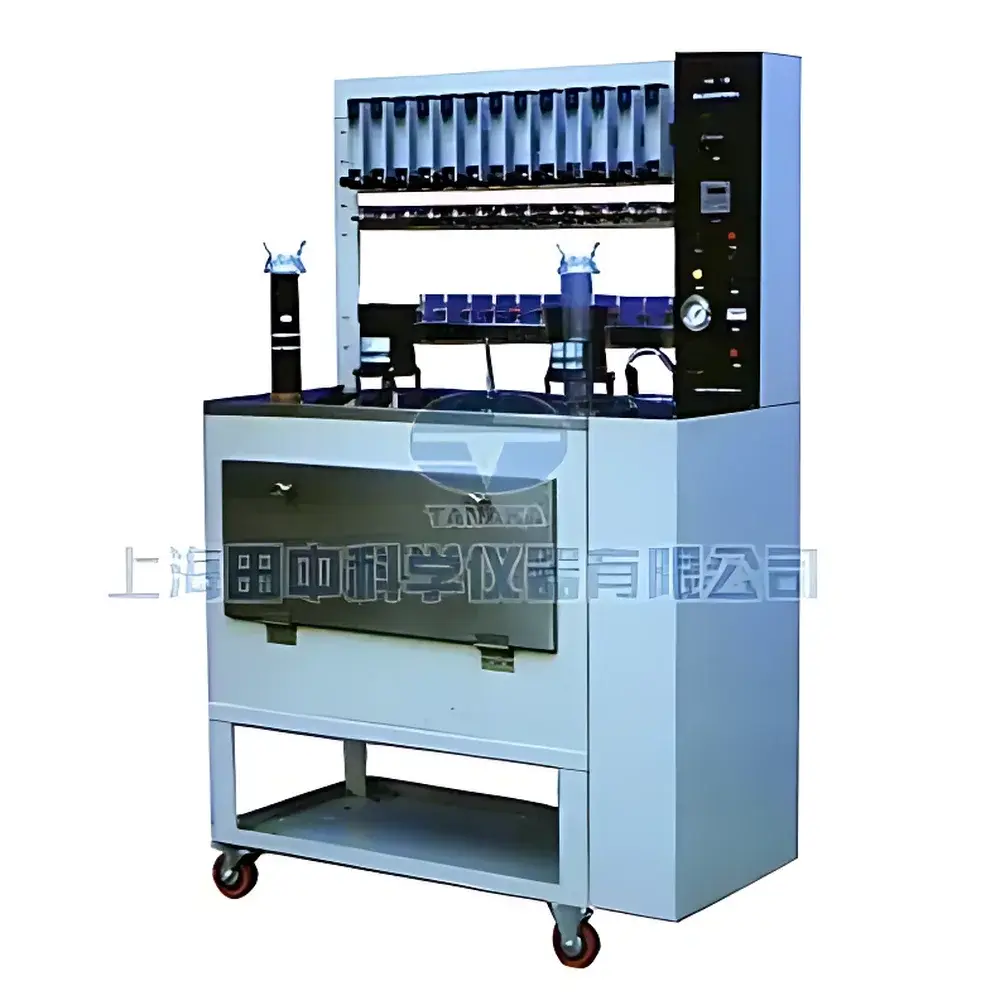
Tanaka TOS-1 Turbine Oil Oxidation Stability Tester
| Brand | Tanaka |
|---|---|
| Origin | Japan |
| Model | TOS-1 |
| Standard Compliance | ASTM D943, GB/T 12581, SH/T 0175, ASTM D2274 (with optional dark chamber) |
| Oxidation Tube Capacity | 13 positions |
| Temperature Range | Ambient to 100 °C |
| Temperature Control Accuracy | ±0.2 °C |
| Sensor Type | Platinum Resistance Thermometer (Pt100) |
| Control Method | PID-based digital temperature controller with 0.1 °C display resolution |
| Heating Power | 2 × 1.08 kW + 1.0 kW = 3.2 kW (dual-zone) |
| Power Supply | AC 220 V, 50/60 Hz, 3.6 kW |
| Dimensions (W×D×H) | 904 × 510 × 1400 mm |
| Weight | Approx. 75 kg |
| Safety Features | Automatic shutdown on power failure, gas supply interruption, or coolant flow loss |
Overview
The Tanaka TOS-1 Turbine Oil Oxidation Stability Tester is a precision-engineered instrument designed for quantitative evaluation of oxidation resistance in lubricating oils under accelerated aging conditions. It operates on the principle of controlled oxygen exposure at elevated temperatures—specifically aligned with the rotating pressure vessel oxidation test (RPVOT) methodology as codified in ASTM D943 and GB/T 12581. The system subjects turbine oils and other low-density circulating lubricants containing antioxidant and anti-rust additives to standardized oxidative stress within sealed oxidation tubes immersed in a thermostatically regulated bath. By measuring the time required for acid number increase or sludge formation beyond defined thresholds, the instrument delivers reproducible metrics for remaining useful life estimation, additive depletion kinetics, and formulation robustness assessment. Its architecture supports both long-term static oxidation testing (e.g., for turbine oil service life prediction) and accelerated oxidation protocols (e.g., ASTM D2274 for distillate fuels), contingent upon integration of an optional light-shielded reaction chamber.
Key Features
- Thermally stable 13-position oxidation tube rack with individual sealing integrity verification capability
- Dual-zone heating system (3.2 kW total) enabling precise thermal uniformity across the entire bath volume
- Pt100 platinum resistance sensor coupled with PID-controlled digital temperature regulation—achieving ±0.2 °C stability over ambient to 100 °C operating range
- Real-time monitoring and fail-safe interlocks for power loss, compressed air interruption, and cooling water flow cessation
- Integrated over-temperature alarm with audible and visual indicators compliant with IEC 61000-6-2 electromagnetic immunity requirements
- Modular design accommodating custom tube configurations and auxiliary modules including dark chamber kits for fuel oxidation testing per SH/T 0175 and ASTM D2274
Sample Compatibility & Compliance
The TOS-1 is validated for use with turbine oils, hydraulic fluids, and circulating lubricants exhibiting density less than that of water and formulated with phenolic or amine-based antioxidants and rust inhibitors. Its test methodology satisfies regulatory and quality assurance requirements across multiple international frameworks: ASTM D943 (turbine oil oxidation stability), GB/T 12581 (Chinese national standard for turbine oil aging), and—when equipped with the optional light-exclusion chamber—ASTM D2274 and SH/T 0175 (oxidation stability of middle distillate fuels). All operational parameters are traceable to NIST-traceable calibration references. The system’s mechanical and electrical architecture conforms to CE marking directives (2014/30/EU EMC Directive and 2014/35/EU Low Voltage Directive), and its safety logic complies with ISO 13849-1 PL e functional safety requirements for laboratory equipment.
Software & Data Management
While the base TOS-1 operates via embedded hardware control with analog/digital hybrid instrumentation, optional RS-485 or Ethernet interfaces enable connection to external LIMS or SCADA platforms. Temperature logs, run duration timestamps, and alarm event records are stored internally with non-volatile memory retention exceeding 10,000 cycles. When integrated into GLP/GMP-regulated environments, the system supports 21 CFR Part 11-compliant data archiving through third-party validation-ready software packages—providing electronic signatures, audit trails, and user access level management. Raw data export is available in CSV format for post-processing in MATLAB, Python pandas, or ASTM-standardized reporting templates.
Applications
- Baseline oxidation stability qualification of new turbine oil batches prior to commissioning
- Monitoring antioxidant depletion profiles during extended service life testing of in-service lubricants
- Comparative evaluation of alternative additive packages under identical thermal-oxygen stress conditions
- Supporting root-cause analysis of premature varnish formation or deposit accumulation in steam turbine systems
- Accelerated oxidation screening of diesel and jet fuel formulations per ASTM D2274 protocol
- Method validation and interlaboratory comparison studies accredited under ISO/IEC 17025
FAQ
What standards does the TOS-1 directly support without add-ons?
ASTM D943 and GB/T 12581 for turbine oil oxidation stability testing.
Can the TOS-1 be used for fuel oxidation testing?
Yes—when fitted with the optional light-shielded reaction chamber, it fully complies with SH/T 0175 and ASTM D2274.
Is temperature calibration traceable to national standards?
Yes—each unit ships with a calibration certificate referencing NIST-traceable Pt100 sensor verification.
What safety certifications apply to the TOS-1?
CE-marked per 2014/30/EU (EMC) and 2014/35/EU (LVD); meets ISO 13849-1 PL e for safety-related control functions.
Does the system support automated data export?
Standard firmware includes timestamped CSV logging; optional communication modules enable real-time LIMS integration.





