
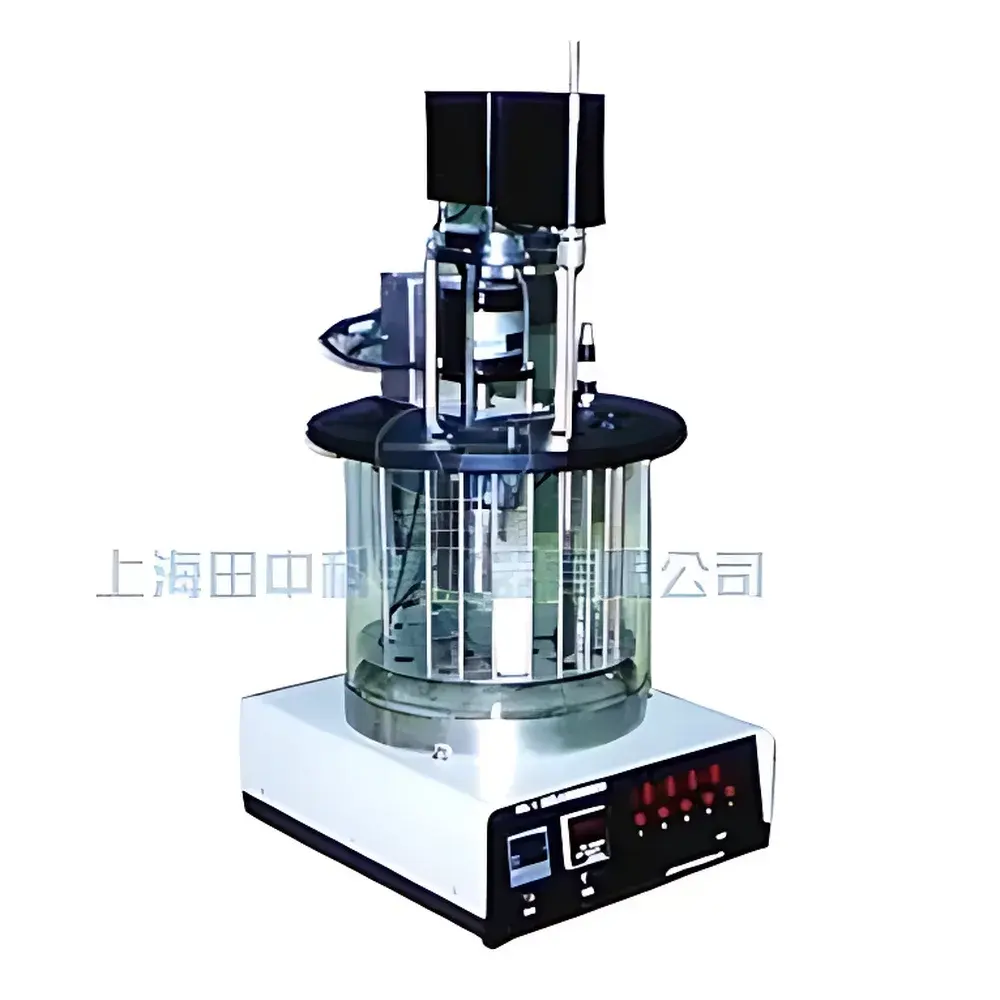
Tanaka SDL-2 Petroleum and Synthetic Fluid Demulsibility Tester
| Brand | Tanaka |
|---|---|
| Origin | Japan |
| Model | SDL-2 |
| Standards Compliance | GB/T 7305-1987, ISO 6614:1983, ASTM D1401-1967 |
| Temperature Range | Ambient to 95 °C |
| Number of Test Stations | 5 |
| Cylinder Dimensions | Φ32 mm × 225 mm |
| Bath Dimensions | Φ300 mm × 300 mm (hardened glass) |
| Heating Power | 1.5 kW |
| Bath Stirrer Motor | AC 220 V, 25 W |
| Sample Agitator Motor | DC 24 V, 80 W |
| Timer Channels | 5 independent digital timers |
| Power Supply | AC 220 V, 50 Hz, 7.5 A |
| Control Unit Dimensions | 360 mm (W) × 400 mm (D) × 130 mm (H) |
| Test Chamber Dimensions | Φ360 mm × 590 mm (D × H) |
Overview
The Tanaka SDL-2 Petroleum and Synthetic Fluid Demulsibility Tester is a precision-engineered laboratory instrument designed to quantitatively assess the demulsification behavior of petroleum-based lubricants, hydraulic fluids, turbine oils, and synthetic base stocks when mixed with water. It operates on the principle of controlled phase separation kinetics under standardized thermal and mechanical agitation conditions—specifically aligned with the interfacial tension, coalescence efficiency, and gravitational settling dynamics governing oil–water emulsion breakdown. The instrument implements the core methodology defined in ASTM D1401 (Standard Test Method for Determining the Demulsibility Characteristics of Turbine Oils), ISO 6614 (Petroleum Products — Determination of Demulsibility), and GB/T 7305 (Petroleum Products — Determination of Demulsibility of Lubricating Oils). Its vertical modular architecture integrates a thermostatically regulated glass bath with five parallel test stations, enabling simultaneous evaluation of multiple samples under identical environmental parameters—a critical requirement for comparative batch analysis and QC release testing in refinery, OEM, and third-party certification laboratories.
Key Features
- Five independent test positions with synchronized digital timing (five-channel timer system), supporting concurrent evaluation of replicate or multi-formulation samples.
- High-stability tempered glass bath (Φ300 mm × 300 mm) with uniform thermal distribution across the full operating range (ambient to 95 °C), maintained via PID-controlled 1.5 kW heating element and low-torque AC stirrer (220 V, 25 W).
- Dedicated DC-driven sample agitator (24 V, 80 W) delivering consistent rotational mixing at standardized speed and duration per ASTM D1401 protocol, minimizing operator-induced variability.
- Ergonomic upright configuration with integrated control unit (360 × 400 × 130 mm) housing all electrical interfaces, safety circuitry, and visual status indicators—including audible/visual alert for timer completion at each station.
- Calibration-ready design compliant with ISO/IEC 17025 traceability requirements; all temperature sensors and timers are accessible for third-party verification and routine metrological validation.
Sample Compatibility & Compliance
The SDL-2 accommodates standard ASTM D1401-compliant cylindrical test vessels (Φ32 mm × 225 mm), suitable for volumes up to 40 mL of oil–water mixture (typically 40 mL oil + 40 mL water). It supports both mineral-based and synthetically formulated fluids—including polyalphaolefins (PAO), phosphate esters, diesters, and polyglycols—provided they remain thermally stable below 95 °C during the 30–60 minute test duration. Regulatory alignment includes full conformance with ASTM D1401-1967 (reaffirmed 2022), ISO 6614:1983, and GB/T 7305-1987. While not inherently 21 CFR Part 11–compliant due to its analog-digital hybrid interface, the instrument’s deterministic timer outputs and fixed protocol execution support audit-ready documentation when paired with GLP-aligned lab notebooks or LIMS-integrated data capture workflows.
Software & Data Management
The SDL-2 operates as a standalone hardware platform without embedded firmware or proprietary software. All operational parameters—including start time, elapsed duration, and endpoint confirmation—are managed via front-panel digital displays and physical push-button controls. Time-stamped endpoint data (e.g., separation volume at 15/30/60 min intervals) must be manually recorded per standard practice. For laboratories requiring electronic data capture, optional RS-232 or USB-to-serial adapters enable integration with external PC-based logging tools or validated spreadsheet templates configured for ASTM D1401 reporting formats. No cloud connectivity, remote access, or automated report generation is provided—ensuring full data sovereignty and compatibility with air-gapped QA environments.
Applications
- Quality control of new turbine oils prior to commissioning in power generation facilities.
- Formulation development of demulsifier additives for industrial lubricants and marine engine oils.
- Stability assessment of synthetic hydraulic fluids exposed to humid operating environments.
- Comparative benchmarking of used oil samples to detect hydrolytic degradation or surfactant contamination.
- Regulatory submission testing for API, DIN, or JIS-certified lubricant approvals where demulsibility is a mandatory specification parameter.
FAQ
What standards does the SDL-2 explicitly support?
ASTM D1401-1967 (reaffirmed), ISO 6614:1983, and GB/T 7305-1987.
Can the instrument be used for non-petroleum-based dielectric fluids?
Yes, provided the fluid exhibits thermal stability ≤95 °C and forms a measurable oil–water interface under ASTM-defined agitation conditions.
Is calibration certificate included with shipment?
No—calibration is performed per customer request and follows ISO/IEC 17025 procedures by authorized metrology providers; factory verification data is supplied with each unit.
What maintenance is required for long-term reliability?
Annual inspection of heater elements, stirrer motor brushes, and timer circuit integrity; periodic replacement of fuses (220 V / 10 A) and cleaning of glass bath interior with non-abrasive solvents.
Does the SDL-2 meet GMP or GLP documentation requirements?
It supports GLP/GMP workflows through deterministic operation and manual recordkeeping; electronic audit trails require external data capture systems configured per laboratory SOPs.



