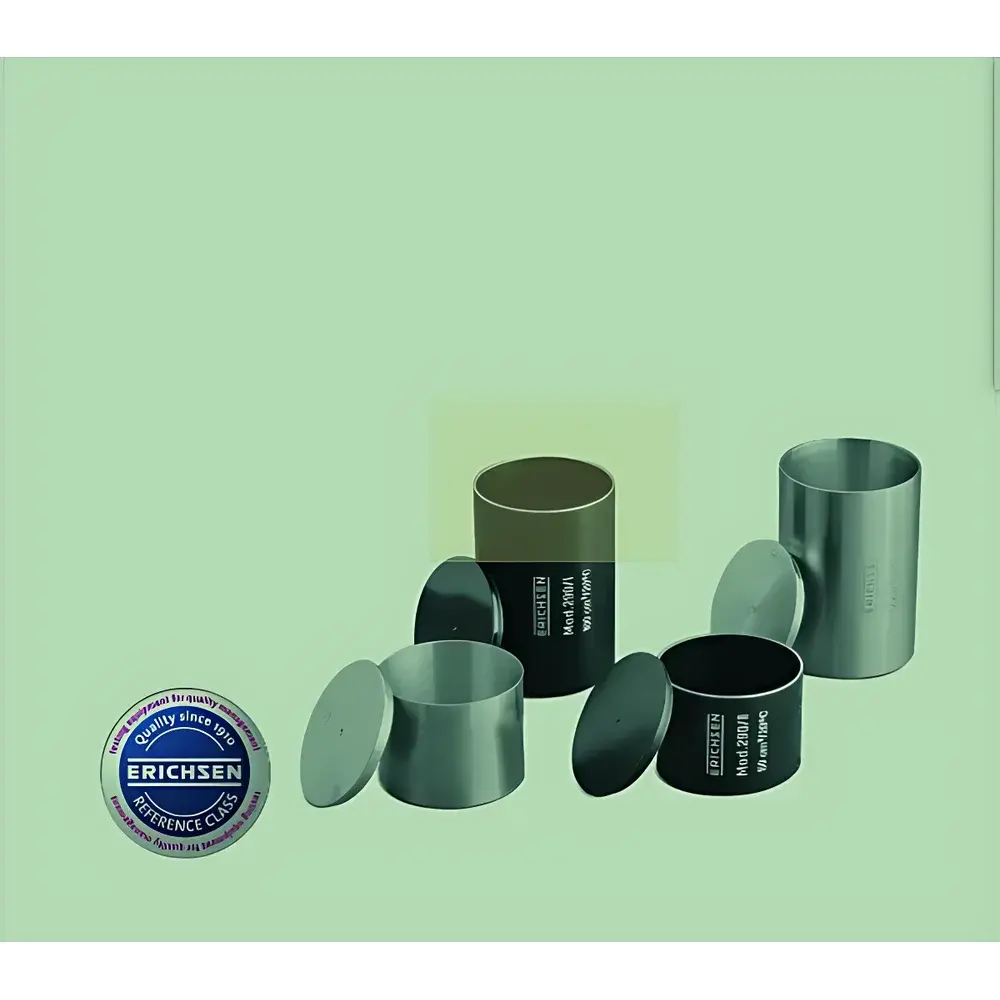
Erichsen 290 Pycnometer (Density Cup)
| Brand | ERICHSEN (Germany) |
|---|---|
| Origin | Germany |
| Model | Erichsen 290 |
| Capacity | 50 mL & 100 mL |
| Material Options | Anodized Aluminum or Stainless Steel |
| Certified Accuracy | ±0.2% (standard certificate), optional ±0.1% (traceable calibration certificate) |
| Compliance | ISO 2811, DIN 53217, VDA 621-103, BS 3900-A12, SIS 18 41 11, SNV 37 100 |
Overview
The Erichsen 290 Pycnometer is a precision-manufactured density cup designed for gravimetric determination of density in accordance with the fundamental physical principle ρ = m/V. Engineered for laboratory and industrial quality control environments, this instrument implements a simple yet highly reproducible volumetric displacement method: a precisely machined cup of known internal volume is filled to overflow via its calibrated vent hole, then weighed after careful surface drying. The resulting mass-to-volume ratio yields true density in g/mL (equivalent to g/cm³) under defined temperature conditions—typically 23 °C per ISO 2811. Unlike digital densitometers or oscillating U-tube systems, the Erichsen 290 operates without electronics, power supply, or fluid pumping mechanisms, delivering inherent long-term stability and minimal maintenance requirements. Its robust architecture ensures consistent performance across decades of use when handled per manufacturer guidelines.
Key Features
- Two standardized volumes: 50 mL (Model 290/II & 290/IV) and 100 mL (Model 290/I & 290/V), optimized for different sample rheologies and handling workflows
- Material options: anodized aluminum (lightweight, corrosion-resistant for routine QC) and stainless steel (chemically inert, suitable for aggressive solvents or elevated cleaning temperatures)
- Integrated overflow vent: precision-drilled vent hole in the lid enables automatic volume definition at fill level, eliminating operator-dependent meniscus judgment
- Traceable metrological certification: supplied with factory-issued test certificate (±0.2% uncertainty); optional accredited calibration certificate (±0.1%, ISO/IEC 17025 compliant) available upon request
- Mechanical simplicity: no moving parts, sensors, or firmware—ideal for GLP/GMP environments where validation burden must be minimized
- Compatibility with standard analytical balances: designed for seamless integration with Class I or II laboratory balances (readability ≤ 0.001 g recommended)
Sample Compatibility & Compliance
The Erichsen 290 supports density measurement of low- to medium-viscosity liquids (e.g., solvents, resins, thin coatings) and semi-solid pastes (e.g., pigmented pastes, thixotropic paints, mastics). The 50 mL variant is particularly suited for viscous or yield-stress materials due to reduced column height and improved fill consistency. All configurations comply with internationally recognized standards including ISO 2811-1 (paints and varnishes), DIN 53217 (coating materials), VDA 621-103 (automotive supplier requirements), BS 3900-A12 (British Standards for paints), SIS 18 41 11 (Swedish standard), and SNV 37 100 (Swiss norm). These standards mandate specific temperature control (23 ± 0.5 °C), cleaning protocols, and balance specifications—requirements fully addressable using the Erichsen 290 within validated SOPs.
Software & Data Management
As a purely mechanical device, the Erichsen 290 requires no embedded software, drivers, or connectivity interfaces. Density calculations are performed externally using validated spreadsheet templates or LIMS-integrated calculation modules. When used in regulated environments (e.g., pharmaceutical excipient testing or automotive OEM labs), laboratories may document usage within electronic lab notebooks (ELN) or integrate results into chromatography data systems (CDS) via manual entry or CSV import. The instrument itself supports full audit trail compliance through physical logbook entries referencing calibration certificate numbers, balance ID, environmental monitoring records, and analyst signatures—fully aligned with FDA 21 CFR Part 11 expectations for paper-based or hybrid workflows.
Applications
- Quality assurance of raw materials (resins, solvents, pigments) in paint, ink, and adhesive manufacturing
- Batch release testing of finished coatings per customer technical data sheets (TDS)
- Formulation development support: tracking density shifts during solvent substitution or solid content adjustment
- Regulatory submission testing for REACH, TSCA, or CLP classification where density informs hazard communication (e.g., UN transport classification)
- Third-party certification labs performing accredited testing to ISO/IEC 17025 scope
- Educational laboratories demonstrating fundamental density principles with traceable instrumentation
FAQ
What is the difference between the 290/I and 290/II models?
The 290/I denotes the 100 mL capacity version; the 290/II denotes the 50 mL version. Suffixes “III” and “IV” refer to stainless steel variants (290/III = 100 mL SS, 290/IV = 50 mL SS).
Is temperature control required during measurement?
Yes. Per ISO 2811, measurements must be conducted at 23 ± 0.5 °C. Users must condition both sample and pycnometer in a temperature-controlled room or water bath prior to filling.
Can the Erichsen 290 be used for volatile solvents?
Yes—provided rapid weighing follows immediate filling and surface drying, and ambient humidity is controlled to prevent condensation or evaporation artifacts.
How often should recalibration be performed?
While the pycnometer’s volume is dimensionally stable, periodic verification against certified reference standards (e.g., water at 23 °C, ρ = 0.99756 g/mL) is recommended annually or per internal QA schedule.
Is the overflow vent adjustable?
No. The vent hole is fixed-diameter and non-adjustable; its geometry is integral to the certified volume specification and must not be modified.