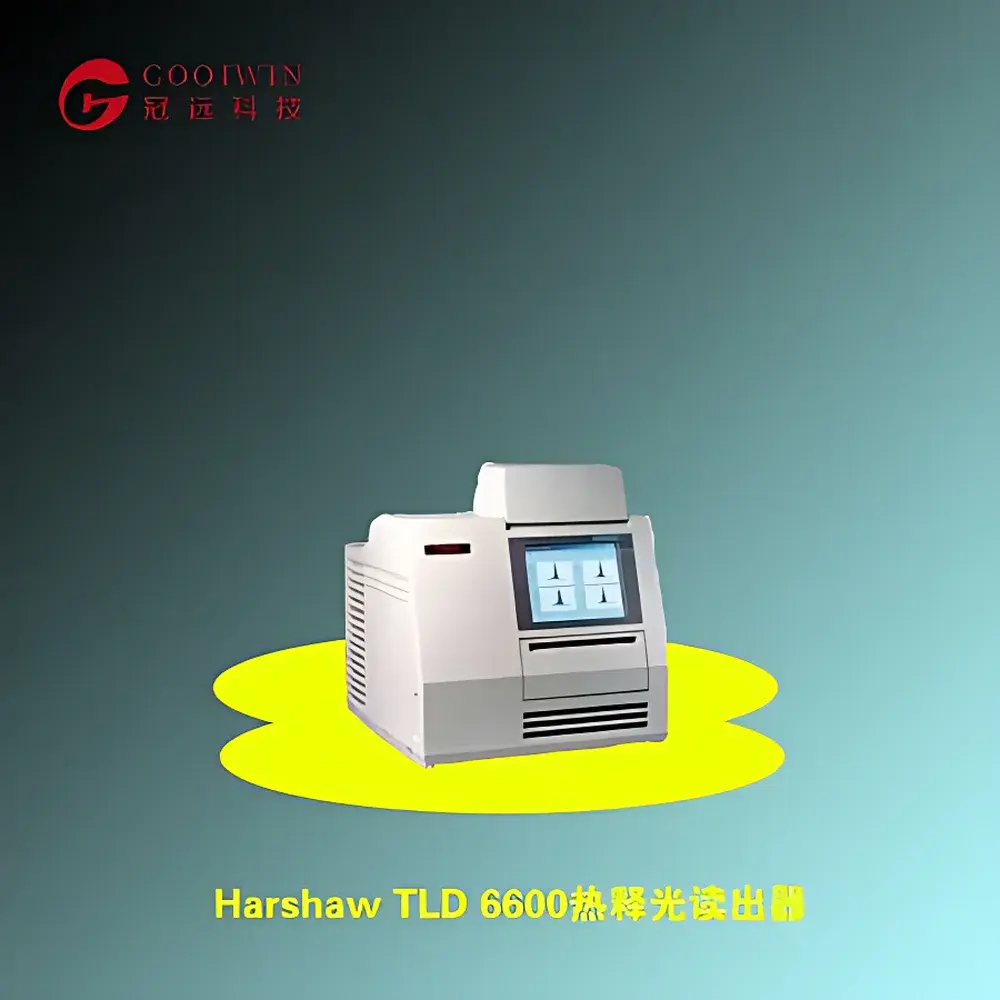
UNION TLD 6600 Thermoluminescence Reader
| Brand | UNION |
|---|---|
| Origin | Germany |
| Model | TLD 6600 |
| Detector Type | Automated Thermoluminescence (TL) Readout System |
| Heating Profile | Linear & Predefined Ramp Control (0.1–10 °C/s) |
| Glow Curve Acquisition | High-Sensitivity PMT with Spectral Response 300–650 nm |
| Sample Capacity | Up to 72 TLD chips or pellets (e.g., LiF:Mg,Ti, CaSO₄:Dy) per batch |
| Readout Sensitivity | < 1 mGy (for LiF:Mg,Ti, 10 mg) |
| Background Noise | < 5 counts/s (shielded chamber) |
| Data Resolution | 1024-channel spectral digitization |
| Compliance | Meets IEC 62387-1:2012 and ISO/IEC 17025 requirements for dosimetry calibration laboratories |
Overview
The UNION TLD 6600 Thermoluminescence Reader is a fully automated, laboratory-grade instrument engineered for precise quantification of ionizing radiation dose in thermoluminescent dosimeters (TLDs). It operates on the fundamental principle of thermoluminescence: when previously irradiated crystalline materials—such as LiF:Mg,Ti, CaSO₄:Dy, or Al₂O₃:C—are heated under controlled conditions, trapped electrons recombine with lattice defects, emitting photons proportional to the absorbed radiation dose. The TLD 6600 captures this emitted light via a low-noise photomultiplier tube (PMT), digitizes the resulting glow curve across 1024 channels, and applies algorithmic deconvolution to isolate individual peak structures—enabling robust discrimination between natural background signals and anthropogenic or environmental dose contributions. While widely deployed in personnel and environmental radiation monitoring, its high sensitivity (<1 mGy detection limit), reproducible heating profiles (0.1–10 °C/s ramp control), and shielded measurement chamber make it particularly suitable for applications demanding trace-level dosimetric fidelity—including archaeological dating, geological stratum analysis, and food irradiation verification.
Key Features
- Automated sample handling with programmable carousel supporting up to 72 standard TLD chips or pellets per run
- High-stability linear heating system with real-time temperature feedback and user-definable ramp rates (0.1–10 °C/s)
- Low-noise, bialkali photocathode PMT optimized for 300–650 nm spectral response—critical for resolving overlapping TL peaks in mixed-dose environments
- Digital glow curve acquisition at 1024-channel resolution, enabling advanced kinetic analysis (e.g., peak shape fitting, activation energy estimation via initial rise or variable heating rate methods)
- Integrated lead–copper shielding (≥60 dB attenuation at 662 keV) to minimize cosmic and ambient background interference
- Compliance-ready firmware architecture supporting audit trails, electronic signatures, and configurable user roles per FDA 21 CFR Part 11 and ISO/IEC 17025 requirements
Sample Compatibility & Compliance
The TLD 6600 accommodates industry-standard dosimetric materials including LiF:Mg,Ti (TLD-100), LiF:Mg,Cu,P (TLD-100H), CaSO₄:Dy, and Al₂O₃:C—each with documented glow curve characteristics referenced against ICRU Report 85 and DIN 6818-2. Its mechanical and thermal design ensures uniform heating across heterogeneous sample geometries (0.5–5 mm diameter chips, 1–10 mg mass range), minimizing thermal lag artifacts. For food irradiation verification, the reader supports pre-annealed silicate minerals extracted from spices, herbs, or dried vegetables—validated per EN 1788:2001 and ASTM F1627-19 protocols. All calibration procedures follow traceable standards issued by national metrology institutes (e.g., PTB, NPL), and routine performance verification aligns with ISO/IEC 17025 clause 7.7 (uncertainty evaluation) and IEC 62387-1:2012 Annex B (type testing requirements).
Software & Data Management
The included TLWin v4.2 software provides full control over acquisition parameters, real-time glow curve visualization, and post-processing tools including peak deconvolution (Gaussian/Lorentzian fitting), kinetic parameter extraction (E, s), and dose–response curve generation. Raw data are stored in vendor-neutral HDF5 format with embedded metadata (operator ID, calibration certificate ID, environmental log timestamps). Audit trail functionality records all parameter modifications, data exports, and report generations with immutable timestamps and user attribution—ensuring compliance with GLP, GMP, and regulatory submissions requiring ALCOA+ principles (Attributable, Legible, Contemporaneous, Original, Accurate, Complete, Consistent, Enduring, Available). Export modules support CSV, XML, and PDF report generation compatible with LIMS integration.
Applications
- Archaeological & Geological Dating: Quantifying accumulated natural radiation dose in sediment quartz or feldspar grains to determine burial age (Optically Stimulated Luminescence cross-validation supported via optional IR/UV stimulation module)
- Food Irradiation Verification: Detecting post-irradiation TL signals in silicate contaminants (e.g., from soil residues in dried herbs) to confirm regulatory compliance with Codex Alimentarius Standard 106-1983
- Environmental Dosimetry: Long-term monitoring of gamma dose rates in soil profiles, building materials, and nuclear facility perimeters using passive TLD arrays
- Retrospective Accident Dosimetry: Rapid assessment of accidental exposure using household ceramics, bricks, or mobile phone components as natural TL detectors
- Research in Radiation Physics: Kinetic modeling of trap distributions, defect engineering studies in doped phosphors, and intercomparison of TL response under mixed-field neutron/gamma irradiations
FAQ
What types of TLD materials are validated for use with the TLD 6600?
LiF:Mg,Ti (TLD-100), LiF:Mg,Cu,P (TLD-100H), CaSO₄:Dy, Al₂O₃:C, and natural quartz/feldspar extracts—all with documented glow curve libraries and annealing protocols included in TLWin.
Does the system support GLP/GMP-compliant reporting?
Yes. TLWin v4.2 includes 21 CFR Part 11-compliant electronic signatures, full audit trail logging, and configurable access controls aligned with ISO/IEC 17025 clause 8.9.
Can the TLD 6600 be used for food irradiation screening according to EU regulations?
Yes. When operated with EN 1788:2001-compliant sample preparation (e.g., silicate extraction from spices), the system meets the minimum detectable dose and specificity thresholds required for regulatory verification.
Is calibration traceable to national standards?
All factory calibrations are traceable to PTB (Physikalisch-Technische Bundesanstalt) reference dosimeters, with certificates provided per ISO/IEC 17025 requirements.
What maintenance intervals are recommended for long-term stability?
Annual PM (preventive maintenance) is recommended, including PMT gain verification, heater calibration, and shielding integrity check—documented in the service logbook included with each unit.