
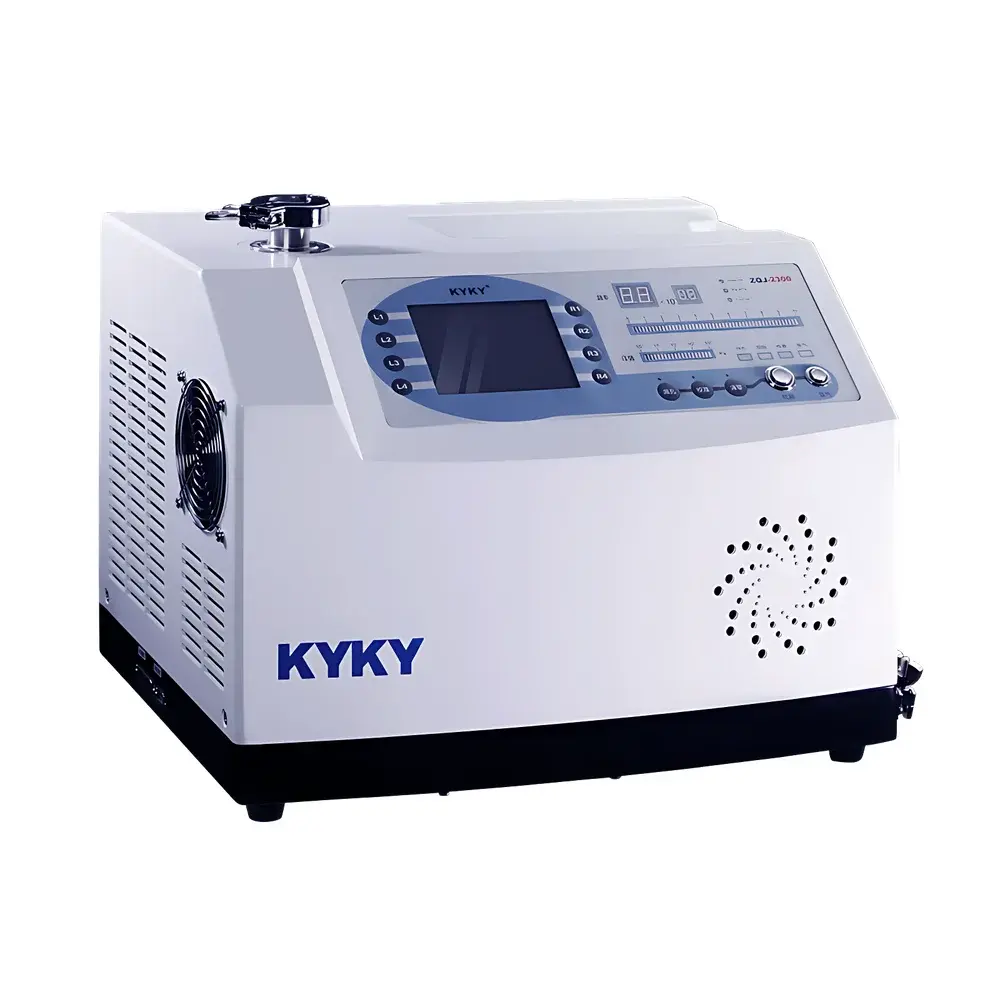
KYKY ZQJ-2300 Helium Mass Spectrometer Leak Detector
| Brand | KYKY |
|---|---|
| Origin | Beijing, China |
| Manufacturer Type | Original Equipment Manufacturer (OEM) |
| Model | ZQJ-2300 |
| Price Range | USD 14,000 – 42,500 |
| Minimum Detectable Leak Rate | 2.0×10⁻¹¹ Pa·m³/s |
| Measurement Range | 1×10⁻¹¹ – 1×10⁻⁵ Pa·m³/s |
| Maximum Test Pressure | 1000 Pa |
| Response Time | ≤2 s |
| Pump-down/Startup Time | <7 min |
| Power Supply | 220 VAC ±10%, 50 Hz, 5 A |
| Operating Environment | 5–45 °C, RH <80% |
| Dimensions (L×W×H) | 500×354×397 mm |
| Weight | 39.5 kg |
Overview
The KYKY ZQJ-2300 Helium Mass Spectrometer Leak Detector is a compact, high-sensitivity residual gas analyzer engineered for quantitative leak detection in ultra-high vacuum (UHV) and high-vacuum systems. It operates on the principle of magnetic sector mass spectrometry, selectively ionizing helium atoms (mass-to-charge ratio m/z = 4) via electron impact ionization and separating them from background gases using a 90° magnetic sector analyzer. This enables unambiguous identification and quantification of helium tracer gas ingress, delivering trace-level sensitivity essential for validating hermetic integrity in mission-critical components. Designed for integration into production lines, R&D laboratories, and field service environments, the ZQJ-2300 meets the fundamental requirements of ISO 20484:2017 (leak testing — vocabulary and definitions) and aligns with ASTM E493-22 (Standard Practice for Leaks Using Helium as a Tracer Gas), supporting both qualitative pass/fail assessment and quantitative leak rate reporting in SI units (Pa·m³/s).
Key Features
- Compact benchtop architecture (500 × 354 × 397 mm; 39.5 kg) optimized for space-constrained cleanrooms, assembly cells, and mobile service carts.
- Integrated bypass pumping interface enabling rapid sample chamber evacuation without interrupting mass spectrometer operation—critical for maintaining stable ion source conditions during dynamic leak testing.
- Dual-port I/O connectivity: RS-232 serial interface for remote command execution (SCPI-compatible), plus opto-isolated digital I/O for hardware-triggered start/stop, alarm output, and vacuum interlock signaling.
- Yttrium oxide (Y₂O₃)-coated tungsten filament providing enhanced thermal stability and extended operational lifetime (>6,000 hours under nominal conditions), reducing scheduled maintenance frequency and consumables cost.
- Active background suppression algorithm combined with fast differential pumping stages achieves sub-2-second response time and <7-minute cold-start stabilization—enabling high-throughput screening without compromising detection threshold reproducibility.
- Robust vacuum protection logic automatically cuts filament power and closes ion source aperture upon pressure excursion above 1000 Pa, preventing contamination and arc damage during rough-pump transitions.
Sample Compatibility & Compliance
The ZQJ-2300 is compatible with standard helium spray probe, vacuum chamber, and sniffer-mode configurations. It supports both integral (vacuum-integrated) and local (sniffer-based) leak detection per ISO 10648-2:1994 and EN 1330-8:2019. Its calibrated sensitivity range (1×10⁻¹¹ to 1×10⁻⁵ Pa·m³/s) satisfies acceptance criteria defined in MIL-STD-883 Method 1014.11 (microelectronics packaging), IEC 60068-2-17 (environmental testing), and GB/T 15823-2011 (Chinese national standard for helium leak testing). The instrument’s analog/digital signal architecture complies with electromagnetic compatibility (EMC) requirements per IEC 61326-1:2022 Class A, and its electrical safety conforms to IEC 61010-1:2010.
Software & Data Management
The ZQJ-2300 includes embedded firmware supporting real-time leak rate logging, timestamped event history, and user-defined pass/fail thresholds. When connected via RS-232, it interfaces with third-party SCADA or MES platforms using ASCII-based command sets (e.g., “MEAS?”, “THRS 1E-9”). Audit-trail-capable data export (CSV format) includes system status flags (filament on/off, pump status, pressure readings), facilitating GLP/GMP documentation workflows. While no proprietary PC software is bundled, the device supports integration into FDA 21 CFR Part 11-compliant environments when deployed with validated external acquisition software and access-controlled user accounts.
Applications
- Industrial manufacturing: Hermeticity validation of lithium-ion battery enclosures, automotive EV power modules, cryogenic heat exchangers, SF₆-insulated switchgear, LNG transfer valves, and MEMS packaging.
- Aerospace & defense: Leak verification of satellite propulsion tanks, avionics housings, life-support O-rings, and hypersonic vehicle thermal protection assemblies.
- Nuclear engineering: Monitoring containment integrity of tritium-handling gloveboxes and fusion reactor vacuum vessel welds.
- Semiconductor & photonics: Testing vacuum feedthroughs, laser cavity seals, and epitaxial reactor load locks where sub-10⁻¹⁰ Pa·m³/s sensitivity is mandated.
- Research infrastructure: Commissioning of synchrotron beamline components, superconducting magnet cryostats, and quantum computing dilution refrigerators.
FAQ
What is the minimum detectable leak rate under standard operating conditions?
The ZQJ-2300 achieves a verified minimum detectable leak rate of 2.0×10⁻¹¹ Pa·m³/s when operated with a clean, dry helium supply (<1 ppm H₂O, <0.1 ppm hydrocarbons) and calibrated against NIST-traceable reference leaks.
Does the instrument support automated test sequences?
Yes—via RS-232 SCPI commands, users can script multi-step protocols including pre-evacuation delay, helium injection timing, measurement dwell, and pass/fail decision logic.
Is the filament replaceable in the field?
Yes—the Y₂O₃-coated tungsten filament is a user-serviceable component requiring only standard vacuum tools and bake-out reconditioning.
Can the ZQJ-2300 be used in sniffer mode?
Yes—it supports local leak detection using an optional helium sniffer probe connected to the inlet port, with adjustable sensitivity scaling and acoustic/visual alarms.
What vacuum pumps are recommended for optimal performance?
A two-stage rotary vane pump (ultimate pressure ≤5×10⁻² Pa) paired with a turbomolecular pump (pumping speed ≥200 L/s for N₂) is recommended for achieving full sensitivity across the specified measurement range.






