
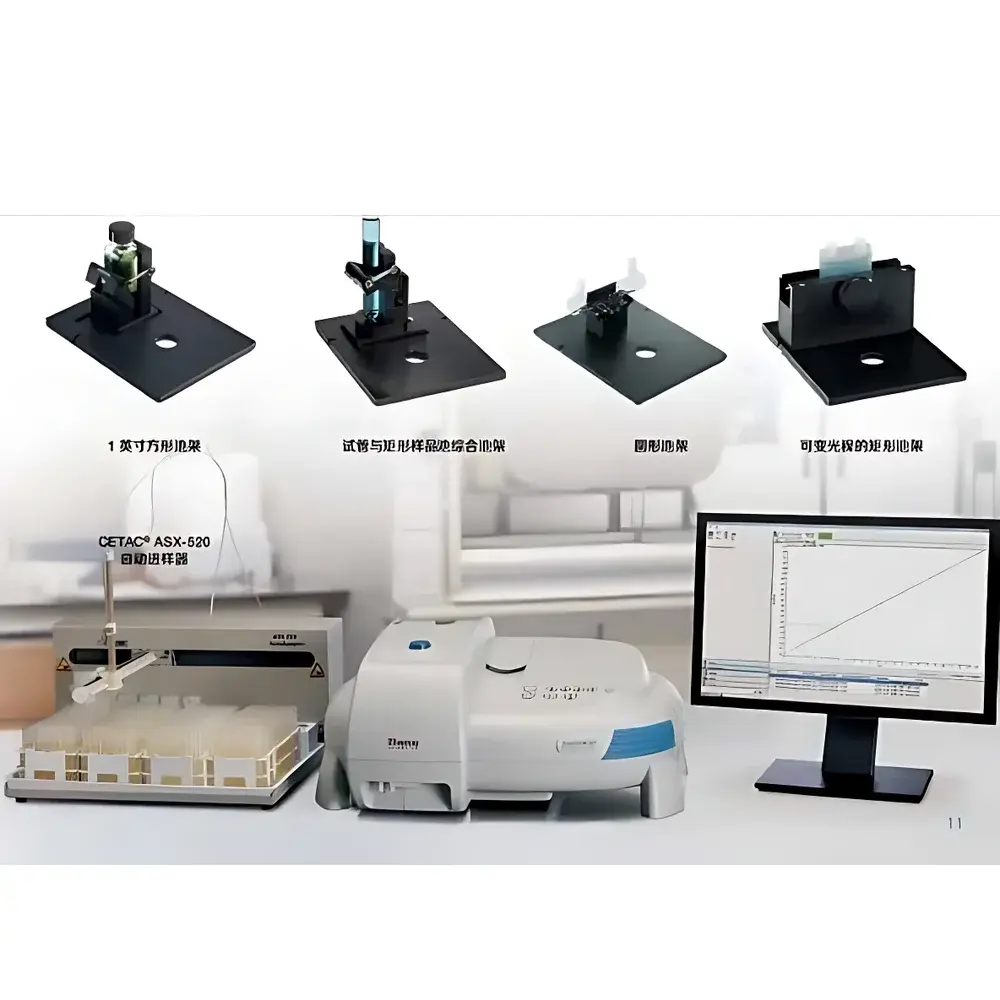
Thermo Scientific Evolution 220 UV-Vis Spectrophotometer
| Origin | USA |
|---|---|
| Manufacturer Type | Authorized Distributor |
| Origin Category | Imported Instrument |
| Model | Evolution 220 |
| Optical System | Double-Beam |
| Detector | Photodiode Array (PDA) |
| Wavelength Range | 190–1100 nm |
| Wavelength Accuracy | ±0.2 nm |
| Spectral Bandwidth | 1 nm |
| Stray Light | <0.02% |
| Wavelength Repeatability | ±0.01 nm |
| Absorbance Accuracy | ±0.002 A (at 1.0 A) |
| Absorbance Range | >3.5 A |
| Baseline Flatness | ±0.0006 A (200–800 nm, 1.0 nm SBW) |
| Noise | <0.00008 A RMS (260 nm, 1.0 nm SBW, 0 A) |
| Drift | <0.0005 A/hr |
| Scan Speed | 1–6000 nm/min |
| Grating Drive Speed | 31,000 nm/min |
| Data Point Resolution | 0.1–10 nm selectable |
Overview
The Thermo Scientific Evolution 220 UV-Vis Spectrophotometer is a high-performance, double-beam scanning spectrophotometer engineered for precision quantitative and qualitative analysis across academic, pharmaceutical, environmental, and industrial laboratories. Based on a robust Czerny–Turner monochromator architecture with a holographic grating and xenon flash lamp source, it delivers exceptional photometric stability and spectral fidelity over its full 190–1100 nm range. Unlike continuous-tungsten/deuterium systems, the pulsed xenon lamp provides uniform intensity across the UV and visible regions without warm-up delay or spectral discontinuity, enabling rapid, reproducible measurements with inherent wavelength accuracy of ±0.2 nm and baseline flatness of ±0.0006 A (200–800 nm). Its double-beam optical design continuously compensates for source drift and environmental fluctuations, ensuring long-term measurement integrity under routine QC and GLP-compliant workflows.
Key Features
- Double-beam optical architecture with real-time reference beam correction for enhanced photometric stability and reduced baseline drift (<0.0005 A/hr).
- Xenon flash lamp source with 3-year limited warranty and typical operational lifetime exceeding 7 years—eliminating lamp alignment, warm-up time, and spectral gaps between UV and visible regions.
- Photodiode array (PDA) detector enabling simultaneous multi-wavelength acquisition, high-speed scanning (up to 6000 nm/min), and flexible data point resolution (0.1–10 nm).
- Advanced Fixed Bandwidth Grating (AFBG) optics optimized for microvolume cuvettes, fiber-optic probes, and solid-sample reflectance measurements—supporting method transfer across diverse sample formats.
- Intuitive touchscreen interface with context-aware main screen navigation, reducing operator training time and minimizing procedural errors in high-throughput environments.
- Integrated CUE scripting environment for building validated, audit-ready workflows—including custom prompts, pass/fail logic, automated report generation, and instrument parameter locking—fully compliant with FDA 21 CFR Part 11 requirements when deployed with Thermo Scientific SampleManager LIMS integration.
Sample Compatibility & Compliance
The Evolution 220 accommodates a broad range of sample types via interchangeable accessories: standard 10-mm pathlength cuvettes, microvolume platforms (e.g., NanoDrop-compatible pedestals), fiber-optic probes for remote or in-situ measurements, integrating spheres for diffuse reflectance, and temperature-controlled cells for kinetic studies. It supports ASTM E275, ISO 6247, USP , and EP 2.2.25 methods out-of-the-box. All firmware and software revisions undergo traceable version control; electronic records include full audit trails (user ID, timestamp, parameter changes, result modifications) meeting GLP and GMP documentation standards. The system is CE-marked and conforms to IEC 61010-1 for laboratory electrical safety.
Software & Data Management
- Thermo Scientific INSIGHT software provides a modular, workbook-style interface for rapid assay setup, multi-curve overlay, derivative spectroscopy, and kinetic modeling—with built-in templates for protein A280, nucleic acid A260/A280, colorimetric assays (e.g., BCA, Bradford), and solvent purity verification.
- CUE Scripting Engine enables creation of SOP-driven applications: users define step-by-step logic (e.g., “if absorbance at 280 nm > 1.5 A, prompt dilution confirmation”), embed calibration checks, enforce data validation rules, and export structured reports (PDF, CSV, XML) with embedded metadata.
- Full 21 CFR Part 11 readiness via optional SampleManager LIMS connectivity: electronic signatures, role-based access control, automated backup, and immutable record archiving are configurable without third-party middleware.
- Data files store raw spectra, instrument configuration, environmental logs (lamp hours, ambient temperature), and user annotations—ensuring full traceability from acquisition to regulatory submission.
Applications
The Evolution 220 serves as a core analytical platform for routine and research-grade applications requiring high photometric accuracy and method flexibility. Typical use cases include: quantification of biomolecules (proteins, DNA, RNA) using extinction coefficients or standard curves; verification of oligonucleotide synthesis purity and concentration; assessment of nanoparticle plasmon resonance shifts; monitoring of enzyme kinetics (e.g., NADH oxidation at 340 nm); excipient compatibility screening in formulation development; and water quality testing per EPA Method 4500-NO₂⁻ and APHA Standard Methods. Its low stray light (<0.02% at 220 nm and 340 nm) and sub-millidegree absorbance noise enable reliable measurements in highly absorbing matrices—critical for pharmaceutical dissolution testing and high-concentration bioprocess monitoring.
FAQ
What is the lamp lifetime specification, and is lamp replacement user-serviceable?
The xenon flash lamp is rated for ≥1×10⁹ flashes and typically operates for 7+ years under standard usage. Replacement requires factory calibration and is performed by Thermo Scientific Field Service Engineers to maintain wavelength and photometric accuracy.
Does the system support automated cuvette changer integration?
Yes—optional 6-, 12-, or 36-position autosamplers are available with barcode reading, temperature control (4–40 °C), and seamless INSIGHT software integration for unattended batch analysis.
Can CUE scripts be exported and shared across instruments?
CUE scripts are portable XML files that retain full functionality when loaded onto other Evolution 220 systems running the same or newer firmware version—enabling method harmonization across multi-site laboratories.
Is baseline correction performed automatically during scan acquisition?
Baseline correction is applied post-acquisition using stored reference scans; however, real-time double-beam compensation ensures minimal baseline deviation without manual intervention during routine operation.





