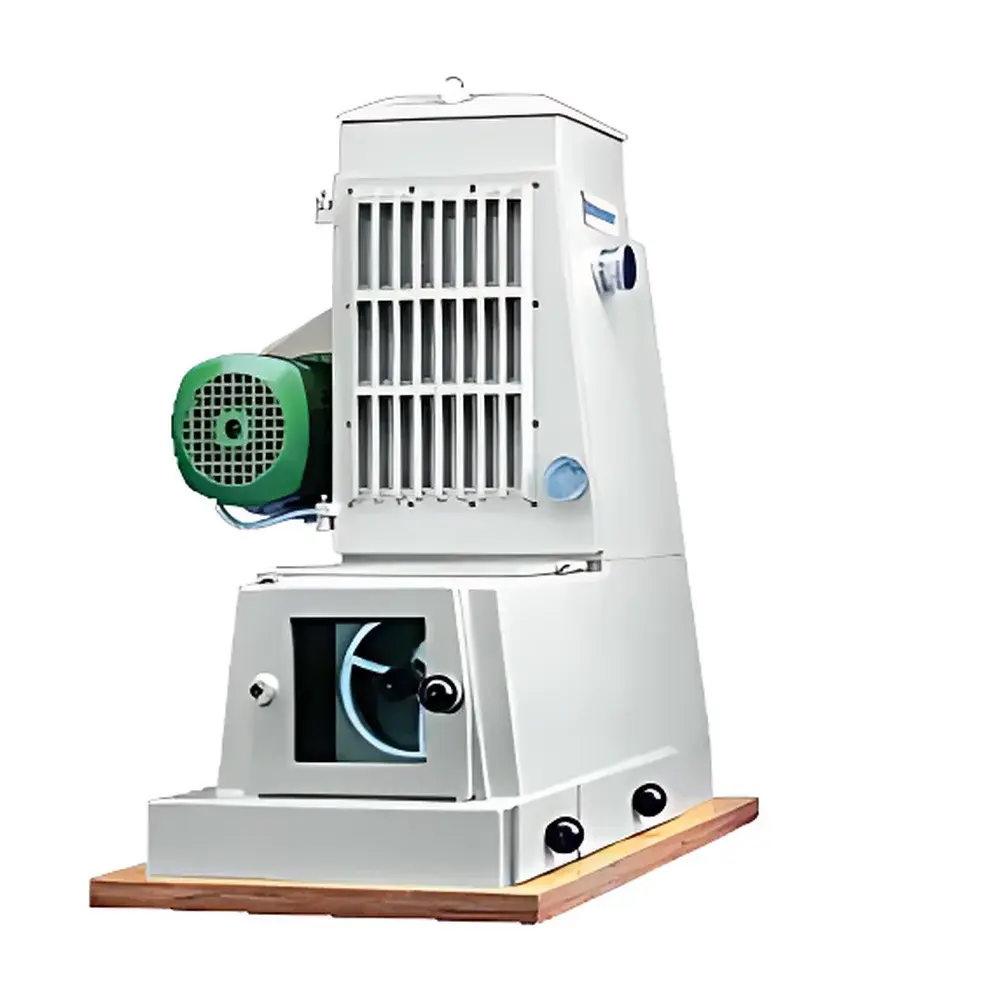
Brabender Quadrumat Junior Laboratory Mill
| Brand | Brabender |
|---|---|
| Origin | Germany |
| Model | Quadrumat Junior |
| Application | Small-scale flour milling for analytical quality testing |
| Compliance | Designed to replicate industrial roller milling principles in a benchtop format |
| Feed Capacity | Adjustable via gravity-fed hopper with precision-controlled inlet gap |
| Grinding System | Four-roller configuration (2-break + 1-heart) with integrated roll geometry and sequential pass-through architecture |
| Sieving | Rotating cylindrical sieve with variable peripheral speed for self-cleaning operation |
| Output Collection | Dual-compartment drawer system (flour and bran separation) |
| Sample Throughput | 100–300 g per run (typical wheat grain) |
| Roller Diameter | ≤80 mm (enabling short residence time and controlled shear) |
| Material Contact Surfaces | Food-grade stainless steel (DIN 1.4301/EN 10088-1 compliant) |
Overview
The Brabender Quadrumat Junior is a compact, benchtop laboratory roller mill engineered to replicate the fundamental mechanical and rheological principles of industrial four-roller milling systems within a controlled analytical environment. Unlike impact or disc mills, it employs a true sequential roller grinding process—based on differential roll speeds, precise gap adjustment, and defined roll surface geometries—to simulate commercial break and heart passages. This enables physicochemical separation of endosperm from bran layers under conditions that preserve particle integrity and minimize starch damage. The device operates on the principle of controlled compression-shear deformation, where grain kernels undergo progressive size reduction across three functional zones: first break (coarse debranning), second break (refined endosperm liberation), and heart passage (fine flour production). Its design adheres to the core tenets of modern milling science: short residence time, minimal thermal load, and optimized roll-to-roll interaction—all critical for generating representative flour samples for downstream analysis.
Key Features
- Four-roller configuration with shared intermediate roll: The second roll of the first break station serves simultaneously as the first roll of the second break, ensuring continuity of material flow without intermediate sieving—mimicking continuous industrial flow sheets.
- Adjustable feed inlet gap: Enables precise control over sample introduction rate and initial kernel orientation, critical for reproducible debranning efficiency across varying moisture contents and hardness profiles.
- Integrated cylindrical sieve with variable peripheral speed: Automatically adapts rotational velocity to maintain optimal self-cleaning performance during extended runs; prevents screen blinding and ensures consistent flour extraction efficiency.
- Food-grade stainless steel contact surfaces: Compliant with DIN 1.4301 (AISI 304 equivalent), meeting EU Regulation (EC) No 1935/2004 requirements for food contact materials.
- Modular drawer system: Separately collects flour (upper drawer) and bran (lower drawer) with calibrated volume markings for direct yield calculation (extraction rate, ash content correlation).
- Benchtop footprint (<600 × 400 × 500 mm): Designed for integration into ISO/IEC 17025-accredited laboratories with limited floor space, yet maintains full traceability of operational parameters (gap settings, roll speed ratios, sieve speed).
Sample Compatibility & Compliance
The Quadrumat Junior processes whole cereal grains—including wheat, rye, spelt, and durum—with moisture contents ranging from 12% to 15.5% (wb). It accommodates both soft and hard cultivars without hardware modification, provided kernel size distribution falls within ISO 712:2017 specifications for cereals. All milling outputs comply with ASTM D6340–22 (Standard Practice for Preparation of Cereal Flour Samples for Analytical Testing) and support method validation per AACC International Approved Methods 26–10.02 (Millability Test) and 26–21.02 (Flour Yield Determination). The system supports GLP-compliant documentation when paired with Brabender’s optional LabSoft data acquisition module, enabling audit-ready records of gap settings, run duration, and sieve speed—fully traceable to individual sample IDs.
Software & Data Management
While the Quadrumat Junior operates as a stand-alone mechanical system, its parameter settings (inlet gap, roll speed ratio, sieve speed) are fully documentable via Brabender LabSoft v5.x software suite. When connected via RS-232 or USB interface, LabSoft logs timestamped operational metadata, supports electronic signature workflows per FDA 21 CFR Part 11, and exports structured CSV reports compatible with LIMS environments. Calibration certificates for gap-setting dials and sieve speed encoders are issued annually per ISO/IEC 17025:2017 clause 6.5.2, ensuring metrological traceability to national standards (e.g., PTB Germany).
Applications
- Pre-breeding evaluation of wheat lines: Rapid assessment of milling yield, flour ash, and particle size distribution to inform selection decisions prior to field-scale trials.
- Quality assurance in flour mills: Benchmarking incoming grain lots against reference standards using identical milling physics—not just empirical correlations.
- Regulatory compliance testing: Generating test flours for mandatory parameters including protein content (ISO 20483), falling number (ISO 2014), and dough rheology (ISO 21415-1).
- Research into grain hardness–millability relationships: Controlled variation of roll gap and speed ratio allows systematic study of fracture mechanics in relation to SKCS or NIR hardness indices.
- Method development for novel cereals: Adapting milling protocols for ancient grains (e.g., einkorn, emmer) where conventional mill settings produce excessive bran fragmentation.
FAQ
Does the Quadrumat Junior require external compressed air or hydraulic power?
No—it operates solely on single-phase 230 V AC power; all motion transmission is mechanical via precision-ground gear trains.
Can it be used for gluten-free cereals such as rice or sorghum?
Yes, provided grain moisture is adjusted to 13–14% (wb) and inlet gap is reduced by 0.1–0.2 mm relative to wheat settings to compensate for lower kernel density.
Is calibration of the roller gap traceable to an accredited body?
Yes—Brabender provides factory calibration certificates (DAkkS-accredited for gap measurement uncertainty ≤ ±2 µm) with each unit shipment.
How frequently must the cylindrical sieve be replaced?
Under normal use (≤200 runs/year), the stainless-steel sieve exhibits no measurable wear; replacement is recommended only after visual inspection reveals >3% perforation deformation per ISO 3310-1:2016 Annex B.
Does the system meet requirements for ISO/IEC 17025 accreditation?
Yes—when operated with documented SOPs, calibrated tools, and LabSoft audit trails, it satisfies ISO/IEC 17025:2017 clauses 6.4.1 (equipment suitability) and 7.2.2 (method validation).