
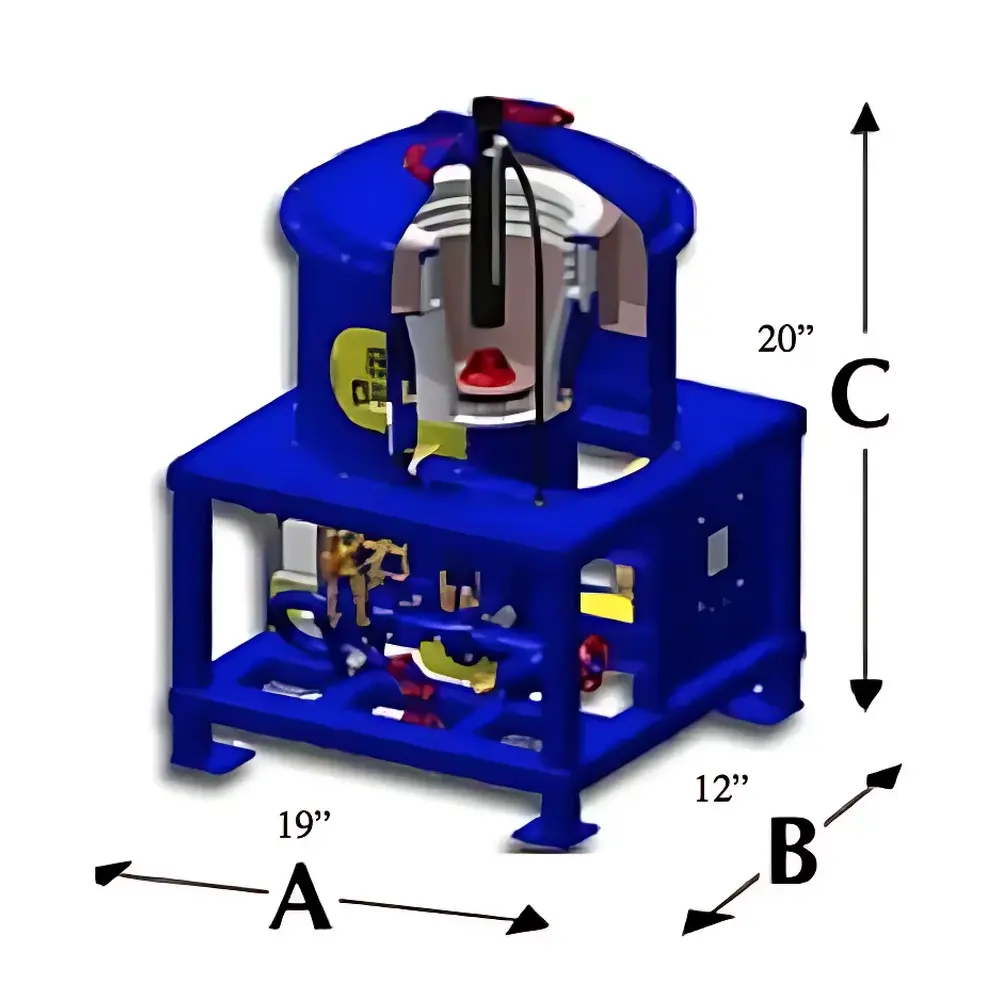
SB Superbowl Batch Laboratory Centrifugal Concentrator
| Origin | USA |
|---|---|
| Manufacturer Type | Authorized Distributor |
| Origin Category | Imported |
| Model | 050L-100 / 050L-110 / 050L-005 |
| Capacity | 0.3 tph (slurry) |
| Feed Rate | 10–135 GPM |
| Gravitational Force Range | 50–300 × g |
| Motor Power | 0.5 HP |
| Water Requirement | 1–5 GPM |
| Weight | 81–6400 lb |
| Bowl ID | 4 in (050L-100), 12 in (050L-005), 38 in (050L-110) |
| Construction | Stainless steel rotor with UHMW polyethylene wear-resistant bowl liner |
| Drive | Variable-speed AC motor |
| Discharge | Automated spray manifold flush system |
Overview
The SB Superbowl Batch Laboratory Centrifugal Concentrator is an engineered gravity-based mineral separation device designed for high-selectivity recovery of free-native precious metals—including gold (Au), silver (Ag), and platinum group elements (PGEs)—from fine- to coarse-grained slurries. Operating on the principle of enhanced centrifugal sedimentation combined with controlled fluidized bed dynamics, the SB concentrator generates gravitational forces up to 300 × g to accelerate particle settling while maintaining differential migration pathways within a stratified, shallow-slope concentrate bed. Unlike continuous feed hydrocyclones or spiral concentrators, the SB employs a semi-batch process: slurry is introduced until the concentrate bed reaches optimal height; feed is then halted, rotation decelerated, and the accumulated heavy fraction flushed from beneath the rotor baffle via an integrated spray manifold. This methodology ensures maximal grade enhancement—commonly achieving 3% Au or higher—while accepting inherently low mass recovery (<1%), a trade-off intrinsic to high-grade gravity concentration targeting liberated metallic particles.
Key Features
- Centrifugally stabilized fluidized bed architecture with adjustable slope and retention time control
- UHMW polyethylene bowl liner for abrasion resistance against feed solids up to 6 mm nominal size
- Variable-speed AC drive enabling precise tuning of gravitational force (50–300 × g) for optimized recovery across particle size distributions
- Automated post-cycle concentrate discharge using pressurized water spray manifold beneath rotor baffle
- Stainless steel structural frame and rotating assembly compliant with ASME BPE and ISO 8573-1 for cleanability and corrosion resistance
- Modular sizing platform: 4″ (050L-100), 12″ (050L-005), and 38″ (050L-110) bowl diameters support laboratory-scale feasibility testing through pilot-scale throughput validation
Sample Compatibility & Compliance
The SB concentrator accepts slurries with solids concentrations ranging from 5–30% w/w and particle size distributions spanning 10 µm to 6 mm. It is particularly effective for recovering free-milling native metals where liberation exceeds 80%—a prerequisite validated by standard liberation analysis (e.g., QEMSCAN or MLA). Feed streams must be deslimed below ~38 µm to prevent bed blinding; optional pre-screening or hydrocyclone classification is recommended. The unit complies with OSHA 1910.212 machine guarding standards and meets CE machinery directive requirements when installed with appropriate local electrical certification. For GLP/GMP-aligned laboratories, the semi-batch operational protocol supports full traceability of feed mass, cycle duration, flush volume, and concentrate mass—enabling audit-ready documentation per FDA 21 CFR Part 11 when paired with validated electronic lab notebook (ELN) integration.
Software & Data Management
While the base SB model operates via analog speed control and manual cycle timing, optional digital instrumentation packages include programmable logic controller (PLC)-based cycle sequencing, real-time RPM and feed flow monitoring (via pulse-output flow meters), and data logging to SD card or Modbus TCP interface. Logged parameters include total cycle time, deceleration profile, flush duration, and estimated concentrate yield based on volumetric displacement calibration. All firmware adheres to IEC 61508 SIL 2 functional safety principles. Exported CSV logs are compatible with LIMS platforms (e.g., LabWare, Thermo Fisher SampleManager) and support statistical process control (SPC) charting per ASTM E2587 for repeatability assessment across ≥30 consecutive cycles.
Applications
- Feasibility-stage evaluation of gravity-recoverable gold (GRG) content in exploration drill core composites
- Optimization of grind size versus concentrate grade trade-offs in metallurgical testwork programs
- Verification of upstream comminution and liberation efficiency prior to cyanidation or leach circuit design
- Recovery of coarse placer gold from alluvial wash plant tailings for environmental remediation audits
- Separation of Pt/Pd-rich fractions from spent automotive catalyst leach residues
- Academic research into particle segregation mechanics under hypergravity conditions (≥200 × g)
FAQ
What is the minimum detectable particle size recoverable by the SB concentrator?
Particles as fine as 10 µm can be consistently recovered when fully liberated and density-differentiated (>12 g/cm³ vs. gangue <3 g/cm³), provided feed rheology and slurry viscosity remain within specified limits (η < 15 cP at shear rate 100 s⁻¹).
Can the SB handle abrasive silica sand or crushed quartz feed?
Yes—UHMW liner wear rates are characterized per ASTM G65 and typically sustain >1,200 operating hours under 25% quartz feed at 15% solids, assuming consistent 1–3 GPM backflush water quality (≤5 NTU turbidity, <0.1 ppm Fe).
Is operator training required for routine operation?
A two-hour competency session covering feed preparation, cycle timing, flush pressure calibration, and routine liner inspection is recommended; no certified instrumentation technician credentialing is required.
How is concentrate grade verified post-recovery?
Standard practice involves fire assay (ASTM E1335) or ICP-MS (ASTM D5685) on homogenized, split concentrate samples—mass balance reconciliation is performed against total feed assay and tailings assay per ISO 11323.
Does the SB comply with EPA Method 1669 for precious metal recovery reporting?
While the SB itself is not a regulatory method, its output data (feed mass, concentrate mass, assay results) satisfies the mass-balance and documentation requirements of EPA Method 1669 when operated under documented SOPs with chain-of-custody records.




