
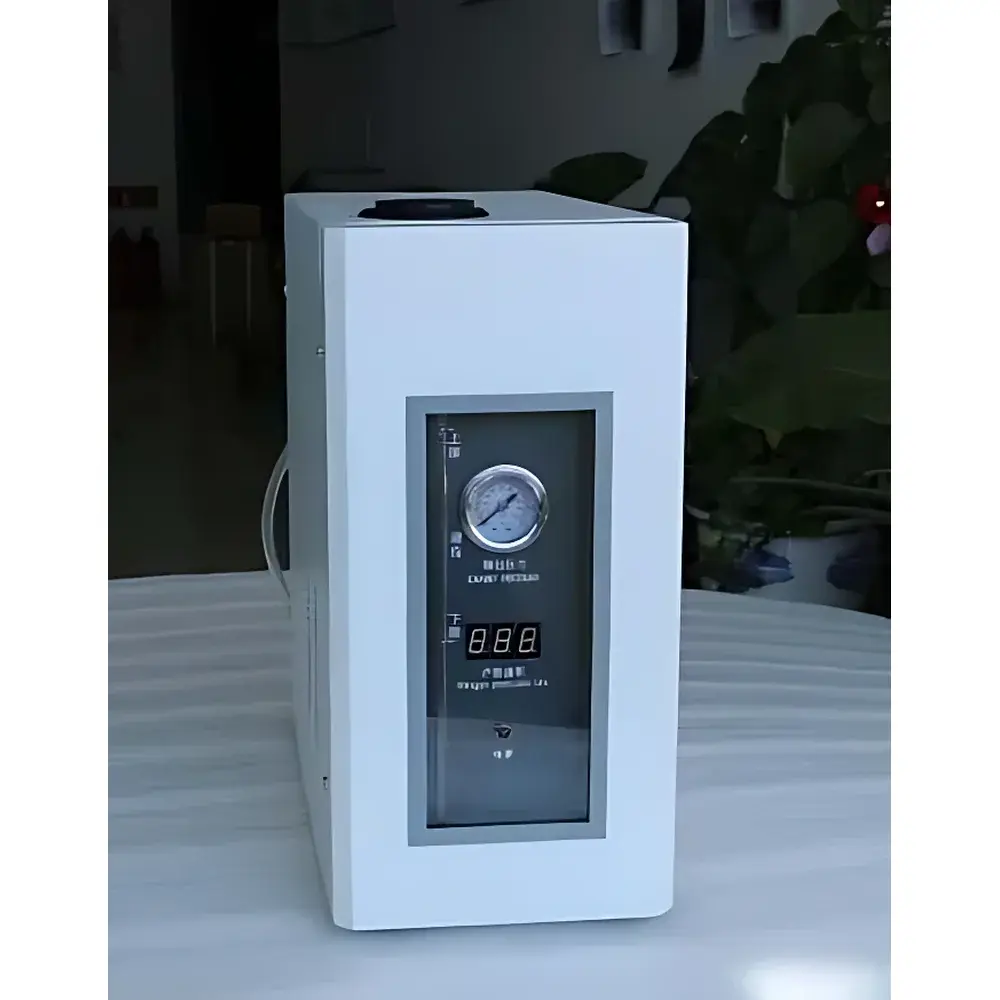
Lunan Ruihong RHN-300 (RHN-500) High-Purity Nitrogen Generator
| Brand | Lunan Ruihong |
|---|---|
| Origin | Shandong, China |
| Model | RHN-300 (RHN-500) |
| Nitrogen Generation Principle | Electrolytic Membrane Separation |
| Output Flow Rate | 0–300 mL/min (RHN-300) |
| Output Pressure | 0.4 MPa |
| Nitrogen Purity | 99.996% (v/v, O₂-equivalent basis) |
| Dew Point | ≤ –40 °C (typical, at output pressure) |
| Input Air Pressure | 0.5 MPa |
| Power Supply | 220 V AC, 50 Hz |
| Power Consumption | 80 W |
| Dimensions (L×W×H) | 420 × 180 × 380 mm |
| Weight | ~14 kg (RHN-300) |
Overview
The Lunan Ruihong RHN-300 and RHN-500 are benchtop electrolytic nitrogen generators engineered for continuous, on-demand supply of high-purity nitrogen gas in analytical laboratories and quality control environments. These instruments utilize proton exchange membrane (PEM) electrolysis technology to separate nitrogen from compressed air feedstock—eliminating reliance on high-pressure cylinders or liquid nitrogen dewars. The core process involves selective electrochemical dissociation of water vapor present in the compressed air stream, followed by catalytic recombination and membrane-based separation to yield nitrogen with ≤4 ppm residual oxygen (equivalent to 99.996% purity). This principle ensures stable, low-oxygen output suitable for sensitive applications including gas chromatography (GC) carrier gas, LC-MS purge gas, and inert atmosphere purging in sample preparation workflows. Designed for uninterrupted operation under ambient conditions (10–40 °C, <85% RH), the system integrates thermal management to maintain consistent electrolyzer temperature, directly contributing to long-term stability and extended membrane service life.
Key Features
- Electrolytic PEM-based nitrogen generation—no consumables, no moving parts in the separation module
- Dual-model scalability: RHN-300 (0–300 mL/min) and RHN-500 (0–500 mL/min) support flexible throughput requirements
- Integrated 10-minute automatic purge cycle at startup to rapidly achieve target purity
- Anti-backflow design prevents condensate or moisture migration into the electrolysis cell, enhancing reliability and reducing maintenance intervals
- Low power consumption (80 W) and compact footprint (420 × 180 × 380 mm) enable deployment in space-constrained lab benches or instrument carts
- Stable 0.4 MPa regulated output pressure compatible with standard GC inlet modules and pneumatic actuators
- Robust aluminum-alloy chassis and sealed electronics housing provide resistance to ambient particulate and non-aggressive vapors
Sample Compatibility & Compliance
The RHN-300/RHN-500 is intended for use with clean, oil-free, desiccated compressed air feed (input pressure: 0.5 MPa, ISO 8573-1 Class 2:2:2 compliant). It is not designed for direct ambient air intake. While the generator itself does not carry CE, UL, or UKCA certification, its operational parameters align with common laboratory safety expectations for low-voltage (<60 V DC internal circuitry), low-energy gas supply systems. Nitrogen output meets ASTM D6866-22 specifications for trace oxygen content in carrier gases used in chromatographic analysis. For GLP/GMP-regulated environments, users may configure external data logging and integrate the unit into facility-wide audit trails via analog pressure/flow monitoring interfaces (optional).
Software & Data Management
These models operate as standalone hardware units without embedded microprocessor control or digital connectivity. All operational parameters—including flow rate, pressure, and purity—are maintained passively through calibrated regulators, pressure relief valves, and fixed-membrane permeation characteristics. No firmware, touchscreen interface, or remote monitoring capability is included. For laboratories requiring electronic recordkeeping, third-party flow meters (e.g., Brooks 5850E) or pressure transducers can be installed downstream and linked to LIMS or ELN platforms. The absence of software simplifies validation protocols and reduces cybersecurity exposure in regulated settings where FDA 21 CFR Part 11 compliance is required for electronic records.
Applications
- Carrier gas source for capillary gas chromatography (GC), including FID, TCD, and ECD detectors
- Purge gas for electrospray ionization (ESI) sources in LC-MS systems
- Inert blanketing during solvent evaporation, solid-phase extraction (SPE), and vial crimping
- Zero-air generation support when paired with catalytic oxidizers for calibration gas standards
- Backup nitrogen supply for gloveboxes and small-scale reaction vessels requiring <100 ppm O₂ environments
- Research labs performing catalyst testing, polymer synthesis, or battery material handling where cylinder logistics are impractical
FAQ
What compressed air quality is required for optimal performance?
Clean, oil-free, and desiccated air meeting ISO 8573-1 Class 2:2:2 (≤0.1 µm particles, ≤0.1 mg/m³ oil aerosol, dew point ≤ –40 °C) is mandatory. Failure to meet this specification will accelerate membrane fouling and reduce nitrogen purity.
Can the RHN-300 be used as a carrier gas for GC-MS systems?
Yes—provided the system’s oxygen content remains ≤4 ppm and hydrocarbon contaminants are removed upstream via activated carbon filtration; users should verify compatibility with their specific MS detector manufacturer’s carrier gas specifications.
Is routine maintenance required beyond filter replacement?
Yes: coalescing and desiccant pre-filters must be replaced every 6–12 months depending on air quality; the PEM stack has a typical service life of 15,000–20,000 operating hours under nominal load.
Does the generator include pressure regulation for variable-flow applications?
Yes—the integrated pressure regulator maintains a constant 0.4 MPa output across the full flow range (0–300 or 0–500 mL/min), ensuring compatibility with pressure-sensitive GC inlets.
How is nitrogen purity verified during operation?
Purity is determined by residual oxygen concentration, measured offline using calibrated electrochemical O₂ analyzers (e.g., Michell XDT-100); real-time monitoring requires optional integration of an inline paramagnetic or zirconia-based sensor.



