
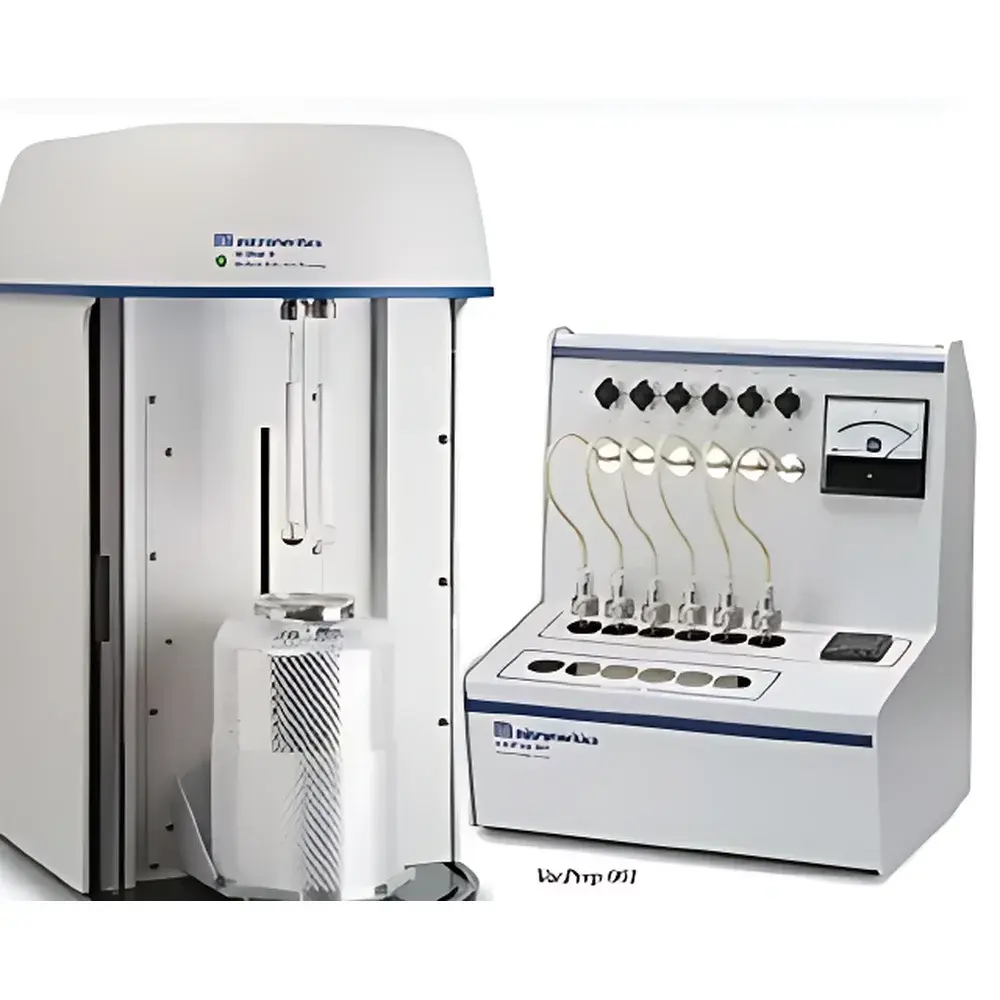
Micromeritics TriStar II 3020 Automated Surface Area and Porosity Analyzer
| Origin | USA |
|---|---|
| Manufacturer Type | Authorized Distributor |
| Origin Category | Imported Instrument |
| Model | TriStar II 3020 Series |
| Pricing | Available Upon Request |
Overview
The Micromeritics TriStar II 3020 is a fully automated, three-station gas adsorption analyzer engineered for high-precision determination of specific surface area (SSA), pore volume, pore size distribution (PSD), and porosity across micro-, meso-, and macroporous materials. Based on the physical principle of gas adsorption—primarily nitrogen at 77 K—the instrument implements volumetric (manometric) measurement methodology in accordance with ISO 9277, ASTM D3663, and IUPAC recommendations. Each analysis station operates independently with dedicated pressure transducers, temperature-controlled manifolds, and real-time vacuum monitoring, enabling true parallel acquisition—not sequential or “queue-based” operation. The system supports both adsorption and desorption isotherm generation over a relative pressure (P/P₀) range from 10⁻⁶ to 0.995, delivering reproducible data for BET surface area, Langmuir modeling, and advanced pore structural characterization.
Key Features
- Three independent analysis stations with simultaneous, non-interfering operation—BET surface area analysis for all three samples completed in under 20 minutes
- Dedicated P₀ (saturation pressure) port with automatic vapor pressure tracking; compatible with multiple Dewar flask sizes (including high-capacity 4 L options) and standardized sample tubes (6 mm and 9 mm OD)
- Upgradeable high-vacuum configuration (<1 × 10⁻⁴ Torr base pressure) for low-surface-area materials (e.g., dense ceramics, metals) and rigorous micropore analysis
- Flexible free-space calibration: automated helium pycnometry, user-defined geometric volume input, or manual entry—no mandatory helium dependency for dead-volume determination
- Integrated cryogenic temperature stabilization: patented Isothermal Jacket maintains consistent 77 K conditions below the jacket throughout extended runs, eliminating liquid nitrogen level drift artifacts
- Extended unattended operation: 4 L Dewar + Isothermal Jacket enables ≥60 hours of continuous analysis without operator intervention
Sample Compatibility & Compliance
The TriStar II 3020 accommodates powders, granules, monoliths, foams, fibers, and coated substrates—including pharmaceutical excipients, catalyst supports, battery electrode materials, aerogels, medical implants, and nanomaterials such as CNTs and MOFs. Sample mass range spans 10 mg to 2 g depending on expected surface area and pore architecture. All hardware and software modules comply with GLP and GMP documentation requirements. Optional 21 CFR Part 11-compliant software (Confirm™) provides electronic signatures, audit trails, role-based access control, and immutable data archiving—validated through IQ/OQ protocols traceable to NIST standards. System performance verification adheres to ISO/IEC 17025 guidelines for testing laboratories.
Software & Data Management
The included TriStar II Software Suite integrates over 25 standardized evaluation models and calculation methods. These include single- and multi-point BET, Langmuir, Temkin, and Freundlich isotherm fitting; BJH, DH, and Dollimore-Heal pore size distribution for mesopores; MP, t-plot, αs-plot, and f-ratio analyses for micropore quantification; DFT/NLDFT kernel libraries (carbon slit-pore, silica cylindrical, alumina spherical models); and D-R, D-A, and HK methods with Cheng & Yang and Saito & Foley corrections. Raw isotherm data are stored in ASTM E1319-compliant .csv and proprietary .ads formats. Batch processing, report templating (PDF/Excel), and metadata tagging support regulatory submission workflows. Data integrity is enforced via time-stamped, version-controlled method files and encrypted project archives.
Applications
This instrument serves core R&D and QC functions across regulated and industrial sectors: catalyst activity prediction via surface accessibility metrics; formulation optimization of inhalable drug carriers using pore confinement effects; quality assurance of activated carbon and zeolites in environmental remediation; thermal barrier coating characterization in aerospace; pore network modeling for PEM fuel cell membranes; and structural stability assessment of sol-gel derived oxides in electronics packaging. It is routinely deployed for ASTM D4641 (carbon black surface area), USP (pharmaceutical porous excipients), and ISO 15901-2 (mercury intrusion vs. gas adsorption correlation).
FAQ
Does the TriStar II 3020 require helium for dead-volume calibration?
No—free space can be determined via automated helium pycnometry, geometric estimation, or manual input. Helium is optional, not mandatory.
Can the system analyze materials with very low surface area (<1 m²/g)?
Yes—when equipped with the high-vacuum upgrade kit and appropriate transducers, detection limits extend down to ~0.01 m²/g with enhanced signal-to-noise ratio.
Is DFT modeling validated against reference standards?
Yes—Micromeritics provides certified reference materials (CRMs) with NIST-traceable surface area and pore structure data for method validation and instrument qualification.
What is the maximum duration for unattended operation?
With a 4 L Dewar and active Isothermal Jacket, uninterrupted analysis exceeds 60 hours—sufficient for overnight and weekend runs without manual refills.
Are IQ/OQ services available globally?
Yes—Micromeritics-certified field engineers perform installation qualification (IQ) and operational qualification (OQ) on-site, generating compliant documentation packages for FDA, EMA, and PMDA submissions.





