
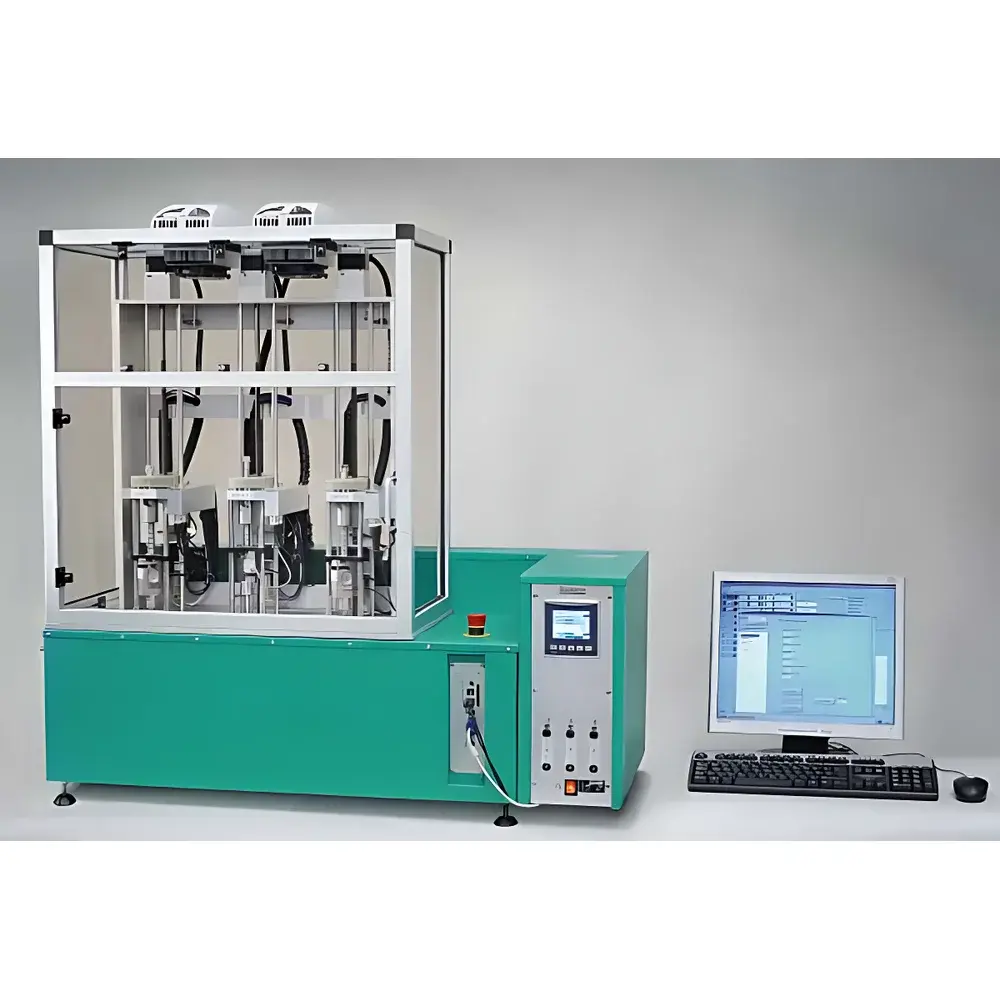
Elastocon EB18-II Automated Stress Relaxation and Creep Tester
| Brand | Elastocon |
|---|---|
| Origin | Sweden |
| Model | EB18-II |
| Compliance | ISO 3384, ISO 6914 (stress relaxation) |
| Test Stations | 3 independent |
| Temperature Range | 40–300 °C |
| Temp Control Accuracy | ±0.5 °C (40–200 °C), ±1.0 °C (200–300 °C) |
| Temp Uniformity | ±0.25 °C |
| Temperature Sensors | Pt 100, 1/3 DIN class, 3 units |
| Oven Chambers | 3 separate |
| Airflow Velocity | <0.001 m/s |
| Air Exchange Rate | 3 cycles/hour |
| Load Cell Options | 0–100 N, 0–500 N, or 0–1500 N (standard: 0–1000 N) |
| Force Resolution | 0.1 N (0.01 N with 100 N tensile-optimized sensor) |
| Displacement Resolution | 0.0001 mm |
| Crosshead Speed | 0.1–200 mm/min |
| Compression Platen Diameter | 50 mm |
| Test Fixture Material | Stainless steel or aluminum alloy |
| Chamber Construction | Painted steel |
Overview
The Elastocon EB18-II is a precision-engineered, fully automated stress relaxation and creep testing system designed for high-reproducibility viscoelastic characterization of polymeric, elastomeric, and thermoplastic materials under controlled thermal conditions. Based on the fundamental principles of time-dependent mechanical response—where stress decay at constant strain (relaxation) and strain accumulation under constant load (creep) are quantified—the EB18-II implements standardized uniaxial compression methodology in accordance with ISO 3384, ISO 6914 (stress relaxation), and ISO 8013, ISO 899 (creep). Its tri-station architecture enables parallel, independently programmable tests across identical or divergent thermal and mechanical profiles—critical for comparative studies, material lot qualification, and accelerated aging protocols. The system’s core design emphasizes thermal stability, mechanical isolation, and metrological traceability, making it suitable for R&D laboratories, quality control departments, and regulatory-compliant environments requiring GLP/GMP-aligned documentation.
Key Features
- Three fully independent test stations housed in thermally isolated, individually controlled ovens—enabling concurrent multi-condition experiments without cross-talk.
- Precision temperature control from 40 °C to 300 °C, with dual-stage accuracy specification: ±0.5 °C between 40–200 °C and ±1.0 °C between 200–300 °C; chamber uniformity maintained within ±0.25 °C via calibrated Pt 100 sensors (1/3 DIN class).
- Ultra-low convection environment (<0.001 m/s airflow, 3 air exchanges/hour) minimizes convective heat transfer artifacts and ensures true isothermal sample exposure.
- Modular load cell configuration: standard 0–1000 N capacity with 0.1 N resolution; optional high-sensitivity 100 N transducer delivers 0.01 N resolution for low-force elastomer testing.
- Sub-micron displacement resolution (0.0001 mm) coupled with programmable crosshead speed (0.1–200 mm/min) supports both quasi-static and dynamic creep/relaxation ramping protocols.
- Stainless steel or anodized aluminum test fixtures—including 50 mm diameter compression platens—ensure corrosion resistance, dimensional stability, and compatibility with ISO-standard specimen geometries.
Sample Compatibility & Compliance
The EB18-II accommodates standard cylindrical or prismatic specimens per ISO 3384, ISO 8013, and ASTM D2990 (adapted via fixture alignment). It supports materials ranging from soft silicone gels (requiring low-load, high-resolution sensing) to semi-crystalline engineering thermoplastics (demanding elevated-temperature stability up to 300 °C). All thermal chambers meet ISO 291 conditioning requirements for environmental control during mechanical testing. The system’s architecture and calibration traceability align with ISO/IEC 17025 requirements for testing laboratories. When integrated with validated software workflows, test execution and data reporting can support FDA 21 CFR Part 11 compliance for electronic records and signatures in regulated industries.
Software & Data Management
The EB18-II operates under Elastocon’s proprietary Windows-based control and analysis suite, which provides real-time force/displacement/temperature monitoring, multi-channel synchronized data acquisition (≥1 kHz sampling), and automated calculation of key viscoelastic parameters—including relaxation modulus E(t), creep compliance J(t), and time–temperature superposition (TTS) master curves. Raw data export is supported in CSV, ASCII, and universal HDF5 formats for third-party analysis (e.g., MATLAB, Python SciPy, or commercial rheology modeling tools). Audit trails, user access levels, and electronic signature capability are configurable to meet GLP and GMP documentation standards. Calibration certificates for load cells and temperature sensors are stored digitally with version-controlled metadata.
Applications
- Quantifying long-term compressive set and recovery behavior of sealing compounds and O-rings per ISO 3384.
- Evaluating thermally induced creep deformation in automotive under-hood polymers exposed to sustained loads at 150–250 °C.
- Generating time–temperature shift factors for predictive lifetime modeling of medical-grade silicones under physiological loading.
- Comparative assessment of crosslink density effects on relaxation kinetics across vulcanized rubber formulations.
- Supporting ISO 10993-1 biocompatibility evaluations where mechanical stability under static compression is required.
FAQ
Can the EB18-II perform both stress relaxation and creep tests in a single run?
No—each test station executes one defined protocol per test sequence. However, three independent tests (e.g., two creep + one relaxation) may run simultaneously across stations.
Is calibration of temperature and force sensors performed in-house or by an accredited lab?
Factory calibration is performed using NIST-traceable references; end-user periodic verification follows ISO 17025 procedures, and Elastocon-certified service engineers provide on-site recalibration with full certificate documentation.
Does the system support custom test profiles beyond ISO-defined durations?
Yes—users define arbitrary time–load–temperature sequences, including stepwise ramps, dwell periods, and conditional termination triggers (e.g., strain threshold or time limit).
What maintenance intervals are recommended for long-term reliability?
Preventive maintenance is advised every 12 months or after 2,000 test hours, including thermal chamber seal inspection, load cell zero-drift verification, and motion system lubrication per OEM specifications.
Are test fixtures interchangeable between different Elastocon models?
EB18-II fixtures are mechanically and electronically compatible with EB18-I and EB18-III platforms, enabling seamless method transfer and fleet-wide standardization.





