
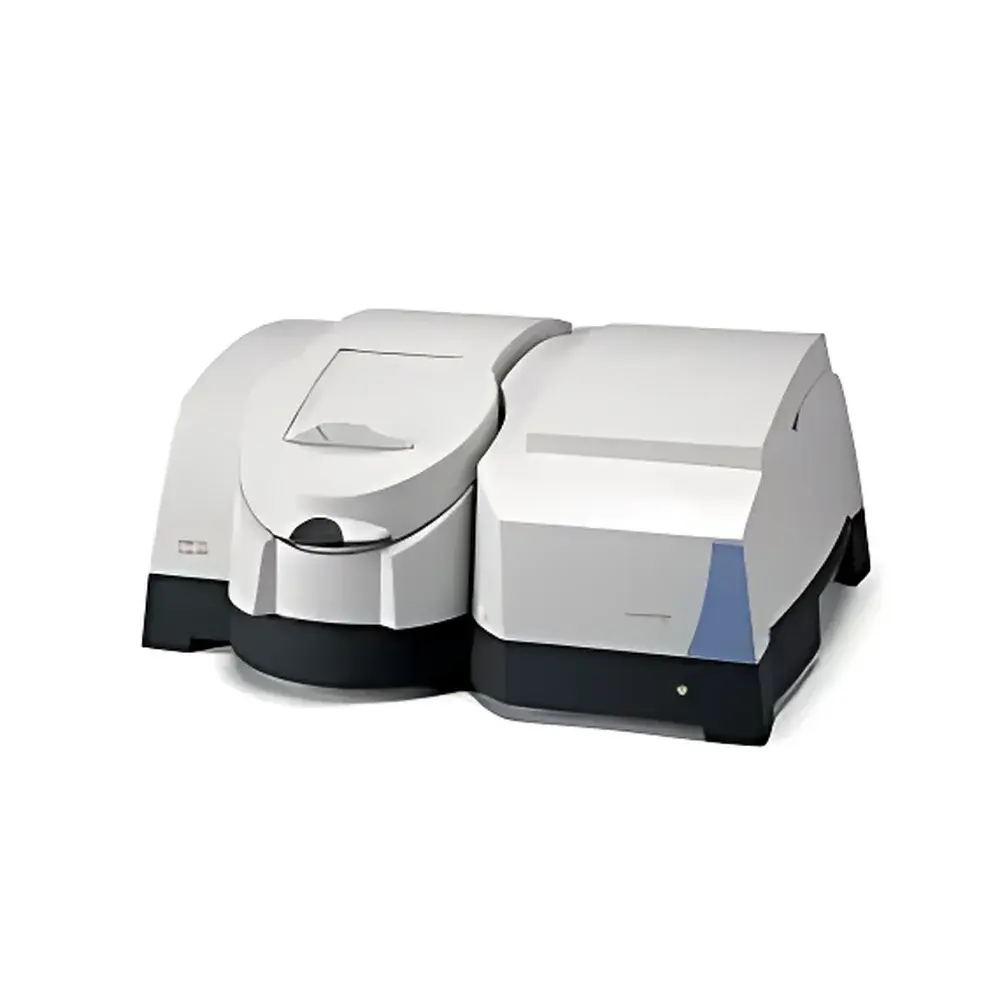
Thermo Scientific Evolution 350 UV-Vis Spectrophotometer
| Origin | USA |
|---|---|
| Manufacturer Type | Authorized Distributor |
| Origin Category | Imported Instrument |
| Model | 350 |
| Price Range | USD 13,500–20,500 (FOB) |
| Optical Design | Double-Beam |
| Detector | Photodiode Array (PDA) |
| Wavelength Range | 190–1100 nm |
| Wavelength Scanning | Motorized Auto-Scan |
| Spectral Bandwidth | Adjustable 0.5–4.0 nm |
| Wavelength Accuracy | ±0.2 nm |
| Stray Light | <0.05% T at 220 nm and 340 nm |
Overview
The Thermo Scientific Evolution 350 UV-Vis Spectrophotometer is a double-beam, photodiode array (PDA)-based instrument engineered for high-fidelity absorbance, transmittance, and reflectance measurements across the ultraviolet, visible, and near-infrared spectral regions (190–1100 nm). It operates on the fundamental principle of Beer–Lambert law-based quantitative spectroscopy, where sample-specific absorption profiles are resolved via dispersion optics and digitized with sub-nanometer wavelength resolution. Designed for laboratories requiring regulatory-compliant performance without compromise, the Evolution 350 integrates thermally stabilized optical pathways, precision stepper-motor-driven monochromators, and real-time beam balancing to ensure measurement reproducibility under variable ambient conditions. Its robust architecture supports uninterrupted operation in QC environments—minimizing downtime associated with recalibration or thermal drift.
Key Features
- Double-beam optical design with real-time reference compensation, eliminating baseline drift caused by lamp intensity fluctuation or detector sensitivity variation.
- High-speed photodiode array detector enabling full-spectrum acquisition in ≤0.1 seconds—critical for kinetic studies and multi-component quantitation.
- Motorized, software-controlled wavelength scanning with programmable slit width adjustment (0.5–4.0 nm), supporting method flexibility across applications from narrow-band trace metal analysis to broad-band polymer characterization.
- Wavelength accuracy certified to ±0.2 nm (traceable to NIST SRM 2034 and 1930a), validated per ASTM E275 and ISO 6425 protocols.
- Stray light performance <0.05% T at 220 nm (KCl solution) and 340 nm (NaNO₂ solution), meeting USP requirements for pharmaceutical assay validation.
- Integrated cuvette autoloader option (up to 12 positions) and fiber-optic probe compatibility for non-contact or flow-cell measurements.
Sample Compatibility & Compliance
The Evolution 350 accommodates standard 10-mm square quartz, glass, or plastic cuvettes; micro-volume adapters (down to 50 µL); integrating spheres for diffuse reflectance; and solid-sample holders for thin-film or powder analysis. All hardware and firmware comply with IEC 61010-1 (safety) and IEC 61326-1 (EMC) standards. When operated with Thermo Scientific INSIGHT software v3.5+, the system supports 21 CFR Part 11-compliant audit trails, electronic signatures, and role-based access control—enabling full GLP/GMP alignment in regulated pharmaceutical, biotechnology, and contract testing laboratories.
Software & Data Management
INSIGHT software provides intuitive method development, automated calibration (including photometric linearity verification per ISO 10992), and customizable reporting templates exportable to PDF, CSV, or XML. Raw spectral data are stored in vendor-neutral .jdx format; processed results include peak integration, derivative spectra, multivariate regression (PLS), and DNA/protein concentration calculators with built-in extinction coefficient libraries. Data integrity is enforced through timestamped metadata, checksum-verified file storage, and optional networked backup to secure NAS or LIMS-integrated repositories.
Applications
- Pharmaceutical: Active pharmaceutical ingredient (API) assay, excipient purity screening, dissolution testing, and stability-indicating methods per ICH Q2(R2).
- Environmental: Nitrate/nitrite, phosphate, and heavy metal (e.g., Cr(VI), Fe²⁺) quantification in wastewater per EPA Methods 353.2 and 365.1.
- Materials Science: Bandgap determination of semiconductors, thin-film thickness modeling, and nanoparticle size estimation via surface plasmon resonance.
- Food & Beverage: Colorimetric quality control (e.g., AOAC 990.17 for anthocyanins), antioxidant capacity (FRAP/TEAC), and ethanol content verification.
- Academic Research: Enzyme kinetics (stopped-flow compatible), ligand-binding stoichiometry, and photochemical reaction monitoring.
FAQ
What regulatory standards does the Evolution 350 meet for pharmaceutical use?
It complies with USP , EP 2.2.25, and ICH Q2(R2) for spectrophotometric method validation—and achieves full 21 CFR Part 11 readiness when paired with INSIGHT software and appropriate IT infrastructure.
Can the instrument perform kinetic measurements?
Yes—its PDA detector enables time-resolved spectral acquisition at up to 10 Hz, supporting enzyme kinetics, reaction progress monitoring, and photochemical decay studies.
Is wavelength calibration traceable to national standards?
Yes—factory calibration uses NIST-traceable holmium oxide and didymium filters; users may perform routine verification using included SRM-certified standards.
Does it support remote operation or integration with laboratory information systems?
Via Ethernet or USB, the Evolution 350 supports OPC UA communication and direct LIMS data push through configurable ODBC drivers and RESTful API endpoints.
What maintenance is required to sustain optical accuracy?
Annual preventive maintenance includes grating alignment verification, lamp output profiling, and detector dark-current characterization—all documented in the service log and aligned with ISO/IEC 17025 technical records requirements.




