
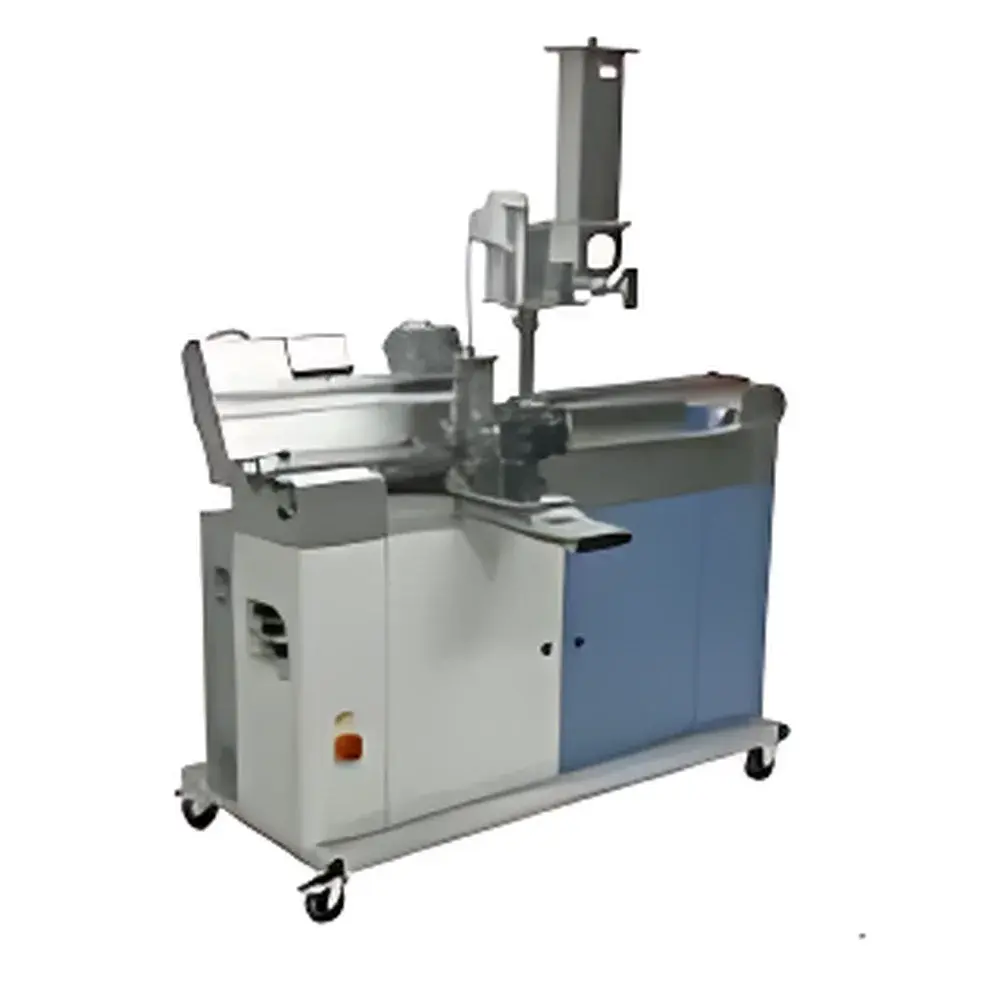
Brabender Plasti-Corder® Lab-Station Torque Rheometer
| Origin | Germany |
|---|---|
| Manufacturer Type | Authorized Distributor |
| Origin Category | Imported |
| Model | Plasti-Corder® Lab-Station |
| Quotation | Upon Request |
| Torque Range | 0–400 N·m |
| Torque Accuracy | ±0.15% of full scale |
| Motor Speed Range | 0.2–350 rpm |
| Speed Accuracy | ±0.2%, closed-loop control |
| Temperature Control Zones | 8–12 independent zones |
| Max Heating Temperature | 500 °C |
| W50EHT Mixer Chamber Volume | ~55 cm³ |
| W50EHT Max Torque | 0–200 N·m |
| Single-Screw Extruder L/D Ratio | 19:1 or 25:1 |
| Max Extrusion Pressure | 700 bar |
| Max Extruder Temp | 450 °C |
| Max Extruder Torque | 150 N·m |
| Die Options | Round (Ø2.0/3.0/4.0 mm), Slit (100 mm × 0–1.5 mm adjustable) |
Overview
The Brabender Plasti-Corder® Lab-Station Torque Rheometer is a high-precision, modular laboratory-scale processing rheometer engineered for real-time, in-situ characterization of thermoplastic polymers and compound formulations under shear, thermal, and mechanical stress conditions that closely replicate industrial extrusion, mixing, and compounding processes. Unlike rotational viscometers or capillary rheometers, the Plasti-Corder operates on the principle of torque-based melt rheology: it measures the resistance torque exerted by molten polymer against counter-rotating rotors (in the W50EHT mixer) or screw elements (in extruders), directly correlating torque magnitude to apparent viscosity, elasticity, and energy dissipation. This enables quantitative assessment of melt flow behavior, thermal degradation onset, shear thinning response, crosslinking kinetics, and filler dispersion efficiency—all within a single, controlled thermal-mechanical cycle.
Key Features
- High-power digital drive system: 16 kW servo motor with closed-loop speed control ensures stable operation across the full range of 0.2–350 rpm, delivering up to 400 N·m nominal torque with ±0.2% speed accuracy—critical for reproducible shear history simulation.
- Multi-zone precision temperature control: Up to 12 independently regulated heating/cooling zones (including rotor shafts, chamber walls, and die blocks) support thermal profiling from ambient to 500 °C with ±0.5 °C stability, enabling ASTM D3835-compliant melt index correlation and thermal stability mapping.
- Modular hardware architecture: Interchangeable processing modules—including the W50EHT twin-rotor mixer (55 cm³ chamber, 0–200 N·m torque), single-screw extruder (L/D 19:1 or 25:1, 700 bar max pressure), and optional twin-screw or specialized downstream units—allow configuration for R&D, formulation screening, or pilot-scale process validation.
- High-fidelity torque transduction: Strain-gauge-based torque sensors calibrated to ±0.15% of full scale (0–400 N·m), integrated with real-time dynamic compensation for inertial and frictional losses, ensure traceable, GLP-compliant rheological data acquisition.
- Robust mechanical design: Cast-iron frame, hardened steel rotors and screws, and corrosion-resistant heating elements ensure long-term dimensional stability and resistance to abrasive fillers (e.g., CaCO₃, glass fiber, carbon black) without calibration drift.
Sample Compatibility & Compliance
The Plasti-Corder Lab-Station accommodates a broad spectrum of polymeric materials—including polyolefins (PP, PE), engineering thermoplastics (PA6, PC, PBT), thermoplastic elastomers (TPEs), biopolymers (PLA, PHA), and filled composites—with sample masses ranging from 30 g (mixer) to continuous feed (extruder). All thermal and mechanical parameters are logged with timestamped metadata compliant with FDA 21 CFR Part 11 requirements when used with Brabender’s WinPC software in audit-trail mode. The system supports method development aligned with ISO 11443 (injection molding simulation), ASTM D2538 (plasticizer migration), and ISO 6721-10 (dynamic mechanical thermal analysis via oscillatory protocols).
Software & Data Management
Control and analysis are executed via Brabender WinPC v7.x, a Windows-based platform offering synchronized acquisition of torque, temperature, pressure, RPM, and power consumption at up to 100 Hz sampling rate. Raw datasets are stored in binary .BRD format with embedded instrument configuration and calibration certificates. Export options include CSV, Excel, and ASCII for integration into LIMS or statistical process control (SPC) platforms. The software includes built-in calculation modules for apparent viscosity (ηapp), specific mechanical energy (SME), power law index (n), and activation energy (Ea) via Arrhenius fitting—enabling direct comparison with production-scale extrusion data.
Applications
- Formulation optimization of polymer blends and masterbatches
- Thermal stability evaluation under processing conditions (e.g., onset of degradation via torque inflection point)
- Shear sensitivity profiling of shear-thinning or shear-thickening systems
- Residence time distribution (RTD) analysis using tracer compounds in extrusion mode
- Quality control of incoming resin lots via standardized mixing curves (e.g., peak torque, equilibrium torque, fusion time)
- Development of reactive extrusion protocols (e.g., grafting, crosslinking, dehydrochlorination)
- Correlation of lab-scale torque profiles with commercial twin-screw extruder output (through SME normalization)
FAQ
What distinguishes torque rheometry from capillary or rotational rheometry?
Torque rheometry captures bulk processing behavior under realistic shear rates and residence times, whereas capillary rheometers measure steady-state viscosity at fixed L/D ratios, and rotational rheometers typically operate at low strains unsuitable for melt fracture or degradation studies.
Can the Plasti-Corder be used for quality assurance in routine production environments?
Yes—its robust construction, automated method recall, and electronic signature support make it suitable for ISO 9001-certified QA labs; many users deploy it for incoming material verification per internal SOPs aligned with ASTM D1238.
Is third-party calibration and traceability available?
Brabender provides NIST-traceable calibration certificates for torque, temperature, and speed sensors, with annual recalibration services adhering to ISO/IEC 17025 standards.
Does the system support GMP-compliant documentation?
When configured with WinPC Audit Trail Mode and networked authentication, it meets EU Annex 11 and FDA Part 11 requirements for electronic records and signatures in pharmaceutical excipient or medical-grade polymer development.
What maintenance intervals are recommended for long-term reliability?
Daily visual inspection of rotor seals and cooling lines; quarterly lubrication of gearboxes; annual torque sensor zero-check and thermal mapping—documented in the included Preventive Maintenance Logbook.



