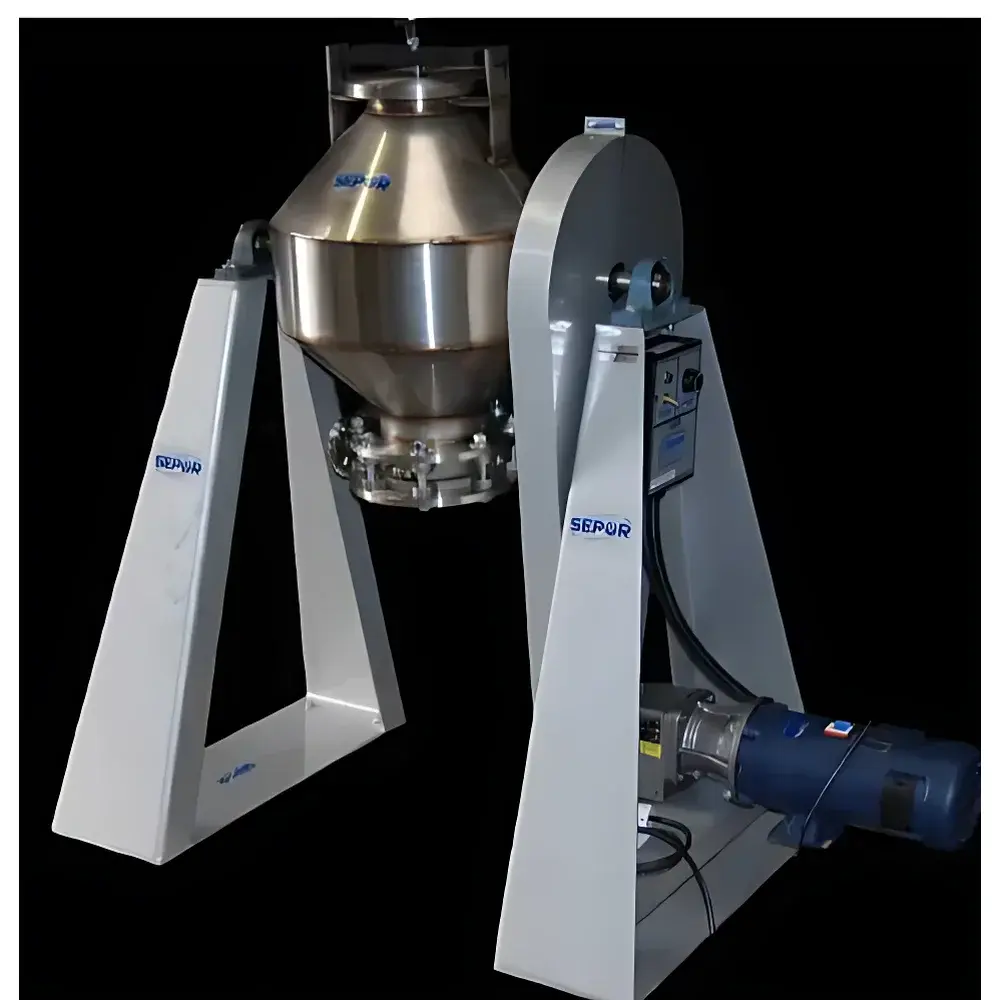
Sepor 080D-010 18-Inch Dual-Conical Tumble Blender
| Origin | USA |
|---|---|
| Manufacturer Type | Authorized Distributor |
| Origin Category | Imported |
| Model | 080D-010 |
| Pricing | Available Upon Request |
Overview
The Sepor 080D-010 is a precision-engineered dual-conical tumble blender designed for gentle, highly reproducible dry and semi-dry powder mixing in laboratory, pilot-scale, and small-batch production environments. Operating on the principle of gravitational convective tumbling, this blender rotates a symmetrical double-cone vessel around a central horizontal axis—inducing controlled particle movement through cascading, rolling, and axial reorientation. The 45° cone angle exceeds the typical angle of repose for most free-flowing solids (30–42°), ensuring continuous material displacement from the apex toward the center cylinder and back—generating three-dimensional diffusion without shear stress or attrition. Unlike high-shear mixers or ribbon blenders, the 080D-010 achieves homogeneity via bulk motion rather than mechanical agitation, preserving particle integrity, minimizing segregation risk, and eliminating over-mixing—a critical advantage for fragile APIs, granules, catalysts, ceramics, and mineral blends.
Key Features
- Dual-conical stainless steel vessel fabricated from ASTM A240 304 stainless steel; all product-contact surfaces electropolished to Ra ≤ 0.4 µm for cleanability and corrosion resistance
- Center cylindrical band with two diametrically opposed, precision-machined trunnion shafts (180° offset) providing rigid rotational support and alignment stability
- Variable-speed AC motor drive with belt-and-pulley transmission and shaft-mounted helical gearmotor (0.75 HP, 1725 RPM nominal)
- Low-profile carbon steel support frame engineered for 18-inch floor clearance—optimized for integration beneath hoods or within confined lab spaces
- Butterfly discharge valve with EPDM gasket and manual handwheel actuation; full-port design ensures rapid, residue-free emptying
- Load-actuated access hatch secured by clamped washers and crossbar assembly—designed for quick opening/closing while maintaining pressure-tight integrity during operation
- Heavy-duty pillow-block bearings with sealed grease fittings; rated for continuous duty at 6–12 rpm (adjustable range)
- Standard electrical configuration: 110 V / 1 Ph / 60 Hz or 220 V / 1 Ph / 50–60 Hz; UL-listed control panel with thermal overload protection and emergency stop
Sample Compatibility & Compliance
The 080D-010 accommodates powders, granules, flakes, and fibrous solids with bulk densities up to 100 lb/ft³ (1600 kg/m³). It is validated for use with pharmaceutical excipients (lactose, microcrystalline cellulose), battery cathode materials (NMC, LFP), food-grade starches and spices, polymer masterbatches, and metallurgical concentrates. All wetted components comply with FDA 21 CFR Part 117 (Current Good Manufacturing Practice for Food) and USP guidelines for equipment qualification. The unit supports GMP-compliant operation when paired with documented cleaning procedures (SOP-based wipe tests), as its smooth internal geometry and absence of dead legs facilitate visual inspection and ATP bioluminescence verification. While not intrinsically rated for hazardous locations, optional ATEX-compliant motors and grounding kits are available upon request.
Software & Data Management
This model operates as a stand-alone mechanical system with analog speed control—no embedded firmware or digital interface. However, it is fully compatible with external process monitoring systems via 4–20 mA tachometer output (optional add-on) or digital pulse encoder (model-specific retrofit). When integrated into a validated manufacturing environment, rotation time, speed setpoint, and batch ID can be logged via PLC-connected HMIs adhering to ISA-88 and ISA-95 standards. Audit trails—including operator login, parameter changes, and cycle completion timestamps—are maintained per FDA 21 CFR Part 11 requirements when interfaced with compliant MES or SCADA platforms. Calibration records for motor speed accuracy (±0.5% full scale) and timer functionality (±0.1 sec) are included in the factory documentation package.
Applications
- Pharmaceutical pre-blending of active pharmaceutical ingredients (APIs) and excipients prior to direct compression or wet granulation
- Mixing of ceramic green bodies and refractory powders where particle size distribution must remain unaltered
- Homogenization of battery electrode slurries’ dry precursors (e.g., LiCoO₂ + conductive carbon + PVDF binder)
- Blending of nutraceutical powders containing heat-sensitive probiotics or enzymes
- Mineral processing labs: combining ore samples for assay reproducibility (ASTM D3740 compliance)
- Food R&D: uniform dispersion of colorants, vitamins, or functional ingredients in dry mixes
- Research-scale formulation development where batch-to-batch consistency is prioritized over throughput
FAQ
What is the working volume of the 080D-010 model?
The nominal working volume is 1.1 ft³ (31 L), calculated at 50% fill level for optimal tumbling dynamics—recommended maximum loading is 100 lb (45.4 kg) for materials with density ≤ 100 lb/ft³.
Can this blender handle abrasive or corrosive materials?
Yes—304 stainless steel construction provides adequate resistance to mild acids, alkalis, and mineral abrasives; for highly chlorinated or HF-containing systems, upgrade to 316L stainless steel is advised.
Is validation documentation provided with shipment?
Yes—each unit ships with Factory Acceptance Test (FAT) report, material certifications (MTRs) for all SS components, and electrical safety certification (ETL or CE-marked equivalents). IQ/OQ protocols are available as optional engineering services.
How long does a typical mixing cycle take?
Uniformity is typically achieved within 8–12 minutes at 8–10 rpm; cycle time optimization requires blend uniformity testing (e.g., NIR spectroscopy or content uniformity assays per USP ).
Does Sepor offer cleaning-in-place (CIP) compatibility?
No—this is a batch tumble blender designed for manual cleaning. However, its fully drainable geometry, smooth welds, and absence of internal agitators simplify SOP-driven wet/dry cleaning and reduce cleaning validation burden.