
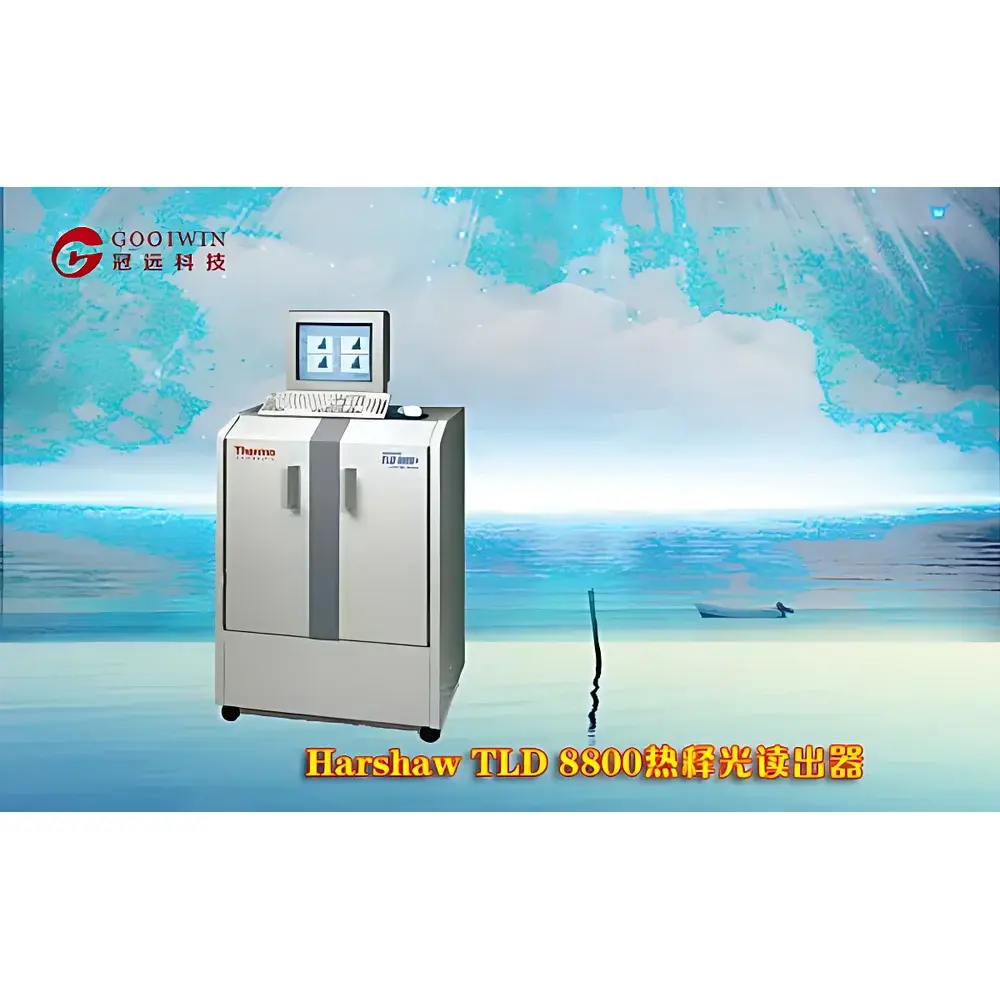
Harshaw TLD 8800 Thermoluminescence Reader
| Brand | UNION |
|---|---|
| Origin | USA |
| Manufacturer Type | Authorized Distributor |
| Origin Category | Imported |
| Model | TLD 8800 |
| Price Range | USD 1,400 – 7,200 |
Overview
The Harshaw TLD 8800 Thermoluminescence Reader is a precision instrument engineered for quantitative thermoluminescent (TL) signal detection in irradiated materials—primarily applied in food safety laboratories for post-irradiation verification of gamma- or electron-beam-treated foodstuffs. It operates on the fundamental principle that crystalline lattice defects induced by ionizing radiation trap electrons and holes at metastable energy levels; upon controlled thermal stimulation, these trapped charges recombine and emit photons proportional to the absorbed dose. The TLD 8800 integrates a calibrated heating ramp (typically 5–30 °C/s), a low-noise photomultiplier tube (PMT) with spectral response optimized for 350–550 nm emission, and a high-stability sample carousel accommodating up to 20 standard TLD chips (e.g., LiF:Mg,Ti, CaSO₄:Dy). Its design conforms to ISO/IEC 17025 requirements for testing laboratories and supports traceable calibration against NIST-traceable dosimetry standards.
Key Features
- Programmable linear heating profile with real-time temperature monitoring via integrated Pt-100 sensor (±0.5 °C accuracy)
- High-sensitivity PMT detection system with dark-current compensation and pulse-height discrimination
- Dual-channel analog-to-digital conversion for simultaneous TL glow curve acquisition and baseline correction
- Onboard memory for storing up to 1,000 full glow curves with timestamp, operator ID, and thermal protocol metadata
- RS-232 and USB 2.0 interfaces compliant with ASTM E1709-22 for data export to LIMS or QA documentation systems
- Modular sample holder compatible with IEC 62387-compliant TLD card formats and custom planchettes for powdered or granular food matrices
Sample Compatibility & Compliance
The TLD 8800 is validated for use with mineral-based TL dosimeters extracted from irradiated food samples—including silicate minerals (e.g., feldspar, quartz) naturally present in spices, herbs, shellfish, and dried vegetables. It meets the analytical performance criteria outlined in EN 1788:2021 (“Foodstuffs — Detection of irradiated food using photostimulated luminescence and thermoluminescence”) and supports GLP-compliant workflows per FDA 21 CFR Part 11 when paired with audit-trail-enabled software. While not directly measuring organic radiolytic products (e.g., 2-alkylcyclobutanones), it provides orthogonal physical evidence complementary to GC-MS or ESR methods—particularly critical where biological matrix interference limits biochemical assay reliability.
Software & Data Management
The included TL Analysis Suite v4.x enables full glow curve deconvolution using peak-fitting algorithms (Gaussian/Lorentzian superposition), dose interpolation via reference calibration curves, and automated pass/fail classification per EN 1788 decision thresholds. All raw data files are stored in vendor-neutral ASCII format with embedded metadata headers. Software validation documentation (IQ/OQ/PQ protocols) is provided for regulated environments. Audit trail functionality records user actions, parameter changes, and report generation events—fully compliant with EU Annex 11 and FDA 21 CFR Part 11 requirements for electronic records and signatures.
Applications
- Regulatory verification of irradiated spices, dried herbs, frozen poultry, and seafood in import control laboratories
- Quality assurance in commercial food irradiation facilities for process validation and routine batch release
- Research applications in radiobiology and food stability studies involving dose-response relationships in lipid oxidation kinetics
- Interlaboratory comparison programs coordinated under IAEA Technical Cooperation Projects (e.g., CRP E3.50.13)
- Supporting HACCP plans where irradiation serves as a critical control point for pathogen reduction (e.g., Salmonella, E. coli O157:H7)
FAQ
Can the TLD 8800 directly analyze raw food tissue without mineral extraction?
No. Regulatory protocols require prior isolation of silicate minerals from the food matrix using standardized acid digestion and density separation—per EN 1788 Section 6.2.
What is the minimum detectable dose for food-grade mineral extracts?
Under optimized conditions (≥10 mg feldspar, 10 s integration time), the instrument achieves a typical MDL of 0.1 kGy for gamma-irradiated samples, consistent with EN 1788 sensitivity requirements.
Is routine recalibration required between analyses?
Yes. Daily system suitability checks using a certified reference TL chip (e.g., NIST SRM 2242) are mandated before sample analysis to ensure thermal and photometric stability.
Does the TLD 8800 support multi-sample throughput for high-volume screening?
With optional autosampler integration (Harshaw AS-20), throughput increases to 120 samples per 8-hour shift, including automatic thermal equilibration and background subtraction.
How does TL analysis compare to PSL for irradiated food detection?
TL offers superior specificity for low-dose applications (<1 kGy) and greater resistance to environmental light exposure during sample handling—making it preferred for field-deployed or decentralized lab settings.




