
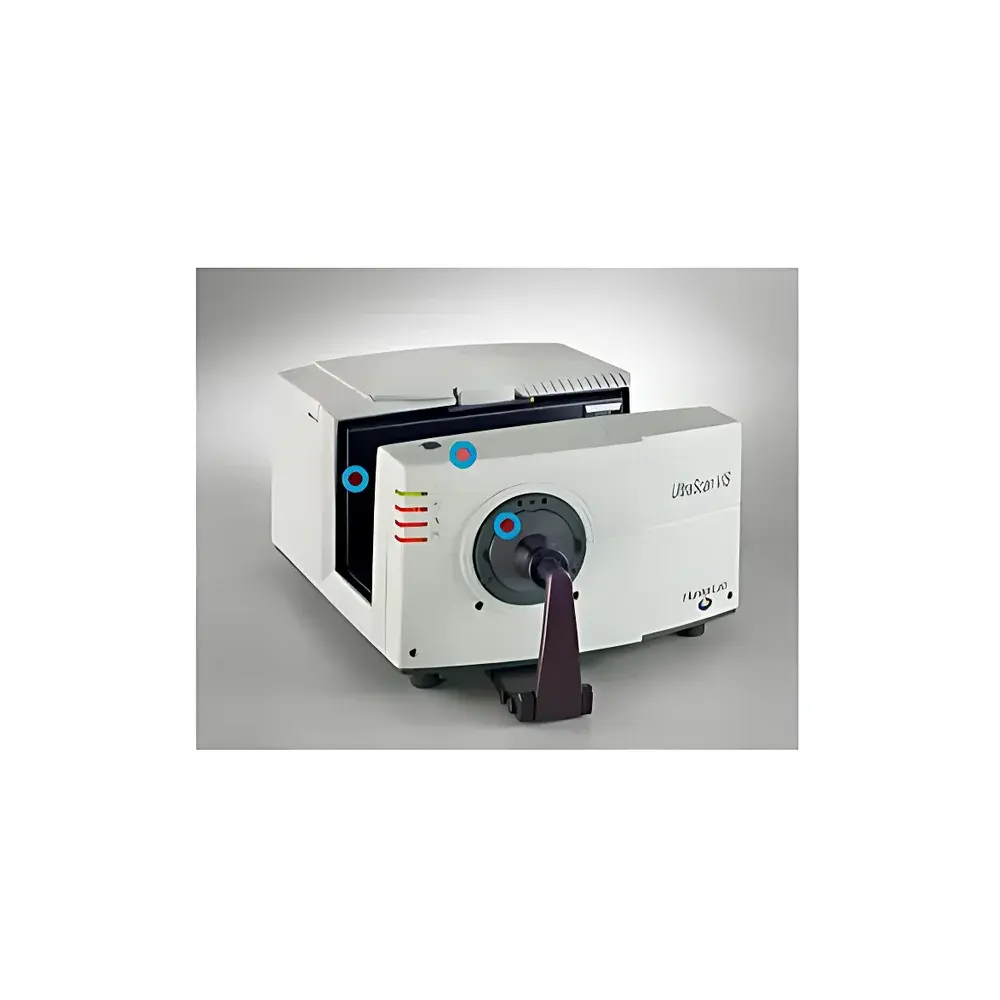
HunterLab UltraScan VIS Benchtop Spectrophotometer
| Brand | HunterLab |
|---|---|
| Origin | USA |
| Model | UltraScan VIS |
| Instrument Type | Benchtop |
| Optical Geometry | d/8° Integrating Sphere |
| Light Source | Pulsed Xenon Lamp (D65 Simulation) |
| Spectral Range | 360–780 nm |
| Spectral Bandwidth | 10 nm |
| Data Interval | 10 nm |
| Repeatability | ΔE*ab ≤ 0.06 |
| UV Control | Automatic UV Calibration & Adjustment |
| Aperture Options | 25 mm and 9.5 mm |
| Software | EasyMatch QC (FDA 21 CFR Part 11 Compliant) |
Overview
The HunterLab UltraScan VIS is a high-precision benchtop spectrophotometer engineered for rigorous color measurement across the full CIE-recommended visible spectrum (360–780 nm). It operates on the principle of diffuse illumination with 8° viewing geometry (d/8°), compliant with ISO 7724-1, ASTM E308, and CIE Publication No. 15. Its dual-beam silicon photodiode array architecture enables real-time reference beam correction at every data point, ensuring exceptional photometric stability and minimizing drift-induced errors. Unlike tungsten-based systems, the UltraScan VIS employs a long-life pulsed xenon lamp to accurately simulate D65 illuminant conditions — critical for daylight-correlated color evaluation in quality control and R&D environments. The instrument’s integrating sphere features spectrally neutral barium sulfate coating and precisely engineered baffling to suppress stray light, supporting accurate measurement of opaque, translucent, and transparent samples — including those exhibiting fluorescence under UV excitation. Its optical design conforms to CIE-defined tristimulus integration limits, guaranteeing metrological traceability for L*a*b*, CIE XYZ, and spectral reflectance/transmittance data.
Key Features
- Comprehensive spectral acquisition from 360 nm to 780 nm at 10 nm intervals, with 10 nm effective bandwidth for high-fidelity spectral resolution
- Automatic UV calibration and adjustable UV energy control to quantify and normalize fluorescent responses in optically brightened materials
- Dual aperture sizes (25 mm and 9.5 mm) accommodate diverse sample geometries — from large tiles and panels to small capsules and vials
- Open three-sided transmission compartment facilitates handling of oversized or irregularly shaped transparent and semi-transparent specimens
- Motorized specular component included/excluded (SCI/SCE) switching enables standardized measurement modes per ASTM D2244 and ISO 13655
- Ergonomic sample stage with adjustable height and tilt supports consistent positioning of powders, liquids, gels, textiles, and rigid solids
- Integrated status LED indicators provide immediate visual confirmation of selected measurement mode (reflectance, transmittance, haze)
- Robust mechanical construction: stainless steel fasteners, vibration-damped optical platform, and sealed electronics for long-term repeatability
- Self-diagnostic routines include wavelength accuracy verification using NIST-traceable holmium oxide filter and spectral linearity validation
Sample Compatibility & Compliance
The UltraScan VIS measures color and appearance attributes of heterogeneous material classes — including pigmented plastics, coated metals, pharmaceutical tablets, cosmetic emulsions, beverage concentrates, architectural glass, textile yarns, ceramic glazes, and optical films. Its d/8° sphere geometry ensures compliance with ISO 11664-4 (CIE colorimetry), ASTM E2539 (haze measurement), and USP (transparency and clarity testing for parenterals). For regulated industries, the system supports audit-ready operation: EasyMatch QC enforces user authentication, electronic signatures, change control logs, and full audit trails aligned with FDA 21 CFR Part 11 and EU Annex 11 requirements. All factory calibrations are traceable to NIST standards, and inter-instrument agreement is maintained within ΔE*ab ≤ 0.15 (10:1 ratio) across global HunterLab installations.
Software & Data Management
EasyMatch QC serves as the validated software platform for instrument control, method development, statistical process monitoring, and regulatory reporting. It supports customizable pass/fail tolerances based on ΔE*ab, ΔL*a*b*, or custom metrics; generates SPC charts with Cp/Cpk calculation; and exports spectral data in ASTM E308-compliant .qtx format. Batch reporting includes full metadata (operator ID, timestamp, environmental conditions, calibration history), and raw spectra can be exported for third-party analysis in MATLAB or Python. The software architecture incorporates role-based access control, electronic signature workflows, and encrypted database storage — meeting GLP/GMP documentation integrity standards. Optional cloud synchronization enables centralized fleet management across multi-site manufacturing networks.
Applications
- Color formulation and batch release in paint, ink, and pigment manufacturing
- Raw material qualification and finished product inspection in food & beverage processing (e.g., juice clarity, dairy whiteness, oil color grading)
- Optical quality assurance of ophthalmic lenses, automotive glazing, and display cover glass
- Pharmaceutical solid dosage form color consistency per USP and ICH Q5C guidelines
- Textile dye lot matching under multiple illuminants (D65, A, F2) and observer angles (2°/10°)
- Plastic recycling sorting via spectral fingerprinting of polymer types and additive packages
- Research into metamerism, goniochromism, and structural color in advanced materials
FAQ
Does the UltraScan VIS support fluorescence correction for optically brightened samples?
Yes — it includes programmable UV energy control and automatic UV calibration using a built-in deuterium lamp reference, enabling quantitative compensation for fluorescence in detergents, papers, and textiles.
Can it measure haze in addition to color coordinates?
Yes — the instrument complies with ASTM D1003 and ISO 14782 for total transmittance and haze measurement of transparent plastics and glass, using its dedicated transmission port and collimated beam path.
Is inter-instrument agreement validated across multiple UltraScan VIS units?
Yes — HunterLab certifies inter-instrument agreement to ΔE*ab ≤ 0.15 (10:1 ratio) when operated under identical conditions and calibrated against common standards.
What regulatory standards does EasyMatch QC satisfy?
It meets FDA 21 CFR Part 11, EU Annex 11, and ISO/IEC 17025 requirements for electronic records and signatures, including audit trail retention, user access control, and data integrity validation.
How frequently must the instrument be recalibrated?
Daily zero and white calibration is recommended; full wavelength and photometric calibration is performed annually or after any hardware service event, using NIST-traceable standards provided by HunterLab.



