
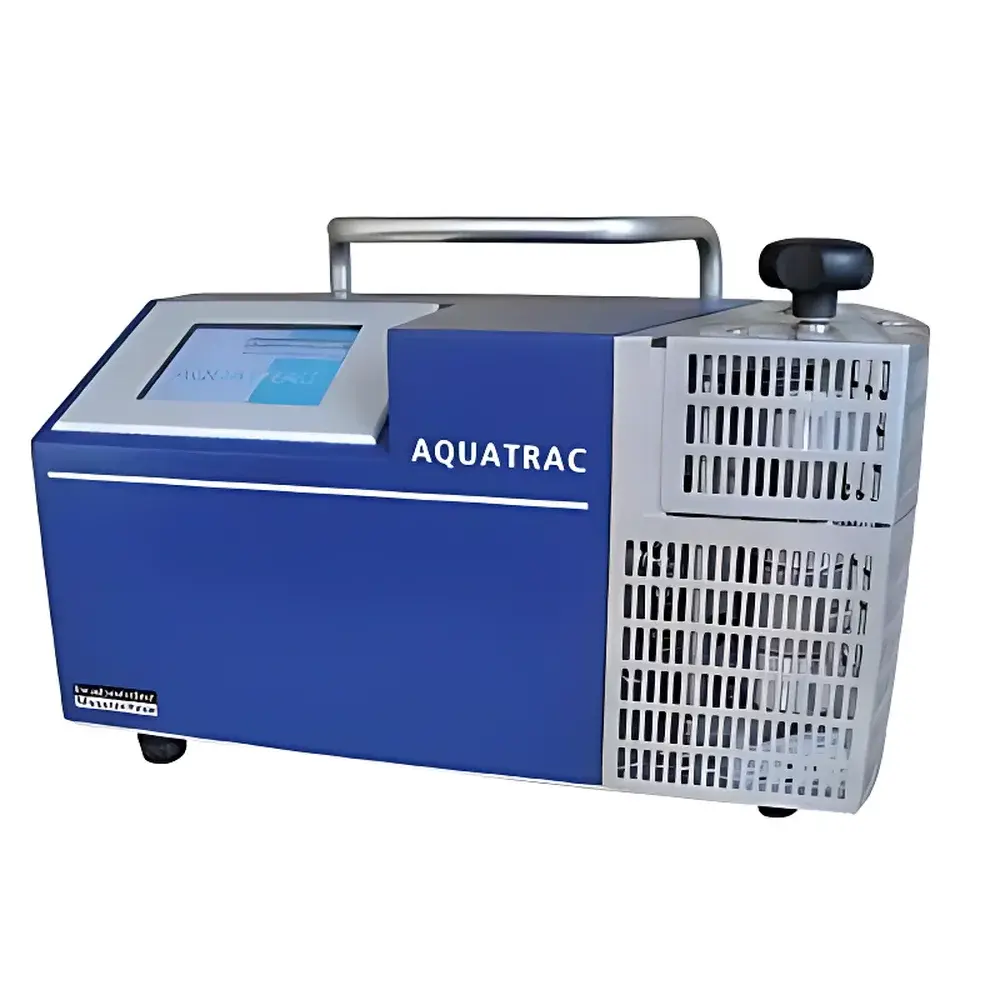
Brabender AQUATRAC-3E Karl Fischer-Free Moisture Analyzer for Plastics
| Brand | Brabender |
|---|---|
| Origin | Germany |
| Model | AQUATRAC-3E |
| Measurement Principle | Calcium Hydride Reaction |
| Test Ranges | <0.1%, 0.1–0.5%, >0.5% H₂O |
| Sample Weight | 0.1–100 g |
| Test Duration | 10–30 min |
| Temperature Control | 60–200 °C (1 °C increments) |
| Output Units | % H₂O or ppm |
| Accuracy | ±2% of reading or ±1% of range |
| Repeatability | ±1% of test range |
| Reagent Capacity | ≥1,000 determinations with standard CaH₂ cartridge |
Overview
The Brabender AQUATRAC-3E is a dedicated, Karl Fischer-free moisture analyzer engineered for rapid, reliable quantification of trace water content in hygroscopic polymer granules and powders. Unlike coulometric or volumetric titration methods, it employs a robust calcium hydride (CaH₂) chemical reaction principle: water in the sample reacts stoichiometrically with CaH₂ to generate hydrogen gas, the volume of which is precisely measured by a high-resolution pressure transducer. This gasometric method eliminates solvent handling, electrode maintenance, and reagent calibration drift—critical advantages in production-floor environments where operator training, safety compliance, and method ruggedness are prioritized. Designed and manufactured in Germany, the AQUATRAC-3E reflects Brabender’s 20+ years of specialization in polymer process analytics, delivering field-deployable performance without compromising laboratory-grade reproducibility.
Key Features
- Three selectable moisture ranges (0.5% H₂O) enable optimal signal-to-noise ratio across diverse polymer grades—from ultra-dry engineering resins (e.g., PEEK, PA66) to moderately hygroscopic thermoplastics (e.g., PET, PC).
- Programmable temperature control (60–200 °C, adjustable in 1 °C steps) allows precise thermal desorption tuning to avoid polymer degradation while ensuring complete water release from crystalline or amorphous domains.
- Integrated pressure-based detection system provides direct, linear correlation between evolved H₂ volume and water mass—eliminating endpoint ambiguity inherent in titration-based systems.
- Compact, benchtop-portable architecture (W × D × H: 320 × 380 × 290 mm) supports deployment at material receiving docks, drying line exits, and extrusion feed hoppers—enabling real-time decision-making without lab turnaround delays.
- Pre-loaded CaH₂ reagent cartridges guarantee consistent stoichiometry and support ≥1,000 consecutive analyses; cartridge replacement requires no recalibration or system purge.
- Compliance-ready design includes password-protected method storage, timestamped result logging, and non-volatile memory retention—facilitating alignment with GLP and internal QA documentation requirements.
Sample Compatibility & Compliance
The AQUATRAC-3E accommodates heterogeneous solid samples including virgin polymer pellets, regrind, masterbatch blends, and multi-component dry-blended formulations. Its 0.1–100 g sample capacity permits representative sub-sampling of bulk lots per ASTM D6980 and ISO 15512. The instrument operates within defined thermal and mechanical parameters suitable for routine QC testing under ISO/IEC 17025-accredited laboratories. While not a regulated medical device, its documented accuracy (±2% of reading), repeatability (±1% of range), and traceable pressure calibration support data integrity requirements aligned with FDA 21 CFR Part 11 when paired with appropriate electronic record controls.
Software & Data Management
Data output is delivered via RS-232 or USB interface to optional Brabender LabSoft software (Windows-compatible), enabling automated report generation, trend charting over time, and batch-level statistical summaries (mean, SD, CPK). All results include embedded metadata: date/time stamp, operator ID, method name, temperature setpoint, sample weight, and range selection. Audit trail functionality records parameter changes and user logins—essential for GMP-aligned plastic compounding facilities subject to third-party quality audits.
Applications
- Receiving inspection of inbound polymer shipments to verify compliance with supplier moisture specifications (e.g., ≤0.02% for polyamide prior to injection molding).
- In-process monitoring of hot-air or desiccant dryer efficiency—comparing inlet vs. outlet granule moisture to validate drying cycle parameters.
- Pre-extrusion verification to prevent hydrolytic degradation during melt processing, especially for polyesters and polyurethanes.
- Blending validation: quantifying equilibrium moisture after high-speed dry blending of multiple resins or additives, where differential hygroscopicity may induce localized saturation.
- R&D screening of new stabilizer packages or surface treatments intended to reduce moisture uptake during storage.
- Root-cause analysis of surface defects (splay, silver streaking) or mechanical property loss linked to residual moisture.
FAQ
Does the AQUATRAC-3E require daily calibration?
No. The pressure transducer is factory-calibrated and stable over time; only periodic verification using certified moisture standards (e.g., sodium tartrate dihydrate) is recommended per ISO 15512 Annex B.
Can it measure moisture in filled or reinforced polymers?
Yes—provided fillers (e.g., glass fiber, talc) do not react with CaH₂ or impede thermal release. Carbon black–loaded compounds require method validation due to potential catalytic interference.
Is operator training required for GMP environments?
Yes. Brabender provides documented SOP templates and on-site training covering method setup, sample preparation, result interpretation, and deviation handling per internal quality procedures.
What maintenance is required beyond reagent replacement?
Annual inspection of sealing O-rings and pressure sensor zero-point verification—both covered under Brabender’s extended service agreement.
How does it compare to near-infrared (NIR) moisture analyzers?
NIR offers speed but requires extensive chemometric modeling per resin type; AQUATRAC-3E delivers absolute, chemistry-based quantification without model development or spectral drift concerns.






