
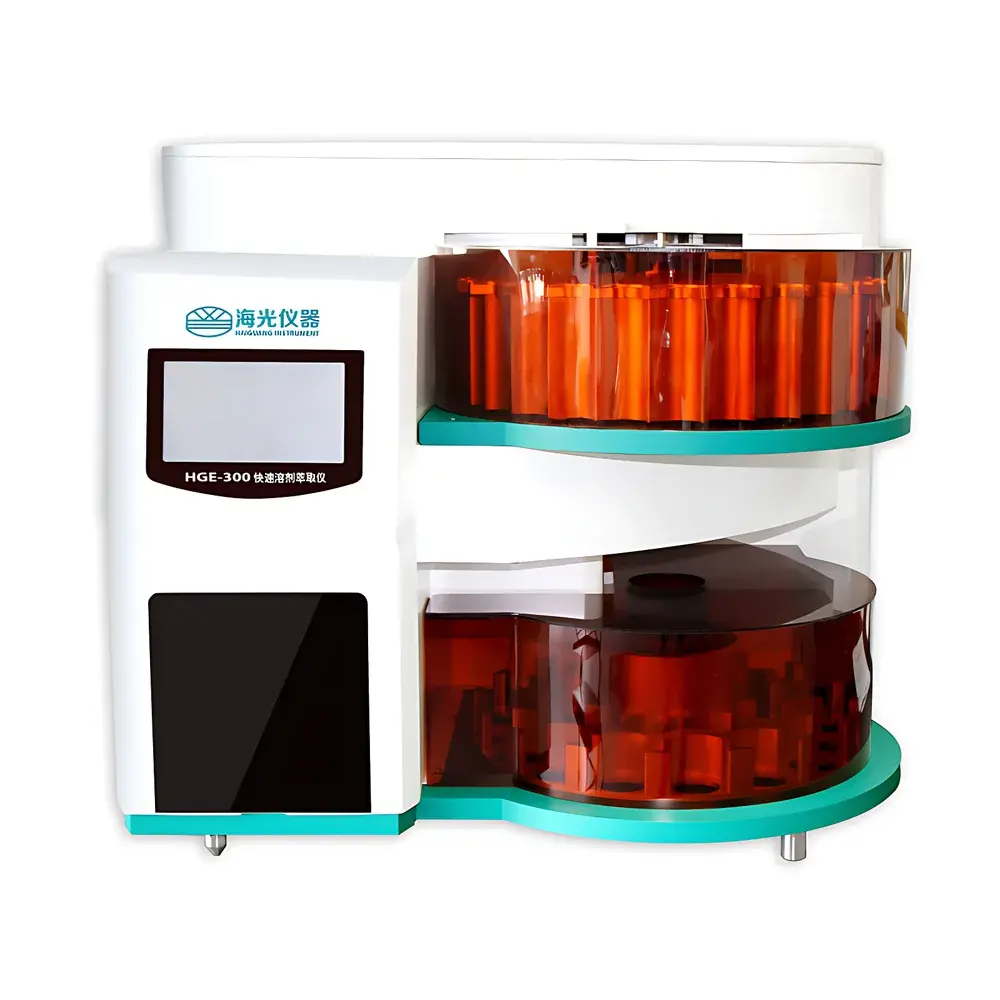
HGE-300 Accelerated Solvent Extractor by Haiguang Instruments
| Brand | Haiguang Instruments |
|---|---|
| Origin | Beijing, China |
| Model | HGE-300 |
| Extraction Type | Solid-Liquid Extraction |
| Sample Capacity | Up to 24 Positions |
| Solvent Handling | Automated Switching, Blending, and Proportional Mixing of Up to 4 Solvents |
| Sealing Material | TFM (Perfluoroalkoxy) Gaskets |
| Safety Features | Integrated Pneumatic Circuit Protection Against Solvent Corrosion and Backflow |
| Compliance Context | Designed for GLP-compliant laboratories |
Overview
The HGE-300 Accelerated Solvent Extractor is an automated solid-liquid extraction system engineered for high-throughput, reproducible isolation of organic analytes from complex solid and semi-solid matrices—including soils, sediments, sludges, plant tissues, food products, and polymer composites. It operates on the principle of pressurized liquid extraction (PLE), where elevated temperature and pressure are applied to enhance solvent penetration, solubility, and mass transfer kinetics—significantly reducing extraction time while maintaining analyte integrity and recovery efficiency. Unlike conventional Soxhlet or ultrasonic extraction methods, the HGE-300 delivers consistent thermal and mechanical conditions across all sample positions, minimizing inter-run variability and supporting method validation under regulated environments.
Key Features
- High-capacity automation: Supports sequential processing of up to 24 samples without manual intervention, enabling unattended overnight operation and improving laboratory throughput.
- Multi-solvent flexibility: Integrated solvent controller allows precise, programmable switching, blending, and ratio adjustment among four independently plumbed solvents—enabling gradient elution strategies and method optimization for diverse analyte polarities.
- Chemically inert sealing architecture: TFM (perfluoroalkoxy) gaskets provide exceptional resistance to aggressive organic solvents (e.g., chlorinated hydrocarbons, acetone, acetonitrile, THF) at elevated temperatures, ensuring long-term seal integrity and eliminating cross-contamination risks.
- Protected pneumatic subsystem: A dedicated gas circuit isolation mechanism prevents solvent vapor ingress into pressure regulation components, mitigating corrosion of solenoid valves, regulators, and tubing—extending service life and reducing maintenance frequency.
- Modular extraction cell compatibility: Accommodates standardized ASE®-compatible extraction cells (e.g., 11 mL, 22 mL, 33 mL, 66 mL), facilitating method transfer and alignment with established regulatory protocols such as EPA Method 3545A.
Sample Compatibility & Compliance
The HGE-300 is validated for use with heterogeneous solid-phase samples requiring minimal pre-treatment—such as dried soil cores, ground tissue homogenates, filter media, and composite materials. Its design supports matrix-specific method development per ISO 14507 (soil and sediment analysis), ASTM D7656 (petroleum-contaminated soils), and USP & FDA-recommended extraction protocols for residual solvent testing in pharmaceutical excipients. The system’s closed-loop solvent delivery and sealed cell architecture meet essential requirements for GLP and GMP environments, including audit-trail-capable event logging (via optional software integration) and traceable parameter recording for 21 CFR Part 11 readiness.
Software & Data Management
Control is managed via a dedicated Windows-based interface supporting full method programming—including temperature ramp profiles, static/dynamic extraction cycles, flush volumes, and purge steps. All operational parameters are timestamped and stored locally with export capability to CSV or XML formats. When integrated with LIMS or chromatography data systems (CDS), the HGE-300 can synchronize sample IDs, injection sequences, and instrument status flags—ensuring bidirectional workflow continuity. Firmware updates and diagnostic logs are accessible through secure USB or Ethernet interfaces, with version-controlled configuration backups to support change management documentation.
Applications
- Environmental analysis: Extraction of PAHs, PCBs, organochlorine pesticides, and petroleum hydrocarbons from contaminated soils and sediments.
- Food safety testing: Recovery of mycotoxins, pesticide residues, fat-soluble vitamins, and plasticizers from cereals, dairy powders, and edible oils.
- Pharmaceutical quality control: Isolation of residual solvents, extractables, and leachables from polymeric packaging and drug product intermediates.
- Academic and method development labs: Platform for optimizing PLE conditions, comparing solvent systems, and validating extraction efficiency against reference methods (e.g., Soxhlet, QuEChERS).
FAQ
What regulatory methods is the HGE-300 validated against?
The system is designed to execute EPA Method 3545A, ASTM D7656, and ISO 14507 with appropriate cell selection and method parameters.
Can the HGE-300 be integrated into an automated analytical workflow?
Yes—it supports digital I/O triggers and ASCII command protocol for synchronization with autosamplers, GC/LC systems, and LIMS via RS-232 or Ethernet.
Is TFM the only gasket material available?
TFM is the standard and recommended sealing material; alternative gasket options are not supported due to solvent compatibility and pressure rating constraints.
Does the system include solvent waste management capabilities?
The HGE-300 outputs spent extract directly into collection vials or fraction collectors; solvent evaporation or post-extraction concentration requires external equipment (e.g., nitrogen evaporators or centrifugal concentrators).
What maintenance intervals are recommended for routine operation?
Pneumatic filters should be inspected every 200 runs; TFM gaskets are replaced after 500–800 extractions depending on solvent aggressiveness and temperature profile.



