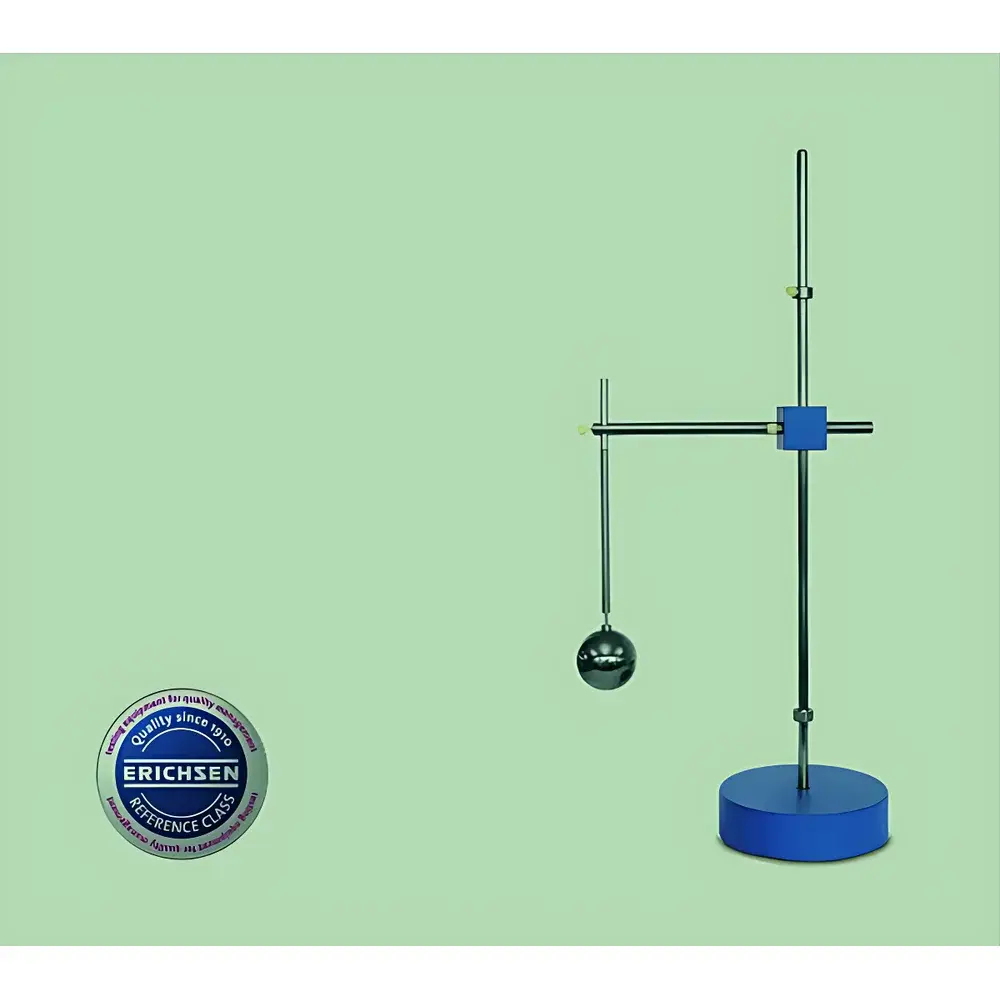
Erichsen 475 Density Sphere (Pycnometer)
| Brand | Erichsen |
|---|---|
| Origin | Germany |
| Model | Erichsen 475 |
| Volume Options | 10 mL ±0.1% or 100 mL ±0.1% (at 20 °C) |
| Compliance | DIN 53217-2, ISO 2811-2, VDA 621-113 |
Overview
The Erichsen 475 Density Sphere is a precision pycnometer engineered for the accurate determination of density in low-viscosity liquid materials—primarily coatings, paints, varnishes, lacquers, solvents, and other non-paste-like formulations. It operates on the fundamental principle of hydrostatic weighing (Archimedean buoyancy), where the mass difference between a container with sample before and after immersion of a calibrated sphere is used to calculate density at a defined reference temperature (20 °C). Unlike digital densitometers or oscillating U-tube instruments, the Erichsen 475 provides traceable, gravimetric density measurement without electronic calibration drift or temperature-compensation artifacts. Its stainless-steel spherical geometry ensures minimal surface area-to-volume ratio, reducing meniscus interference and improving repeatability in manual immersion protocols. Designed for integration into quality control laboratories adhering to ISO/IEC 17025 requirements, the instrument delivers metrologically sound results when used with analytical balances meeting OIML R76 Class I or II specifications.
Key Features
- Two precision-calibrated sphere volumes: 10 mL (±0.1% at 20 °C) for high-resolution measurements of low-density or limited-sample materials; 100 mL (±0.1% at 20 °C) for enhanced signal-to-noise ratio in routine QC applications.
- Stainless-steel construction ensures chemical resistance to organic solvents, aliphatic/aromatic hydrocarbons, and aqueous systems common in paint and coating manufacturing.
- Dual configuration options: standard vertical support stand (0020.02.32) for benchtop stability, or optional rotating-arm tabletop stand (0020.01.32) enabling ergonomic single-hand operation and consistent immersion depth control.
- Four certified variants: Models 475/I and 475/III provide factory-calibrated volume accuracy; Models 475/II and 475/IV include official calibration certificates issued by national metrology institutes (e.g., PTB or DAkkS-accredited bodies), fulfilling traceability requirements per ISO/IEC 17025 and supporting GLP/GMP audit documentation.
- Designed for use with laboratory balances offering readability of ≤1 mg (for 10 mL version) or ≤10 mg (for 100 mL version), ensuring compliance with measurement uncertainty budgets specified in DIN 53217-2 Annex A.
Sample Compatibility & Compliance
The Erichsen 475 is validated for Newtonian and near-Newtonian liquids with kinematic viscosity below 500 mm²/s (cSt) at 20 °C. It is unsuitable for thixotropic, shear-thinning, or highly volatile samples requiring sealed-cell handling. The method conforms strictly to three internationally harmonized standards: DIN 53217-2 (German standard for density of paints and related products), ISO 2811-2 (Paints and varnishes — Determination of density — Part 2: Immersion method), and VDA 621-113 (German automotive industry specification for coating material testing). All variants meet dimensional and thermal stability requirements outlined in ISO 4787 for volumetric glassware and metal pycnometers. The stainless-steel sphere undergoes passivation treatment per ASTM A967 to prevent leaching or surface oxidation during repeated solvent exposure.
Software & Data Management
The Erichsen 475 is a manually operated, analog gravimetric instrument and does not incorporate embedded firmware or proprietary software. However, it integrates seamlessly into regulated laboratory environments through standardized data capture workflows. Users typically record W₁ (mass of beaker + sample), W₂ (mass reading during immersion), and ambient temperature in LIMS or ELN platforms compliant with FDA 21 CFR Part 11. Templates for calculation—including air buoyancy correction (ρL = 0.0012 g/mL) and thermal expansion adjustment per ISO 4787—are preconfigured in validated spreadsheets used across global R&D labs. Traceability is maintained via certificate-of-calibration reference numbers linked to NIST-traceable master standards. For laboratories implementing paperless QC, the instrument supports audit-ready documentation when paired with balance printouts showing timestamped weight values and operator ID.
Applications
- Batch release testing of architectural and industrial coatings against internal specifications and customer technical data sheets (TDS).
- Raw material verification of resins, pigments dispersions, and thinners prior to formulation.
- Stability assessment of solvent-based systems over time via periodic density trending (e.g., detecting solvent loss or polymer degradation).
- Supporting ASTM D1475 and ISO 3233 test methods for calculating theoretical and actual solids content in coatings.
- Reference measurement for validating inline density sensors (e.g., Coriolis or vibrating fork transmitters) installed in production lines.
FAQ
What is the recommended balance readability for each model?
For Erichsen 475/III and 475/IV (10 mL sphere), analytical balances with ≤1 mg readability are required. For 475/I and 475/II (100 mL sphere), ≤10 mg readability suffices.
Can the density sphere be used above or below 20 °C?
The stated volume tolerance (±0.1%) applies only at 20 °C. Measurements at other temperatures require volumetric expansion correction using the stainless-steel coefficient of cubical expansion (≈3×10⁻⁵ K⁻¹) and must be justified in method validation documentation.
Is cleaning validation required between samples?
Yes—residue carryover affects buoyancy force. Recommended protocol: rinse with compatible solvent (e.g., xylene for alkyd systems), followed by ethanol and nitrogen drying; verify cleanliness via blank immersion test yielding consistent W₂ baseline.
Does Erichsen supply certified reference liquids for verification?
No—Erichsen does not market certified density standards. Users should procure NIST SRM 2190 (water) or SRM 2191 (toluene) for periodic system suitability checks.
How often should recalibration be performed?
Per ISO/IEC 17025, recalibration interval is risk-based. Most users schedule biannual verification against accredited reference spheres or perform before critical batch releases—especially when operating under IATF 16949 or ISO 9001 quality systems.