
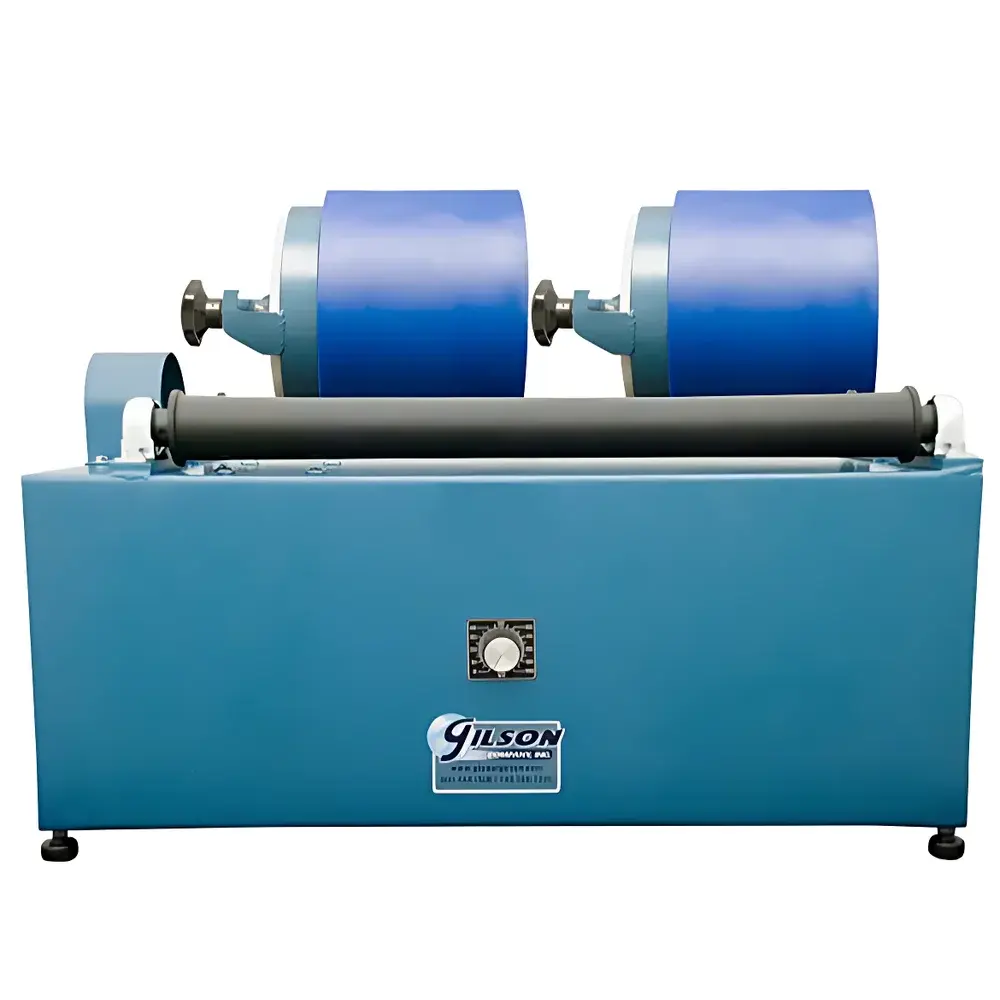
Labconco LC-91 & LC-91F Single-Tier Benchtop Jar Mill
| Origin | USA |
|---|---|
| Supplier Type | Authorized Distributor |
| Origin Category | Imported |
| Model | LC-91 (115 V, 50–60 Hz), LC-91F (220 V, 50–60 Hz) |
| Motor | 0.25 HP, DC, fully enclosed |
| Speed Range | 20–300 rpm |
| Roller Diameter | 2 in (50.8 mm), chloroprene rubber-coated |
| Jar Capacity | 1–2 jars, diameter range 2–15 in (51–381 mm) |
| Max Batch Volume | 125 L |
| Frame | Welded steel benchtop construction |
| Drive | Roller-chain transmission |
| Bearings | Sealed ball bearings |
| Final Particle Size | 1–50 µm |
| Top Particle Size (feed) | ≤1 mm |
Overview
The Labconco LC-91 and LC-91F Single-Tier Benchtop Jar Mills are precision-engineered mechanical grinding systems designed for consistent, scalable batch size reduction of solid materials in laboratory and pilot-scale settings. Operating on the principle of tumbling attrition—where rotational motion imparts kinetic energy to grinding media inside a sealed cylindrical jar—the unit achieves particle size reduction through repeated impact, compression, and shear forces between media and sample. Unlike high-energy mills relying on vibration or impact, the LC-91 series delivers controlled, low-heat comminution ideal for heat-sensitive compounds, brittle ceramics, pharmaceutical actives, and mineralogical samples requiring minimal amorphization or phase transformation. Its fixed-axis horizontal roller configuration ensures stable jar positioning across variable load conditions, supporting reproducible energy input per unit mass—a critical parameter in method development aligned with ASTM E1155 and ISO 13320 guidelines for particle size analysis validation.
Key Features
- Fully enclosed 0.25 HP DC motor with analog speed control, enabling precise adjustment from 20 to 300 rpm—optimized for both coarse pre-grinding and fine finishing passes.
- Two chloroprene rubber-coated rollers (50.8 mm diameter) mounted on rigid steel shafts; roller spacing is manually adjustable via calibrated thumb screws to accommodate jars from 51 mm to 381 mm in diameter without tools.
- Welded structural steel frame with anti-vibration feet ensures operational stability during extended runs, minimizing harmonic resonance and protecting adjacent instrumentation.
- Roller-chain drive system with maintenance-free sealed ball bearings rated for >10,000 hours of continuous operation under nominal load conditions.
- Designed for compatibility with standard ceramic, alumina, stainless steel, or polymeric grinding jars—no proprietary jar interface required.
- No integrated grinding media or jars supplied; users select media type (e.g., zirconia, stainless steel, agate) and jar geometry based on chemical compatibility, density requirements, and target final particle distribution.
Sample Compatibility & Compliance
The LC-91 series accommodates dry, moist, or slurry-based feed materials with initial top size up to 1 mm. It is routinely employed in QC laboratories for ASTM C782 (cementitious materials), USP (pharmaceutical granules), and ISO 5725-2 (method precision verification). The absence of electrical components inside the grinding zone and non-sparking roller design supports use in Class I, Division 2 hazardous locations when paired with appropriate jar sealing and grounding protocols. Units comply with UL 61010-1 and CE marking requirements for laboratory electrical equipment. Documentation packages support GLP/GMP audit readiness, including factory calibration records and traceable motor performance curves.
Software & Data Management
While the LC-91 and LC-91F operate as standalone analog instruments, they integrate seamlessly into digital lab workflows via optional RPM logging modules (e.g., LabVIEW-compatible tachometer interfaces) and time-stamped run logs maintained in LIMS environments. Speed setpoints and runtime duration are manually recorded per SOP, satisfying FDA 21 CFR Part 11 requirements when paired with electronic lab notebooks (ELNs) featuring audit trail functionality. No embedded firmware or cloud connectivity is present—ensuring data sovereignty and eliminating cybersecurity exposure vectors common in IoT-enabled mills.
Applications
- Pharmaceutical: Pre-formulation milling of API powders prior to dissolution testing or tablet compaction studies.
- Materials Science: Homogenization of precursor blends for solid-state battery cathode synthesis (e.g., NMC, LFP).
- Geology & Mining: Preparation of rock core samples for XRF, XRD, or ICP-MS analysis per ASTM D5684 protocols.
- Ceramics & Catalysts: Size reduction of sintered oxide pellets to achieve narrow PSD for BET surface area measurement.
- Academic Research: Teaching labs demonstrating first-order comminution kinetics and Bond Work Index estimation.
FAQ
What jar sizes are supported?
Jars from 2 in (51 mm) to 15 in (381 mm) in diameter can be accommodated using the adjustable roller spacing mechanism.
Is the mill suitable for wet grinding?
Yes—provided jars are chemically resistant and properly sealed; no internal lubrication or electronics are exposed to potential solvent ingress.
Does the unit include grinding media or jars?
No—jars and media are selected and procured separately based on application-specific requirements for hardness, density, and contamination control.
Can speed be logged or controlled remotely?
The base unit features manual analog speed control; optional external tachometers or programmable logic controllers (PLCs) may be interfaced for automated logging.
What maintenance is required?
Biannual inspection of chain tension and bearing lubrication status; chloroprene rollers typically exceed 5 years of service life under normal loading conditions.





