
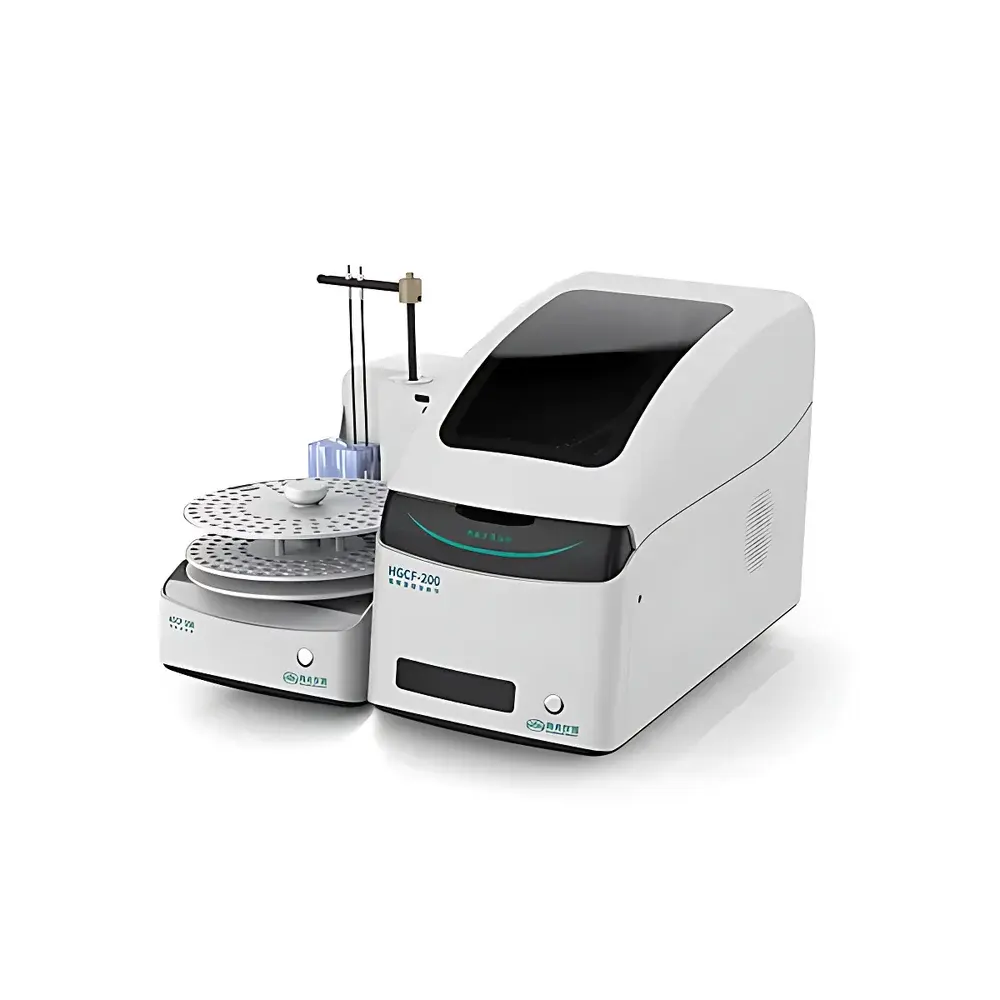
Haiguang HGCF-200 Continuous Flow Analyzer for Cyanide
| Brand | Haiguang Instrument |
|---|---|
| Origin | Beijing, China |
| Instrument Type | Laboratory Benchtop CFA |
| Application | Total and Free Cyanide Determination in Water and Environmental Matrices |
| Compliance | ASTM D7511, ISO 14403:2012, HJ 484–2009, EPA Method 335.4 |
| Detection Principle | Segmented Flow Analysis (SFA) with Air Segmentation, On-line Distillation & UV Digestion |
| Optical System | LED-based Photometer with Quartz Flow Cell and Full-spectrum CCD Detector |
| Sample Throughput | Up to 60 samples/hour |
| Detection Limit | ≤0.2 µg/L CN⁻ (as applicable per ISO 14403) |
| Linear Dynamic Range | 0–1000 µg/L (adjustable via on-line dilution 1:1 to 1:5000) |
| Reagent Management | Integrated Smart Reagent Rack with Level Sensing & Leak Detection |
| Automation | Fully Automated Sample Introduction, Pre-treatment, Reaction, Separation, Detection & Data Reporting |
Overview
The Haiguang HGCF-200 Continuous Flow Analyzer for Cyanide is a laboratory-grade segmented flow analysis (SFA) system engineered for precise, reproducible, and regulatory-compliant quantification of total and free cyanide in environmental water matrices. It implements internationally recognized air-segmented continuous flow methodology—where discrete sample plugs are separated by precisely controlled air bubbles within chemically inert quartz tubing—to eliminate carryover, suppress diffusion-driven dispersion, and ensure complete reaction kinetics under steady-state hydrodynamic conditions. The system integrates on-line distillation for volatile cyanide liberation, UV-assisted digestion for complex-bound cyanide conversion, and bubble elimination modules to stabilize optical path integrity. Designed in accordance with ISO 14403:2012, HJ 484–2009, and EPA Method 335.4, the HGCF-200 delivers trace-level sensitivity (sub-µg/L detection limits), high inter-run precision (<2% RSD), and robust performance across heterogeneous sample types including wastewater, surface water, groundwater, seawater, and digested soil extracts.
Key Features
- Air-segmented flow architecture with quartz manifold (ID ≥2 mm) minimizing memory effect and clogging risk—ideal for turbid or particulate-rich environmental samples without pre-filtration or degassing.
- Integrated on-line distillation unit optimized for HCN volatilization at controlled pH and temperature, followed by alkaline absorption and colorimetric detection via pyridine-barbituric acid or isonicotinic acid–barbituric acid (ISA–BA) chemistry.
- On-board UV digestion module (254 nm, adjustable exposure time) enabling complete release of cyanide from iron- and cobalt-cyanide complexes prior to distillation.
- Quartz flow cell with selectable optical path lengths (10–50 mm) and thermally stabilized LED light source (365–660 nm range) ensuring long-term photometric stability and minimal drift.
- Full-spectrum CCD detector with built-in monochromator-free wavelength selection, real-time background correction, and dual-beam referencing—eliminating need for mechanical filter wheels and reducing maintenance intervals.
- High-precision on-line dilution system (1:1 to 1:5000) co-located with autosampler; supports single-point calibration curve generation and auto-range extension for out-of-spec samples.
- Modular autosampling options: polar-coordinate or 3D Cartesian configurations with 40–240 vial capacity; dual-needle operation with integrated needle wash station and programmable rinse solution exchange.
Sample Compatibility & Compliance
The HGCF-200 accommodates liquid samples with suspended solids ≤50 mg/L and salinity up to 3.5% (seawater-compatible). It accepts direct injection of clarified wastewater, filtered surface water, acid-preserved groundwater, and microwave-digested soil leachates. All fluidic pathways—including distillation condensate lines and reagent manifolds—are constructed from high-purity quartz or PFA to prevent metal ion interference and adsorption losses. The system meets GLP data integrity requirements through audit-trail-enabled software (21 CFR Part 11 compliant), full electronic signature support, and immutable raw signal logging. Validated methods include ISO 14403:2012 (total and free cyanide), ISO 14402:1999 (phenol), ISO 23913:2016 (Cr(VI)), and multiple Chinese EPA standards (HJ 484–2009, HJ 665–2013, HJ 667–2013).
Software & Data Management
Control and data acquisition are managed via Haiguang’s proprietary CFA Studio software—a Windows-based platform supporting method development, sequence scheduling, real-time chromatogram visualization, peak integration with baseline correction algorithms, and automated QC flagging (e.g., drift, pressure anomaly, reagent exhaustion). All raw absorbance traces, instrument status logs, and calibration metadata are stored in encrypted SQLite databases with configurable backup policies. Export formats include CSV, PDF analytical reports, and LIMS-ready XML files conforming to ASTM E1384 and ANSI/NIST ITL 10-1 standards. Software validation documentation (IQ/OQ/PQ protocols) and electronic record retention settings are provided for regulated laboratories.
Applications
The HGCF-200 serves as a core analytical platform in environmental monitoring labs, municipal water quality centers, industrial effluent compliance facilities, and third-party testing organizations. Primary applications include routine cyanide monitoring in discharge permits (e.g., NPDES), drinking water safety verification (WHO guideline value: 0.07 mg/L CN⁻), landfill leachate characterization, mining site runoff assessment, and emergency response screening following chemical spills. Its multi-parameter capability extends to ammonia nitrogen (HJ 665–2013), nitrate/nitrite (HJ 636–2012), phosphate (ISO 15681-2:2003), phenol (ISO 14402:1999), sulfide (HJ 667–2013), and Cr(VI) (ISO 23913:2016)—all using shared fluidic architecture and reagent management logic.
FAQ
Does the HGCF-200 comply with U.S. EPA regulatory methods for cyanide analysis?
Yes—it fully supports EPA Method 335.4 (automated colorimetric determination of total cyanide) when configured with on-line distillation and ISA–BA chemistry.
Can the system analyze both free and total cyanide in a single run?
No—free cyanide requires direct colorimetry without distillation; total cyanide requires distillation. Two separate methods must be loaded and executed sequentially.
Is method validation documentation included with the instrument?
Yes—pre-validated IQ/OQ protocols, system suitability test procedures, and reference material traceability records are supplied as part of the installation qualification package.
What maintenance is required for the quartz flow cell and distillation unit?
Quartz components require quarterly inspection for etching or deposits; distillation coils should be cleaned monthly with 10% HNO₃ followed by deionized water flush—no disassembly needed.
Can the software interface with enterprise LIMS systems?
Yes—via HL7 or ASTM E1384-compliant API integration; custom middleware configuration services are available upon request.
Related Products







