
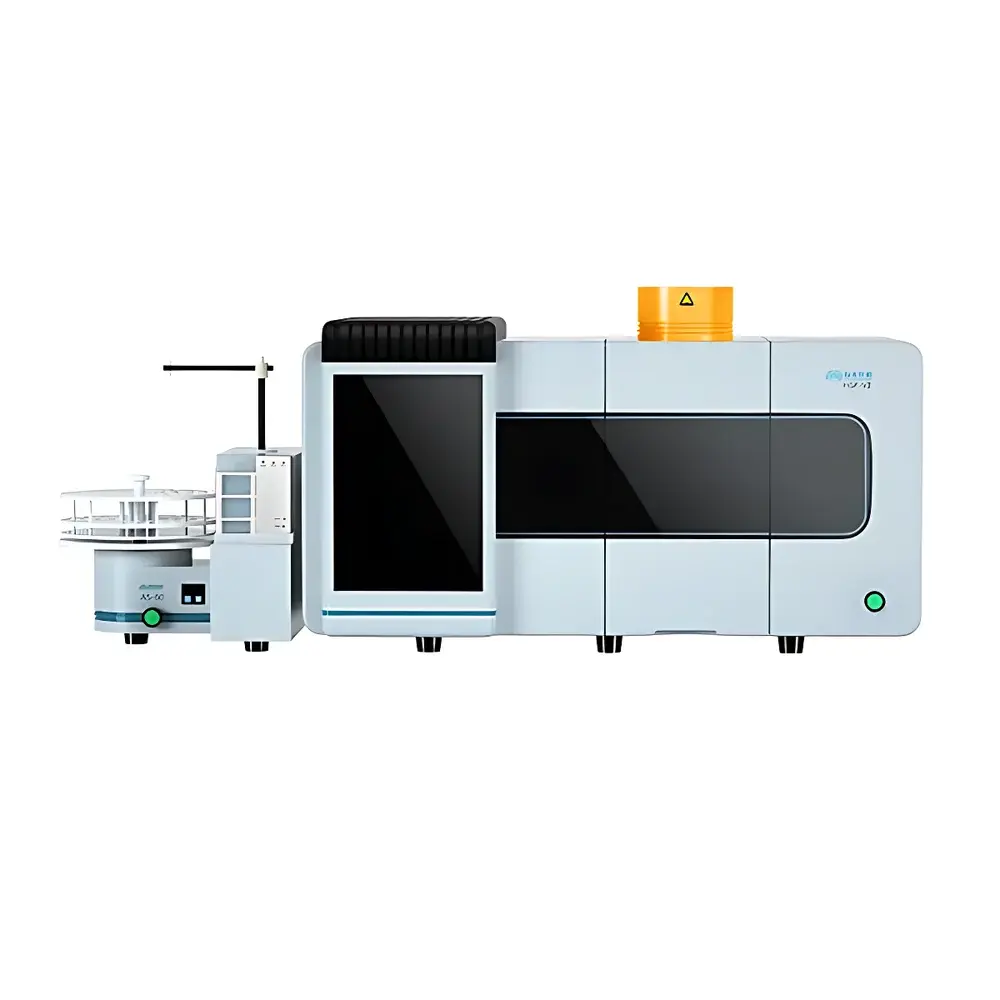
Haiguang HGF-V2 Atomic Fluorescence Spectrometer
| Brand | Haiguang Instrument |
|---|---|
| Origin | Beijing, China |
| Model | HGF-V2 |
| Instrument Type | Multi-channel Atomic Fluorescence Spectrometer |
| Sample Introduction | Dual Sequential Injection Pump |
| Waste Disposal | Gravity-based |
| Sample Introduction Mode | Vapor Generation / Hydride Generation |
| Gas Flow Control | Mass Flow Controller (MFC) |
| Detectable Elements | As, Se, Pb, Bi, Sb, Te, Sn, Hg, Cd, Ge, Zn, Au |
| Relative Standard Deviation (RSD) | < 0.6% |
| Linear Dynamic Range | > 3 orders of magnitude |
| Detection Limits (As, Se, Pb, Bi, Sb, Te, Sn) | < 0.01 µg/L |
| Photomultiplier Tube Wavelength Range | 160–320 nm |
| Atomizer Temperature Control Range | 50–450 °C |
Overview
The Haiguang HGF-V2 Atomic Fluorescence Spectrometer is a next-generation multi-channel analytical instrument engineered for ultra-trace quantification of hydride-forming and cold-vapor elements in complex environmental, biological, food, and geological matrices. Based on the principle of atomic fluorescence spectroscopy (AFS), the system excites ground-state atoms—generated via hydride vapor generation (HVG) or cold-vapor atomic fluorescence (CV-AFS)—using high-intensity, element-specific hollow cathode lamps. The resulting fluorescence emission at characteristic wavelengths is detected by a low-noise photomultiplier tube (PMT) operating across 160–320 nm. Designed as part of Haiguang’s AFS 4.0 platform, the HGF-V2 integrates hardware-level automation, optical noise suppression, and thermal stabilization to deliver long-term measurement stability and high reproducibility under routine laboratory conditions.
Key Features
- Multi-channel, multi-lamp auto-alignment optical system: Eliminates manual lamp alignment; supports simultaneous or sequential multi-element analysis without mechanical adjustment.
- Optimized optical path design: Incorporates internally blackened threaded components, asymmetric apertures, and proprietary anti-stray-light coating to reduce background scatter and improve signal-to-noise ratio (SNR) by >40% versus conventional AFS systems.
- 3D integrated fluidic architecture: Minimizes tubing length and dead volume; mitigates mercury memory effects and cross-contamination through geometric flow control and surface passivation.
- Microliter-scale sequential injection manifold: Fully maintenance-free with no peristaltic pump tubing; enables programmable, repeatable reagent delivery, reaction timing, and post-analysis cleaning cycles.
- Triple-gas digital mass flow control: Independently regulated carrier gas, auxiliary gas, and shield gas (all at milliliter-per-minute precision) ensure consistent atom cloud formation and plasma stability over extended operation.
- Self-regulating three-stage gas–liquid separator: Water-cooled, overflow-type design with automatic foam suppression and moisture removal; compatible with high-organic-content samples (e.g., digested tissues, lipid-rich extracts).
- Dual-zone temperature-controlled quartz atomizer: Separately regulated heating zones for carrier gas pre-heating and atomization chamber—maintains optimal atomization efficiency across 50–450 °C with ±0.5 °C stability.
- Million-cycle electrodeless ignition system: Solid-state ignition eliminates filament replacement; ensures >10⁶ consecutive ignitions without degradation in plasma initiation reliability.
- Hg lamp drift compensation module: Real-time intensity monitoring and feedback-driven current modulation stabilize mercury signal output over multi-hour analytical runs.
- Integrated sensor suite: Monitors liquid leakage, MFC output, ignition current, and atomizer chamber status via onboard video feed—enabling predictive diagnostics and GLP-compliant event logging.
Sample Compatibility & Compliance
The HGF-V2 is validated for use with acid-digested, microwave-assisted, or direct hydride-generating sample preparations. It complies with key international and national regulatory methods including ASTM D6722-22 (Hg in coal), ISO 17892-10:2022 (geotechnical testing – trace metals in soils), and multiple Chinese National Standards (GB, HJ, GBZ/T) governing arsenic, mercury, selenium, antimony, and bismuth determination in food, water, soil, urine, blood, and airborne particulates. Its hardware architecture supports 21 CFR Part 11–compliant audit trails when paired with Haiguang’s certified software package, meeting GLP/GMP requirements for QC laboratories in pharmaceutical, environmental, and public health sectors.
Software & Data Management
Controlled via Haiguang’s AFS-Link v5.x software suite, the HGF-V2 supports fully automated method execution—including calibration, sample analysis, system cleaning, and shutdown—with optional remote supervision via Ethernet (10/100BASE-TX) or IEEE 802.11ac Wi-Fi. All raw spectral data, instrument parameters, and operator actions are timestamped and stored in encrypted SQLite databases. Software modules include peak integration with baseline correction, multi-point calibration curve fitting (linear/log-log), QC charting (Levey-Jennings), and customizable report generation aligned with ISO/IEC 17025 documentation requirements.
Applications
The HGF-V2 delivers reliable performance across regulated and research-driven workflows: quantification of inorganic arsenic in rice and infant formula (per GB 5009.11-2014); total mercury and methylmercury speciation support in fish tissue (per GB 5009.17-2021); monitoring of As, Sb, and Bi in ambient PM2.5 filters (per HJ 1133-2020); screening of urinary antimony in occupational exposure assessments (per GBZ/T 302-2018); and rapid screening of Cd and Zn in agricultural soils (per GB/T 22105-2008). Its robustness extends to clinical toxicology, mining geochemistry, wastewater compliance testing, and academic spectroscopy research requiring sub-ppt detection sensitivity and inter-day RSD ≤0.6%.
FAQ
What hydride-forming elements does the HGF-V2 detect with certified performance?
The instrument is validated for As, Se, Pb, Bi, Sb, Te, Sn, Hg, Cd, Ge, Zn, and Au using standardized vapor generation protocols per GB, HJ, and ISO methods.
Is the HGF-V2 compatible with existing laboratory information management systems (LIMS)?
Yes—via configurable ASCII or XML export templates and ODBC connectivity; full LIMS integration support is available under Haiguang’s Enterprise Interface License.
Does the system require external cooling water or compressed air?
No. The water-cooled gas–liquid separator uses recirculating thermoelectric cooling; all gas flows are internally regulated via integrated mass flow controllers—no external utilities required.
How is calibration verification performed between analyses?
Built-in dual-standard bracketing, continuous internal standard addition (optional), and automated recalibration triggers based on signal drift thresholds ensure ongoing metrological traceability.
Can the HGF-V2 be upgraded to support speciation analysis (e.g., As(III)/As(V))?
Yes—when coupled with an HPLC module (e.g., Haiguang LC-AFS interface kit), the system supports hyphenated separation–detection workflows compliant with EPA Method 1632 and HJ 694-2014 Annex B.




