
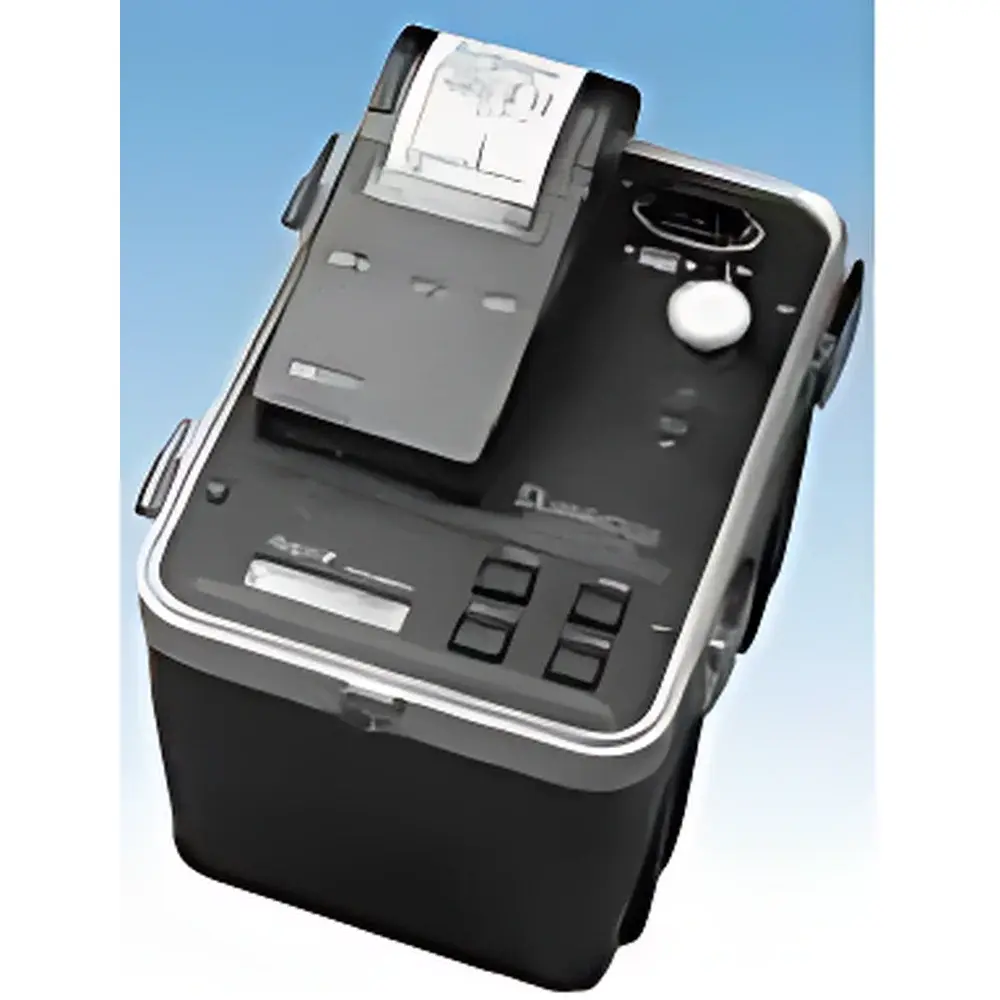
RAD-7 Radon Detector by DURRIDGE
| Origin | Germany |
|---|---|
| Manufacturer Type | Authorized Distributor |
| Origin Category | Imported Instrument |
| Model | RAD-7 |
| Pricing | Available Upon Request |
| Sensitivity | 0.4 cpm per pCi/L |
| Measurement Range | 0.1–20,000 pCi/L |
| Pump Flow Rate | 1 L/min |
| Alpha Energy Discrimination | Yes (Rn-222 vs. Rn-220/Th-232 progeny) |
| Battery Life | 24 h sampling mode / 72 h continuous monitoring mode |
Overview
The RAD-7 Radon Detector is a field-deployable, solid-state alpha spectrometer engineered for high-reliability radon-222 (²²²Rn) and thoron-220 (²²⁰Rn) measurement in air, soil gas, and water matrices. Unlike passive integrating devices (e.g., charcoal canisters or alpha-track detectors), the RAD-7 employs pulsed ionization chamber technology with real-time alpha energy spectroscopy to resolve individual decay events within the 5.49 MeV (²²²Rn) and 6.29 MeV (²²⁰Rn) energy windows. This enables unambiguous discrimination between radon and thoron progeny—critical for accurate environmental assessment in regions with elevated thorium-bearing geology or during short-term diagnostic surveys. The instrument operates on the principle of electrostatic collection of positively charged radon progeny onto a silicon alpha detector, followed by pulse-height analysis to identify nuclide-specific alpha emissions. Its compact, ruggedized enclosure meets IP54 ingress protection standards, supporting operation across ambient temperatures from –10 °C to +50 °C and relative humidity up to 95% non-condensing.
Key Features
- Real-time alpha spectrometry with digital pulse processing for simultaneous ²²²Rn and ²²⁰Rn quantification
- Integrated dual-mode sampling pump (1.0 L/min ±5%) with flow calibration traceable to NIST-certified standards
- High-sensitivity silicon surface-barrier detector (active area: 300 mm²) optimized for low-background counting
- Onboard thermal printer for immediate hard-copy reporting of time-series data, calibration logs, and QA/QC flags
- Rechargeable lithium-ion battery pack supporting 24 hours of active sampling (pump + detector cycle) or 72 hours of standby monitoring (detector-only mode)
- Internal memory stores >10,000 data points with timestamp, temperature, pressure, and humidity metadata (via optional external sensor integration)
- Programmable sampling protocols: continuous mode, timed cycles (1–240 min), or event-triggered acquisition
Sample Compatibility & Compliance
The RAD-7 accommodates direct air sampling via built-in pump or external manifold configurations for soil gas extraction (using stainless-steel probes and vacuum regulators) and water analysis (via RAD-H2O accessory kit employing liquid scintillation equilibration). All measurement protocols comply with EPA Protocol #1 (for indoor air), ASTM D6768-22 (Standard Test Method for Determining Radon in Soil Gas), and ISO 11665-2:2021 (Measurement of radioactivity — Radon-222 — Part 2: Integrated measurement methods). The system supports GLP-compliant audit trails, including user login history, method version control, and electronic signature capability when operated with RADSoft v7.5 or later. Firmware adheres to IEC 61508 SIL2 functional safety requirements for radiation instrumentation.
Software & Data Management
RADSoft software (Windows-based, FDA 21 CFR Part 11 compliant) provides full instrument control, spectral visualization, decay-corrected activity calculation, and automated report generation in PDF/CSV formats. It implements embedded uncertainty propagation per GUM (JCGM 100:2008), incorporating statistical counting error, flow rate deviation, and energy calibration drift compensation. Raw spectral files (.SPE) are exportable for third-party validation using ORTEC GammaVision or Canberra Genie 2000. Data integrity safeguards include write-protected memory partitions, SHA-256 hash logging of all configuration changes, and optional networked deployment with TLS 1.2 encrypted remote access.
Applications
- Indoor radon screening and mitigation verification in residential, school, and healthcare facilities per WHO Guidelines (2021) and national action levels (e.g., 148 Bq/m³ EU reference level)
- Geological surveying and uranium exploration via soil gas radon mapping (grid-based static or mobile profiling)
- Water supply compliance testing for public drinking water systems under EPA UCMR 5 requirements
- Occupational health monitoring in underground mines, caves, and nuclear decommissioning sites
- Research applications in atmospheric transport modeling, building physics, and radon exhalation rate studies (J. Environ. Radioact. Vol. 243, 2022)
FAQ
What is the minimum detectable concentration (MDC) for radon-222 in air mode?
The MDC is 0.1 pCi/L (3.7 Bq/m³) at 95% confidence level for a 1-hour measurement under typical background conditions (≤0.3 cpm).
Can the RAD-7 measure radon in water without accessories?
No. Water analysis requires the RAD-H2O kit, which includes a sparging vessel, nitrogen supply regulator, and calibrated transfer lines to ensure quantitative radon transfer into the detection chamber.
Is firmware upgrade supported in the field?
Yes. Updates are delivered via USB flash drive and validated through cryptographic checksum verification prior to installation.
Does the instrument meet ISO/IEC 17025 accreditation requirements for testing laboratories?
Yes—when used with documented calibration procedures traceable to NIST SRM 4351B and maintained according to DURRIDGE’s Technical Bulletin TB-RAD-009, the RAD-7 satisfies metrological requirements for accredited radon testing labs.
How often must the silicon detector be recoated?
The gold-plated detector surface is rated for ≥5 years of routine use; recoating is only required if spectral resolution degrades below 45 keV FWHM at 5.49 MeV, verified annually during calibration.
Related Products







