
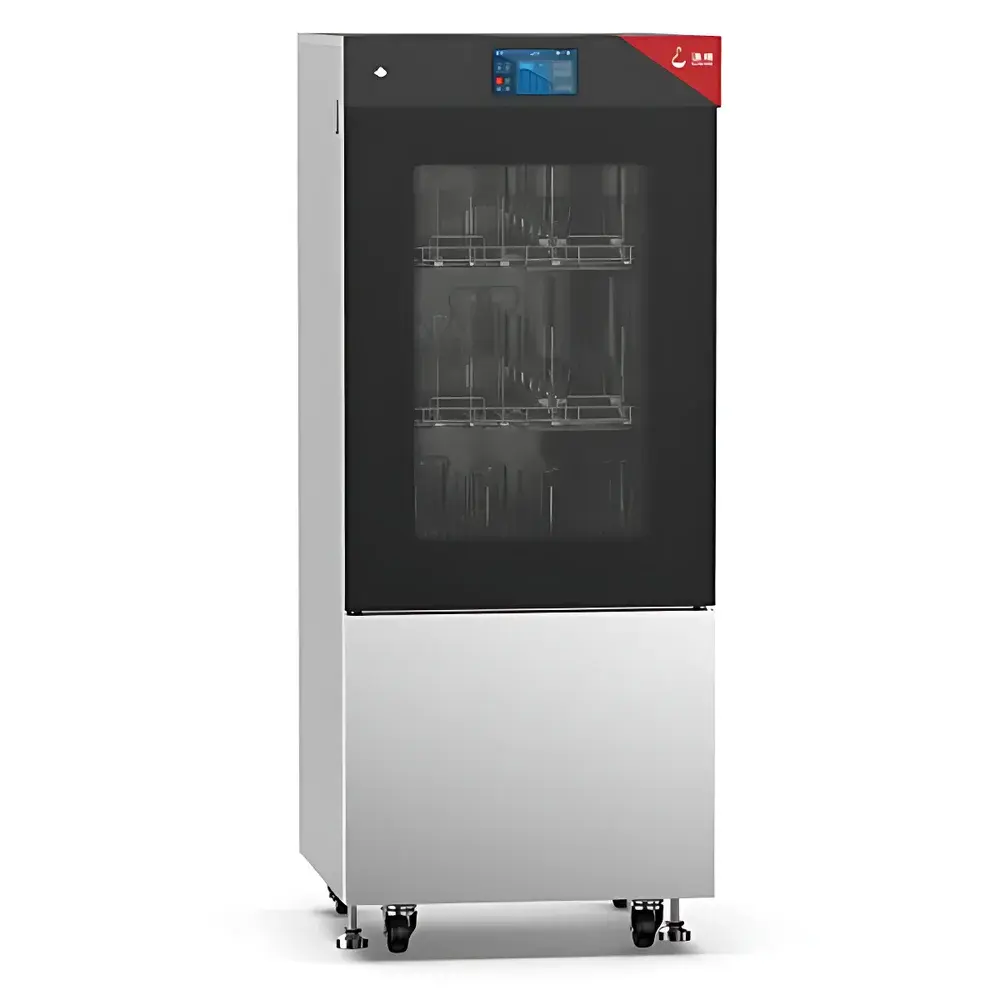
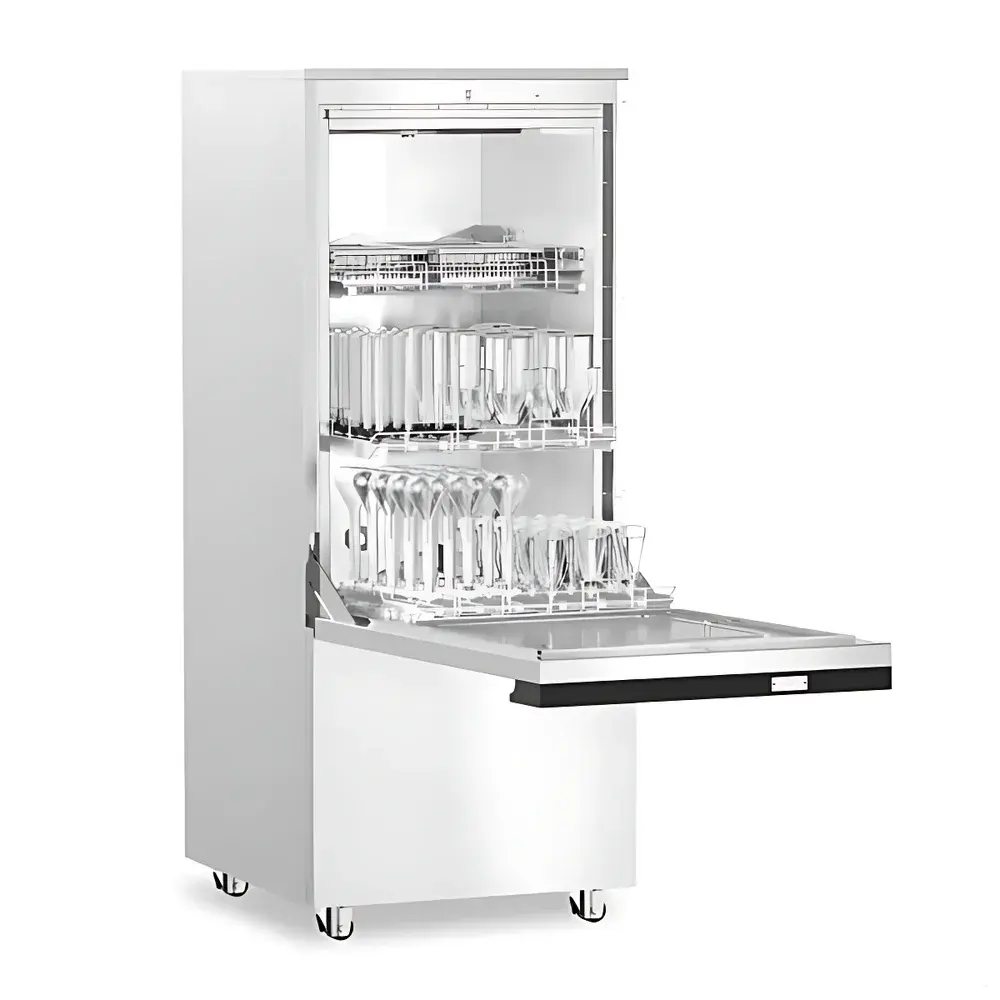
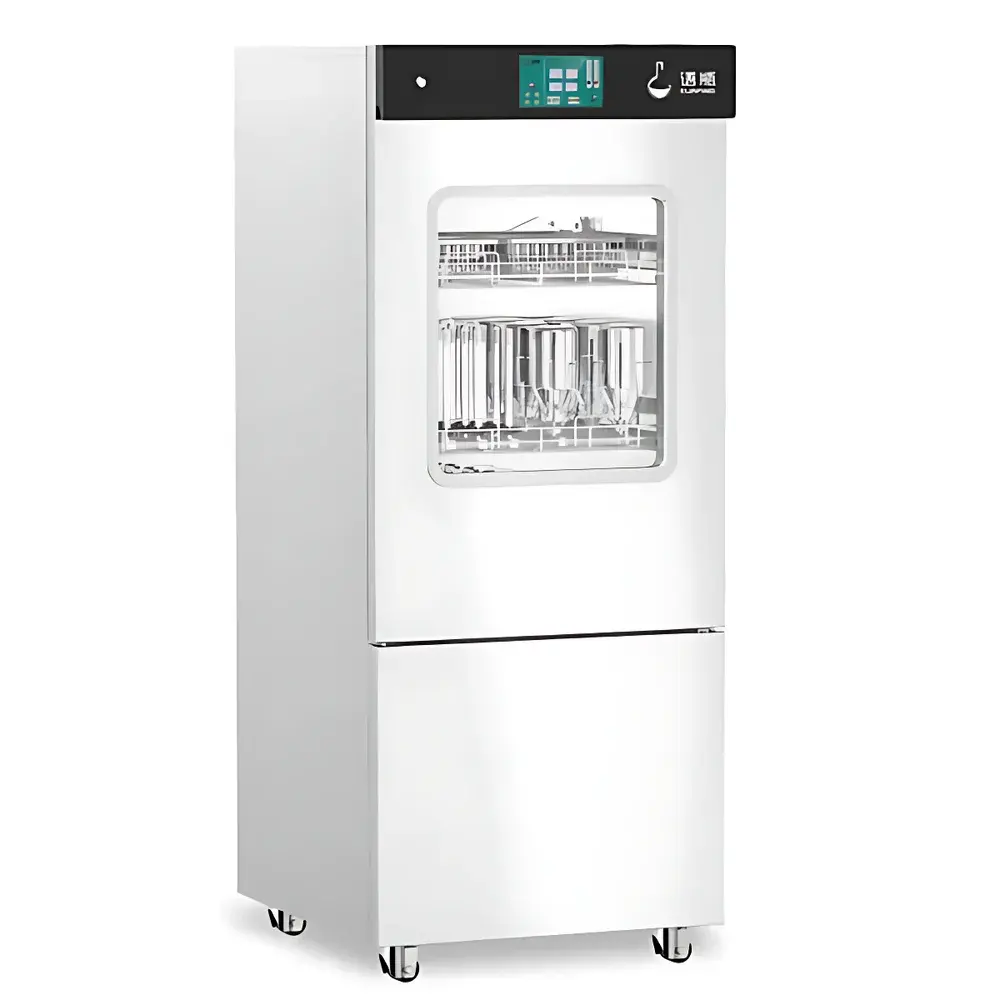
EURPING Q920D Laboratory Bottle Washer
| Brand | EURPING |
|---|---|
| Origin | Tianjin, China |
| Manufacturer Type | Direct Manufacturer |
| Region of Origin | Domestic (China) |
| Model | Q920D |
| Chamber Volume | 317 L |
| Heating Power | 4 kW |
| Maximum Cleaning Temperature | 95 °C |
| Circulation Pump Flow Rate | 0–800 L/min |
| Compatible Cleaning Agents | Acidic and Alkaline Solutions |
| External Dimensions (L×W×H) | 670 × 757 × 1650 mm |
| Rated Voltage/Frequency | 220 V / 50 Hz |
| Total Power Consumption | 5 kW |
| Touchscreen Interface | 9-inch capacitive display |
| Predefined Programs | 30 standard |
| Custom Programs | 120 user-configurable |
| Access Control | Three-tier permission system with fingerprint authentication |
| Drying System | Dual HEPA-filtered compressed-air drying modules |
| Condensation Technology | EU-W water-saving condensing system |
| Safety Features | Electronic safety lock, auto-locking door, overtemperature protection (heater, hot air heater, pump, blower), real-time leak detection, dry-run protection, power-loss resume function, multi-stage filtration |
Overview
The EURPING Q920D Laboratory Bottle Washer is an engineered solution for high-throughput, traceable, and GxP-aligned cleaning of glassware and plastic labware in regulated research, quality control, and clinical testing environments. Designed around a closed-loop, recirculating spray-wash principle, the system delivers reproducible cleaning performance via precisely controlled thermal, mechanical, and chemical parameters. Its 317 L monolithic chamber—pressure-formed without internal welds—eliminates crevices where residues or biofilms may accumulate, supporting ISO 15883-1 compliance for washer-disinfectors used in laboratory settings. The Q920D operates across a validated temperature range up to 95 °C, enabling thermally assisted removal of organic, inorganic, and proteinaceous residues while maintaining compatibility with both acidic and alkaline detergent chemistries. All operational events—including pump activation, heater duty cycle, door status, sensor readings, and program execution—are timestamped and logged internally, forming an auditable electronic record suitable for GLP, GMP, and ISO/IEC 17025 workflows.
Key Features
- Monolithic 317 L stainless steel chamber with seamless, weld-free interior—designed to prevent residue entrapment and simplify validation
- Dual-stage HEPA-filtered compressed-air drying system delivering uniform airflow and particulate-free drying
- EU-W water-saving condensing technology reduces condensate water consumption by up to 40% versus conventional systems
- Variable-frequency circulation pump (0–800 L/min) with real-time pressure monitoring and spray arm rotational speed feedback
- 9-inch industrial-grade touchscreen interface with intuitive navigation, multilingual support, and embedded audit trail functionality
- Three-level user access control (administrator, supervisor, operator) with optional fingerprint biometric authentication
- Real-time basket recognition via FL-EXCH modular rack system—detects rack type, orientation, and loading status on-screen
- Comprehensive safety architecture including electronic door interlock, multi-point overtemperature cutoffs, leak detection, and automatic power-resume after interruption
Sample Compatibility & Compliance
The Q920D accommodates a broad spectrum of common laboratory vessels: volumetric flasks (250 mL tiered across three levels), chromatography vials (up to 900 units per cycle), test tubes, Erlenmeyer flasks, beakers, graduated cylinders, wide-mouth bottles, and narrow-neck sample containers. Its programmable spray dynamics and adjustable dwell times allow optimization for fragile plastics (e.g., polypropylene centrifuge tubes) and heat-sensitive coatings. The system meets structural and functional requirements outlined in ISO 15883-1:2018 (washer-disinfectors for thermolabile medical devices) and aligns with key elements of ASTM E2500-13 (risk-based approach to equipment qualification). While not certified as a medical device washer, its design principles—including traceable cycle execution, calibrated temperature monitoring, and nonvolatile memory logging—support qualification under FDA 21 CFR Part 11 when deployed in pharmaceutical QC labs.
Software & Data Management
The embedded microcontroller runs a deterministic real-time OS with deterministic I/O handling. Each cleaning cycle generates a structured log file containing timestamps, setpoints, actual values (temperature, pressure, flow rate), alarm events, and user identity. Logs are stored in nonvolatile flash memory with write-cycle redundancy and exportable via USB or Ethernet (optional). The system supports CSV export for integration into LIMS or ELN platforms. Audit trail records are immutable post-execution and include change history for all user-modifiable parameters. Software validation documentation (IQ/OQ templates, test scripts, and protocol examples) is available upon request for regulated users.
Applications
- Pre-analytical preparation of HPLC/GC vials and autosampler racks in analytical chemistry labs
- Routine decontamination of volumetric glassware in calibration laboratories requiring ISO/IEC 17025 traceability
- Residue removal from cell culture flasks and bioreactor accessories in life science R&D facilities
- Cleaning validation support for pharmaceutical manufacturing environments (e.g., cleaning verification prior to batch release)
- High-volume processing of reusable pipette tips, PCR tubes, and microcentrifuge tubes in molecular diagnostics labs
- Removal of radioactive or cytotoxic residues under controlled containment protocols (when configured with exhaust ducting)
FAQ
Does the Q920D support automated data export to LIMS?
Yes—via USB mass storage or optional Ethernet interface, logs can be exported in CSV format compatible with most LIMS and ELN systems.
Is the system compliant with 21 CFR Part 11 for electronic records?
The hardware and firmware support Part 11 requirements (audit trail, electronic signatures via fingerprint, role-based access); full compliance depends on site-specific SOPs and validation practices.
Can the Q920D clean plastic labware without deformation?
Yes—programmable temperature ramping, reduced spray pressure modes, and extended rinse cycles minimize thermal stress on polypropylene and polycarbonate items.
What maintenance is required for long-term reliability?
Routine tasks include filter cleaning every 50 cycles, descaling every 200 cycles (depending on water hardness), and annual verification of temperature sensors and pressure transducers.
Is external ventilation required for the drying system?
No—dual HEPA-filtered compressed-air drying operates in closed-loop mode; however, optional exhaust ducting is available for solvent-laden or high-humidity environments.
Related Products



