
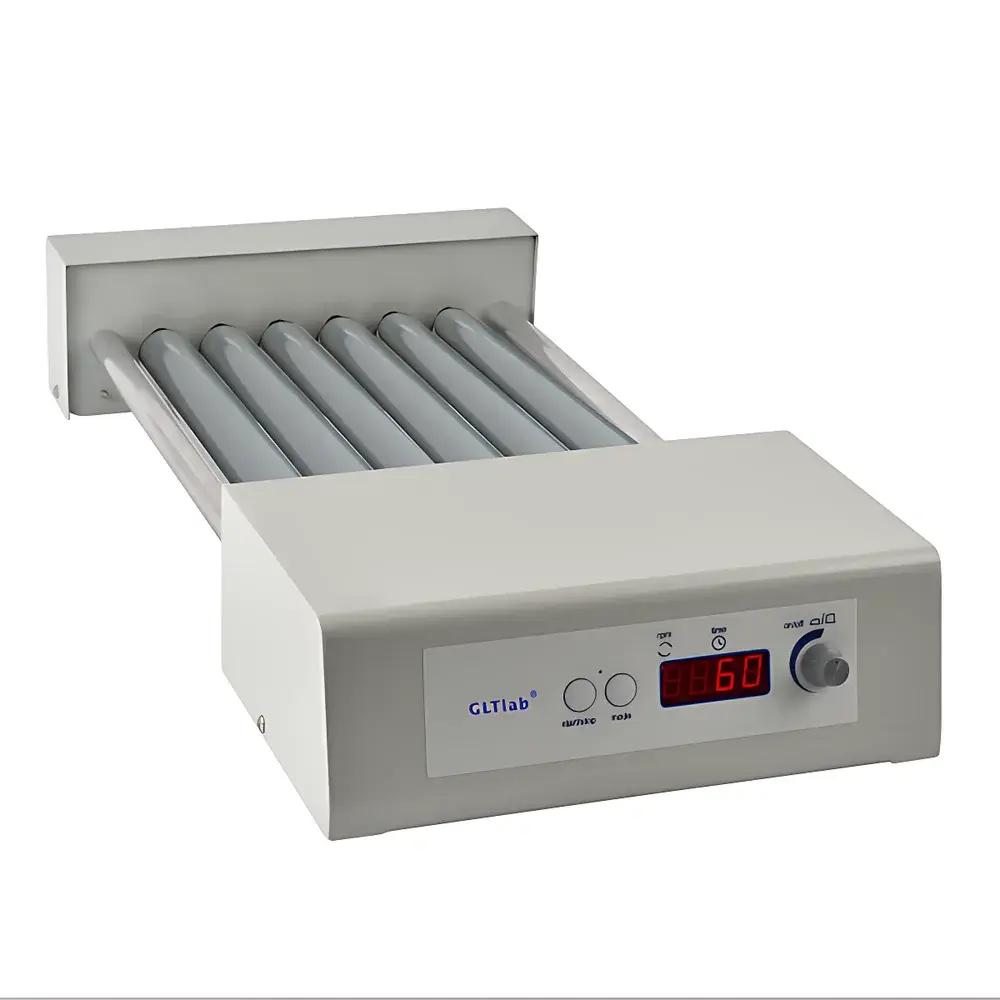
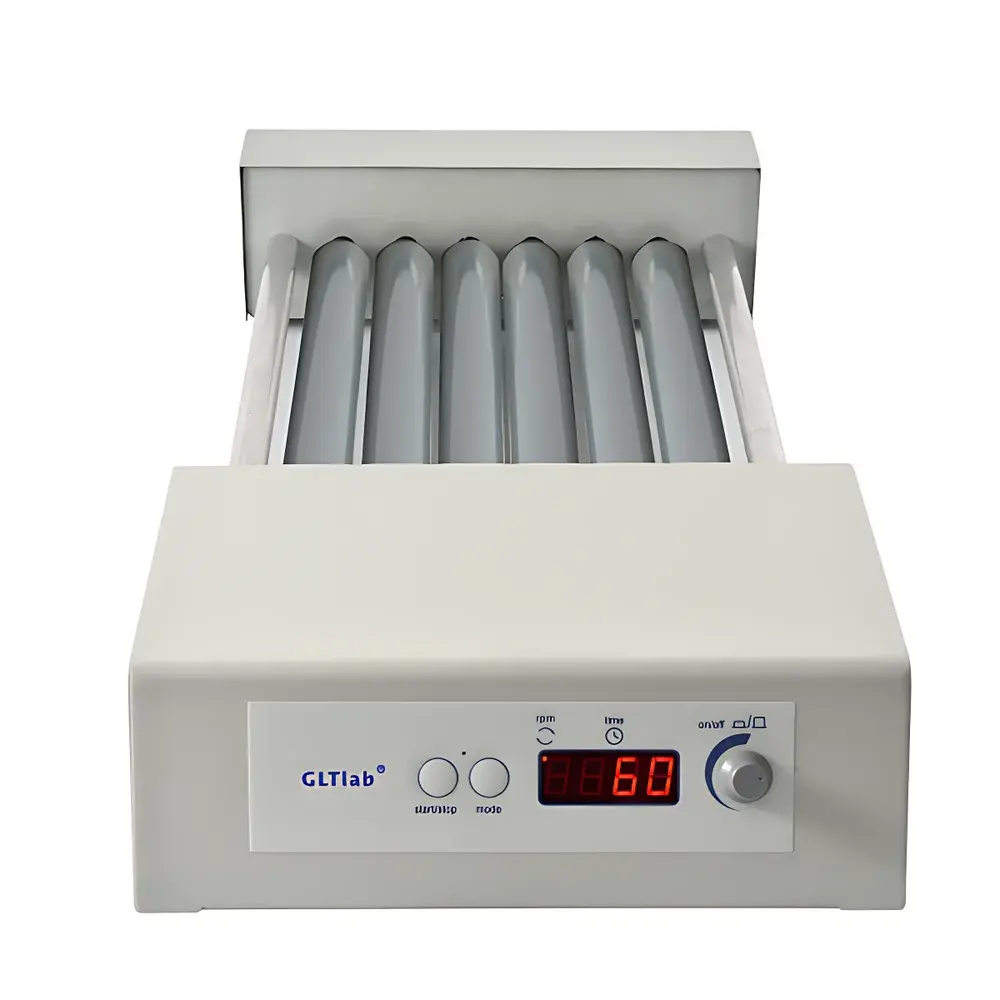
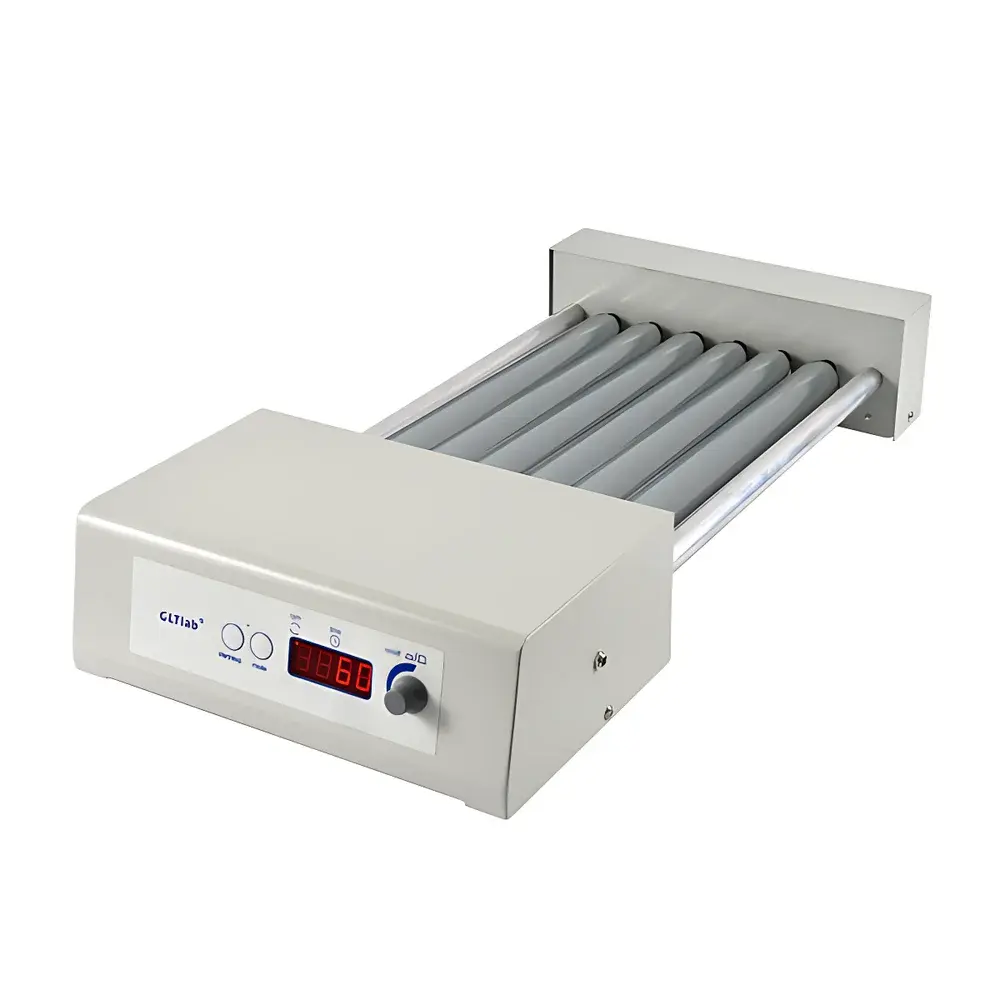
GLTLab MTR-1D Digital 6-Axis Rolling & Rocking Homogenizer
| Brand | GLTLab |
|---|---|
| Origin | Guangdong, China |
| Manufacturer Type | Direct Manufacturer |
| Product Category | Domestic |
| Model | MTR-1D-B |
| Price | USD 420 (FOB) |
| Dimensions (W×D×H) | 556 × 286 × 98 mm |
| Processing Capacity | 0–10 kg |
| Speed Range | 5–300 rpm |
| Motion Modes | Rolling + Adjustable Rocking |
| Roll Axis Count | 6 |
| Roller Dimensions | 340 × 30 mm (L×Ø) |
| Timer Range | 0–540 min |
| Power Supply | 230 V, 50 Hz, 50 W |
| Operating Environment | −4 °C to +60 °C, ≤80% RH |
| Net Weight | 5.0 kg |
| Control Interface | Digital LCD with Keypad |
| Safety Features | Motor stall detection, overload protection, audible/visual alarm |
Overview
The GLTLab MTR-1D Digital 6-Axis Rolling & Rocking Homogenizer is an engineered solution for gentle, reproducible mixing of sensitive biological and material science samples. Unlike high-shear homogenizers or vortex mixers, the MTR-1D employs a dual-mode mechanical agitation principle—simultaneous rolling and programmable rocking—based on coaxial and angular offset roller axis kinematics. This design induces laminar, low-turbulence fluid motion within sealed containers, minimizing shear stress, foaming, and thermal degradation. The device operates on the principle of synchronized rotational translation: as six precision-machined rollers rotate at user-defined speeds (5–300 rpm), sample vessels—tubes, bottles, or vials—are passively engaged and rotated along their longitudinal axis. When configured in rocking mode, the roller assembly introduces a controlled angular oscillation (±2°–±5°, factory-calibrated), generating mild vertical displacement that enhances homogenization of viscous suspensions, cryopreserved specimens, and anaerobic solid–liquid dispersions. Its architecture supports continuous operation under environmentally constrained conditions—including incubators (up to +60 °C), cold rooms (+4 °C), and standard laboratory ambient—making it suitable for applications requiring strict thermal or atmospheric control.
Key Features
- Six independently aligned stainless-steel rollers with precision-ground surfaces ensure uniform torque transmission and long-term dimensional stability.
- Dual-motion capability: selectable rolling-only (coaxial alignment) or rolling-plus-rocking (angular offset) modes via front-panel configuration.
- Digital LCD interface with keypad navigation enables precise speed setting in 1-rpm increments and timer programming up to 540 minutes (9 hours).
- Integrated safety logic monitors motor current draw and rotational feedback; automatic shutdown occurs upon stall detection, overload (>10 kg), or encoder signal loss, accompanied by audible alert and error code display.
- Compact footprint (556 × 286 × 98 mm) and low power consumption (50 W) enable integration into biosafety cabinets, refrigerated chambers, and multi-instrument workstations.
- Universal vessel compatibility: accommodates tubes from 1.5 mL to 50 mL, cylindrical bottles up to Ø75 mm × 150 mm H, and irregularly shaped containers without adapter fixtures.
Sample Compatibility & Compliance
The MTR-1D is validated for use with whole blood, serum, plasma, bacterial culture broths, polymer precursor gels, battery slurry formulations, and cryogenic cell suspensions. Its low-shear profile meets handling requirements for fragile analytes such as exosomes, extracellular vesicles, and temperature-sensitive catalysts. While not certified to ISO 13485 or FDA 21 CFR Part 11 out-of-the-box, the instrument’s deterministic motion control, non-volatile timer/speed memory, and event-logged error reporting support GLP-compliant documentation when integrated into validated laboratory workflows. It complies with IEC 61010-1:2010 for electrical safety in laboratory equipment and operates within EMC Class B limits per EN 61326-1:2013.
Software & Data Management
The MTR-1D operates as a standalone embedded system with no external software dependency. All operational parameters—including set speed, elapsed time, remaining time, and fault history—are retained in non-volatile memory across power cycles. The digital controller logs up to 20 recent error events (e.g., E01 = motor stall, E02 = overload) with timestamp resolution of ±1 second. For audit-trail compliance, users may manually record session data (start time, speed, duration, vessel type) in laboratory notebooks or LIMS-integrated electronic records. Optional RS-232 serial output (available on request) permits basic telemetry logging to external PCs using terminal emulation software.
Applications
- Hematology: Gentle resuspension of sedimented RBCs and leukocyte pellets without hemolysis.
- Microbiology: Uniform dispersion of biofilm fragments and anaerobic culture media prior to plating or DNA extraction.
- Materials Science: Homogenization of cathode/anode slurries for Li-ion battery R&D, ensuring particle deagglomeration without binder degradation.
- Cryobiology: Controlled thawing of frozen cell stocks via low-speed rolling combined with ambient or chilled incubation.
- Pharmaceutical QA: Reconstitution of lyophilized reference standards and viscosity-sensitive protein formulations.
- Environmental Testing: Extraction of microplastics from sediment matrices using solvent-based agitation protocols.
FAQ
What types of containers are compatible with the MTR-1D?
Standard 1.5–50 mL centrifuge tubes, glass or plastic vials (up to Ø75 mm), and cylindrical bottles (max height 150 mm) are directly supported. No adapters or clamps are required due to the self-centering roller geometry.
Can the MTR-1D operate inside a CO₂ incubator?
Yes—it is rated for continuous operation at temperatures up to +60 °C and relative humidity ≤80%, provided ventilation clearance (≥5 cm on all sides) is maintained per IEC 61010-1.
Is speed calibration traceable to national standards?
Factory calibration uses a NIST-traceable optical tachometer; a Certificate of Conformance (CoC) with calibration date and tolerance (±2 rpm at 30–300 rpm) is supplied with each unit.
Does the device support remote monitoring or network connectivity?
Not natively; however, the optional RS-232 port (order code: MTR-1D-RS) enables basic command-and-status polling for integration into centralized lab automation systems.
What maintenance is required?
Roller surfaces should be wiped with isopropyl alcohol monthly; no lubrication or internal servicing is needed within the first 10,000 operating hours. The brushless DC motor has a rated service life of ≥20,000 hours.
Related Products



