
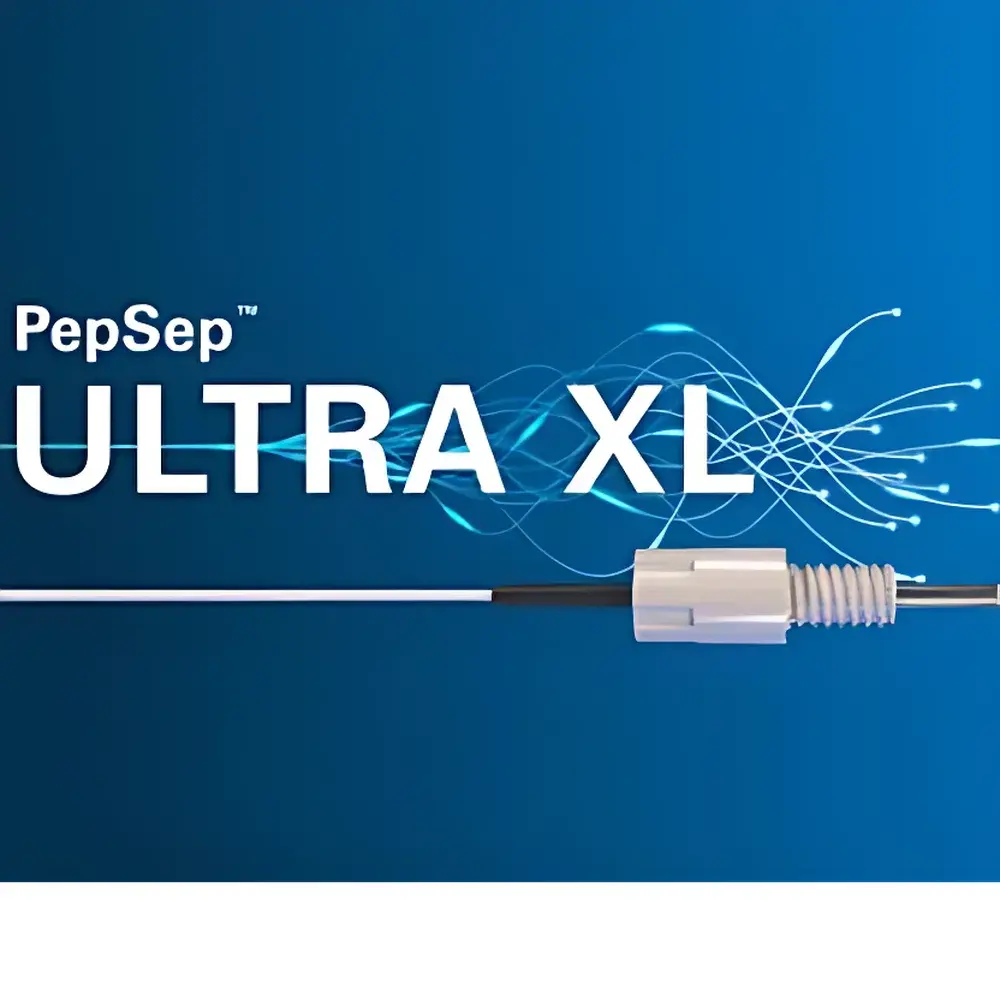
Bruker PepSep™ C18 Reversed-Phase HPLC Column for LC-MS/MS Proteomics
| Key | Brand: Bruker |
|---|---|
| Origin | Germany |
| Model | PepSep™ C18 |
| Type | Reversed-phase analytical column for nano/micro-flow LC-MS |
| Packing Material | Surface-modified silica with endcapping |
| Particle Size | 1.6 µm (typical for PepSep™ series) |
| Pore Size | 100 Å |
| Column ID | 75 µm × 25–50 cm (standard configurations) |
| Pressure Rating | ≤1000 bar |
| Compatible With | NanoLC, microLC, and timsTOF platforms (e.g., timsTOF Pro, timsTOF SCP) |
| Surface Chemistry | C18 bonded phase with low silanol activity |
| Batch-to-batch reproducibility | ≤3% RSD in retention time (n=5 injections, standard peptide mix) |
Overview
The Bruker PepSep™ C18 Reversed-Phase HPLC Column is an engineered chromatographic separation device designed specifically for high-sensitivity, high-throughput bottom-up proteomics workflows coupled to tandem mass spectrometry (LC-MS/MS). It operates on the principle of hydrophobic interaction chromatography, where peptides are retained on a chemically stable, surface-modified C18 stationary phase under aqueous mobile phase conditions and eluted via a gradient of increasing organic solvent (typically acetonitrile with 0.1% formic acid). The column’s sub-2-µm particle packing, narrow-bore format (75 µm inner diameter), and precisely controlled pore architecture enable exceptional peak capacity, resolution, and loading efficiency—critical parameters for deep proteome coverage and quantitative reproducibility. Its integration into nanoLC systems—particularly when paired with Bruker’s trapped ion mobility–time-of-flight (timsTOF) mass spectrometers—supports ultra-high scan speed acquisition modes such as Parallel Accumulation–Serial Fragmentation (PASEF®), maximizing duty cycle utilization and minimizing signal loss across complex biological samples.
Key Features
- Optimized for nano/micro-flow LC-MS coupling: Robust stainless-steel or fused-silica capillary construction with integrated emitter tip or zero-dead-volume union compatibility.
- High batch-to-batch reproducibility: Certified retention time RSD ≤3% across multiple lots using standardized tryptic digest reference standards (e.g., Yeast lysate or iRT kit).
- Low nonspecific adsorption: Endcapped, sterically shielded C18 ligands minimize peptide carryover and improve recovery of basic and hydrophilic analytes.
- Ultra-low backpressure design: Engineered for stable operation up to 1000 bar, enabling rapid gradients without compromising column longevity or system integrity.
- Tool-free installation: Integrated hand-tightenable ferrule and sleeve system ensures leak-free connections without torque wrenches or specialized tools—reducing setup time and operator variability.
- Compatible with extended gradient durations (60–240 min): Maintains consistent retention and peak shape across multi-hour separations required for deep-proteome profiling.
Sample Compatibility & Compliance
The PepSep™ column demonstrates broad compatibility with enzymatically digested proteomic samples—including trypsin-, Lys-C-, and Asp-N-digested lysates from mammalian, microbial, and plant sources—as well as post-translationally modified (PTM) peptides (e.g., phosphorylated, acetylated, ubiquitinated species). It meets critical requirements for regulated environments: columns are manufactured under ISO 9001-certified processes; lot-specific QC documentation includes chromatograms, retention time stability reports, and pressure profiles. While not a GMP-grade device per se, its performance consistency supports GLP-compliant discovery proteomics and method development aligned with ICH M10 and FDA Bioanalytical Method Validation guidance. No leachable compounds have been detected above 1 ppb in blank gradient runs (tested by LC-MS/MS), ensuring minimal background interference during low-abundance peptide detection.
Software & Data Management
PepSep™ columns are fully interoperable with Bruker’s instrument control and data analysis ecosystem. When used with timsTOF platforms, they integrate natively into DataAnalysis™ software (v5.1+) and the real-time database search engine ProteoScape™, which leverages PASEF-acquired mobility-resolved spectra for improved peptide identification confidence and false discovery rate (FDR) control. Column metadata—including lot number, installation date, and cumulative run count—is automatically logged in the acquisition method file, supporting audit trails compliant with 21 CFR Part 11 when deployed with validated electronic lab notebook (ELN) integrations. Retention time alignment algorithms in MaxQuant and Spectronaut also recognize PepSep™-generated elution profiles for cross-experiment normalization.
Applications
- Deep shotgun proteomics: Achieves >10,000 protein group identifications from single-shot HeLa digest injections on timsTOF SCP with 120-min gradients.
- Label-free quantification (LFQ): Delivers <5% median CV across technical replicates due to superior retention time stability and peak area reproducibility.
- Phosphoproteomics enrichment workflows: Resolves co-eluting phosphopeptide isomers with enhanced selectivity under acidic mobile phases (0.1% TFA or formic acid).
- Clinical cohort studies: Supports automated, walk-away operation over 500+ injections with no observable decline in resolution or sensitivity (verified per Bruker QC protocol).
- Single-cell proteomics: Enables robust separation of sub-nanogram peptide loads with sub-femtomole LODs when coupled to nanospray emitters and timsTOF fleX.
FAQ
What flow rates are recommended for optimal performance on the PepSep™ C18 column?
For 75 µm ID columns, the recommended flow rate is 250–300 nL/min using standard nanoLC systems; microflow configurations (300 µm ID) operate at 3–5 µL/min.
Can PepSep™ columns be regenerated or cleaned in-line between runs?
Yes—standard cleaning protocols include 10 column volumes of 95% acetonitrile/0.1% formic acid followed by re-equilibration; harsh solvents (e.g., isopropanol) are not recommended.
Is there a documented correlation between PepSep™ column lifetime and timsTOF PASEF cycle time?
Empirical data shows >800 injections maintain <10% resolution loss at 20 Hz PASEF scanning; column aging has negligible impact on mobility calibration stability.
Are PepSep™ columns compatible with non-Bruker mass spectrometers?
Yes—they conform to universal nanoLC interface standards (e.g., Thermo Scientific, Sciex, Waters) and have been validated on Q-Exactive HF-X and TripleTOF 6600+ platforms.
Does Bruker provide column qualification reports for regulatory submissions?
Upon request, lot-specific Certificates of Analysis (CoA) including retention time, asymmetry factor (As), and plate count (N) are supplied in PDF format compliant with ALCOA+ principles.




