
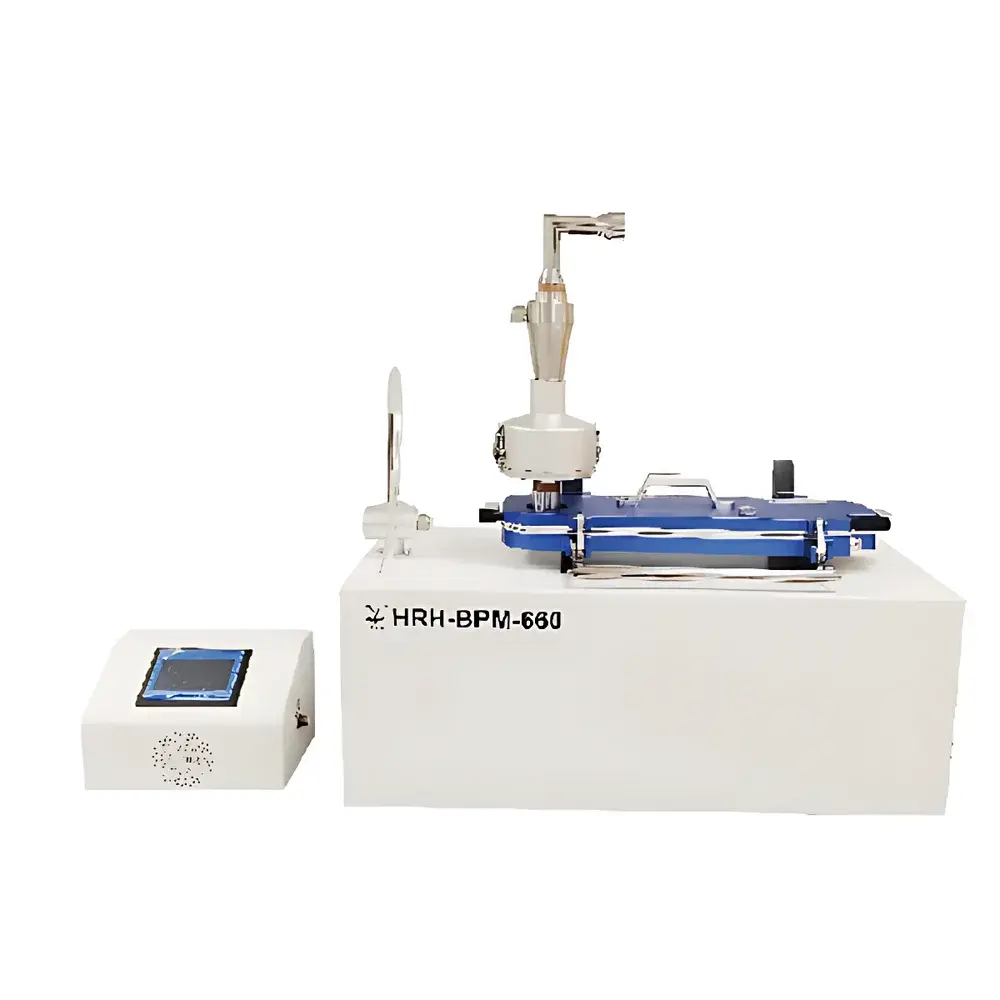
In Vitro–In Vivo Correlation (IVIVC) Testing System HRH-20 by Huironghe
| Brand | Huironghe |
|---|---|
| Model | HRH-20 |
| Origin | Beijing, China |
| Type | In Vitro–In Vivo Correlation (IVIVC) Simulation System for Orally Inhaled Products (OIPs) |
| Airflow Range | 0–100 L/min |
| Peak Inspiratory Flow Rate Simulation | 0–100 L/min |
| Flow Acceleration Rate | 0–15 L/s² |
| Respiratory Waveform Customization | Yes |
| Compliance Reference | Good Cascade Impactor Practices (GCIP), AIM & EDA Guidelines for Orally Inhaled Products (2013) |
| Intended Use | IVIVC development, aerodynamic particle size distribution (APSD) testing, delivered dose uniformity (DDU) assessment |
Overview
The HRH-20 In Vitro–In Vivo Correlation (IVIVC) Testing System is an engineered platform designed to bridge the gap between conventional pharmacopoeial in vitro testing and clinical pharmacokinetic behavior of orally inhaled products (OIPs). Unlike static-flow cascade impactor methods—such as those specified in USP <601>, Ph. Eur. 2.9.18, or JP 6.11—the HRH-20 implements dynamic, time-resolved airflow profiles that replicate physiological breathing patterns. Its core measurement principle is based on real-time pneumatic simulation of human inspiratory effort, integrating variable flow rate, acceleration, duration, and waveform morphology to modulate aerosol dispersion, throat deposition, and stage-wise particle impaction within next-generation impactors (NGIs) or Andersen cascade impactors (ACIs). This capability directly addresses a well-documented limitation in regulatory science: the weak correlation between fixed-flow in vitro data and in vivo lung deposition metrics, particularly for pressurized metered-dose inhalers (pMDIs), dry powder inhalers (DPIs), and soft-mist inhalers (SMIs).
Key Features
- Physiologically representative airflow generation: Programmable inspiratory waveforms with adjustable peak flow (0–100 L/min), rise time, and acceleration rate (0–15 L/s²), enabling simulation of pediatric, adult, geriatric, and disease-affected breathing profiles.
- High-fidelity pressure and flow control: Closed-loop feedback regulation ensures ≤±2% deviation from target waveform across full operational range, supporting reproducible APSD generation under GLP-compliant test conditions.
- Seamless NGI integration: Designed with standardized 22 mm mouthpiece interface and synchronized trigger logic for automated actuation timing relative to inspiratory onset—critical for accurate fine particle fraction (FPF) and mass median aerodynamic diameter (MMAD) determination.
- Modular software architecture: Supports import/export of respiratory waveforms in CSV format; includes preloaded templates aligned with GCIP-recommended profiles (e.g., slow-deep, fast-shallow, COPD-simulated).
- Rugged industrial-grade construction: Stainless-steel air path, ISO 8573-1 Class 2 compressed air compatibility, and electromagnetic interference (EMI)-shielded electronics ensure long-term stability in QC laboratory environments.
Sample Compatibility & Compliance
The HRH-20 is validated for use with all major commercial inhaler platforms—including pMDIs with spacers, DPIs with resistance-matched capsules, and SMI devices—and compatible with USP Apparatus 7 (Aerolizer), Ph. Eur. Annex 8, and FDA-recommended impactor configurations. It supports compliance with ICH Q5A(R2) and Q5C guidelines for product comparability studies and aligns with regulatory expectations outlined in FDA’s 2022 Guidance on “Demonstrating Bioequivalence for Generic Inhalation Aerosols and Nasal Sprays.” All system firmware and control logs are timestamped and audit-trail enabled, meeting baseline requirements for 21 CFR Part 11 electronic record integrity when paired with validated LIMS or ELN systems.
Software & Data Management
The embedded control interface provides real-time visualization of flow vs. time curves, pressure differentials across impactor stages, and event markers for actuation synchronization. Exported datasets include raw flow/time arrays, calculated inspiratory parameters (e.g., T50, Tpeak, inspiratory time), and metadata tags for batch, operator, and environmental conditions (temperature/humidity logged via optional sensor module). Data files conform to ASTM E2974-21 standards for inhalation testing metadata structure and are interoperable with WinCAS, Aerosol Particle Sizer (APS) analysis suites, and custom Python-based IVIVC modeling pipelines.
Applications
- Development of Level A IVIVC models linking in vitro FPF to in vivo pharmacokinetic AUC ratios.
- Comparative evaluation of device–formulation interactions under patient-representative breathing profiles.
- Supporting ANDA submissions through enhanced discrimination of formulation differences masked under fixed-flow testing.
- Root-cause analysis of batch-to-batch variability in lung deposition efficiency.
- Method qualification per USP <1201> for dynamic airflow-based APSD testing protocols.
FAQ
Does the HRH-20 meet FDA or EMA requirements for IVIVC method validation?
Yes—its dynamic waveform capability and traceable calibration protocol support alignment with EMA’s CHMP Reflection Paper on IVIVC (2021) and FDA’s Bioequivalence Recommendations for OIPs (2023), provided method-specific validation (precision, accuracy, robustness) is performed per ICH Q2(R2).
Can third-party respiratory profiles be imported into the system?
Yes—CSV-formatted flow/time data with column headers “Time_s” and “Flow_L_min” can be loaded and executed without modification.
Is the system compatible with non-NGI impactors such as ACI or Marple?
Yes—mechanical mounting adaptors and pressure compensation settings are configurable for any cascade impactor meeting ISO 27427:2013 dimensional specifications.
What maintenance is required to sustain waveform fidelity over time?
Annual recalibration of mass flow sensors and verification of actuator response latency against NIST-traceable reference standards is recommended; no consumables are required beyond standard compressed air filtration.





