
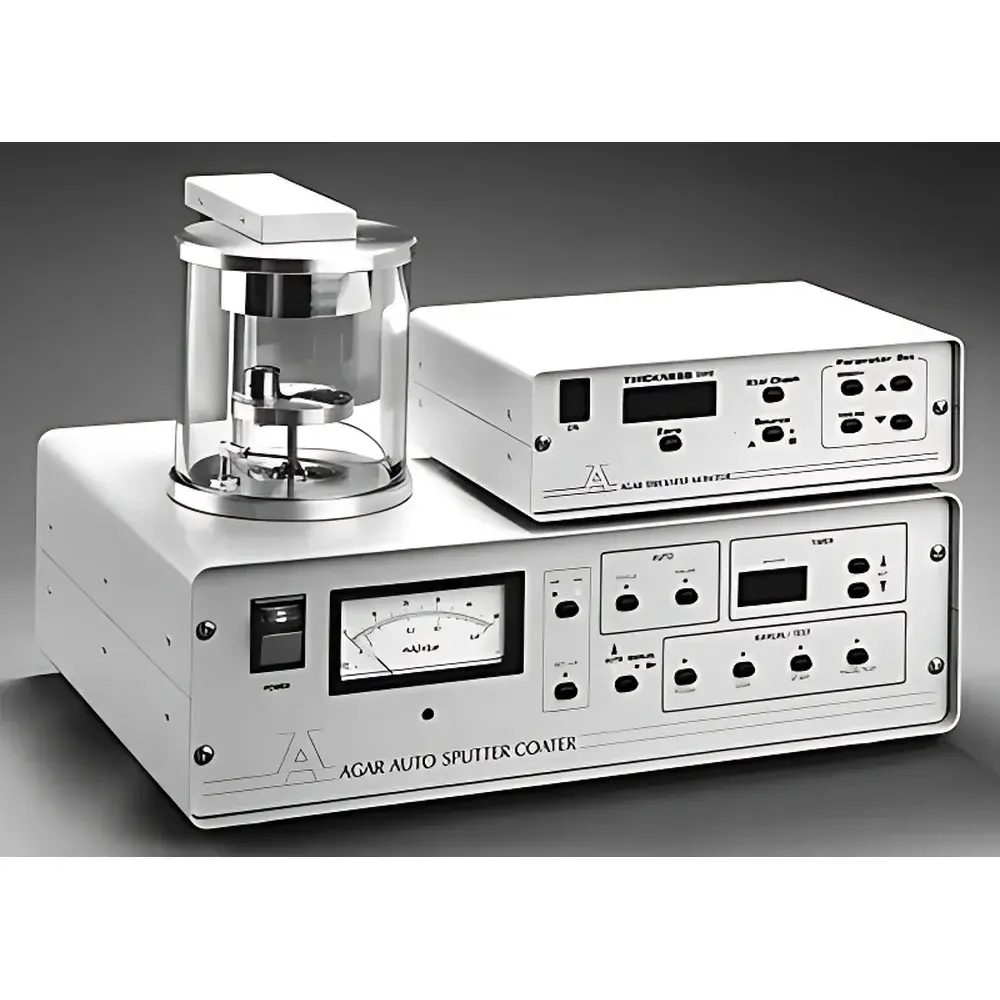
Agar Scientific AGB7341 High-Performance Sputter Coater for SEM Sample Preparation
| Brand | Agar Scientific / Oxford Instruments |
|---|---|
| Origin | UK |
| Model | AGB7341 |
| Chamber Dimensions | 120 mm Ø × 120 mm H (optional 150 mm × 165 mm) |
| Sample Stage Capacity | 12 standard pin-type stubs |
| Stage Height Adjustment Range | 0–60 mm |
| Sputter Head | Low-voltage planar magnetron |
| Target Diameter/Thickness | 57 mm Ø × 0.1 mm |
| Standard Target Material | Au |
| Optional Targets | Pt, Au/Pd, Pt/Pd, Ag |
| Max Current | 40 mA |
| Current Control Range | 0–50 mA |
| Vacuum Range | Atmosphere to 1 × 10⁻³ mbar |
| Process Gas | Argon (≥99.9% purity) |
| Pumping Speed | 2 L/s mechanical pump |
| Power Supply | 220 V, 50/60 Hz |
| Digital Timer | 0–300 s with pause function |
| Safety Features | Vacuum interlock, over-current protection |
| Optional Quartz Crystal Thickness Monitor | In-situ nanoscale monitoring (resolution: 0.1 nm) |
Overview
The Agar Scientific AGB7341 is a high-reliability, microprocessor-controlled sputter coater engineered specifically for reproducible, high-fidelity conductive coating of non-conductive and beam-sensitive specimens prior to scanning electron microscopy (SEM) analysis. It operates on the principle of DC magnetron sputtering—where energetic argon ions bombard a metallic target (e.g., gold or platinum), ejecting atoms that condense uniformly onto the sample surface to form a continuous, ultra-thin conductive film. Designed and manufactured in the UK under stringent quality control protocols, the AGB7341 delivers stable plasma generation, precise current regulation, and vacuum-integrated safety interlocks—ensuring consistent coating morphology, minimal thermal load, and negligible topographic distortion. Its compact stainless-steel chamber architecture supports routine lab throughput while maintaining compatibility with international vacuum standards (ISO 27400, ASTM E1558) and GLP-compliant documentation workflows.
Key Features
- Robust 304 stainless-steel vacuum chamber with optional enlarged dimensions (150 mm × 165 mm) for oversized or multi-stub configurations.
- Planar magnetron sputter head operating at low DC voltage (< 1.5 kV), enabling fine-grained, low-energy deposition ideal for delicate biological, polymeric, or ceramic specimens.
- Quick-change 57 mm diameter targets—including Au (standard), Pt, Au/Pd (80/20), Pt/Pd (60/40), and Ag—with integrated dark-space shielding to suppress peripheral arcing and enhance lateral uniformity.
- Digital microprocessor controller with real-time current/voltage feedback, programmable timer (0–300 s, ±0.1 s resolution), and “pause” functionality for process interruption without vacuum break.
- Integrated vacuum safety interlock system compliant with IEC 61000-6-2 and EN 61000-6-4; automatic gas purge and vent sequencing prevents accidental exposure during maintenance.
- Analog vacuum gauge calibrated from atmosphere to 1 × 10⁻³ mbar, paired with a 2 L/s oil-free rotary vane pump optimized for argon handling and rapid pump-down (< 90 s to operational pressure).
Sample Compatibility & Compliance
The AGB7341 accommodates up to twelve standard 12.7 mm or 25 mm pin-type SEM stubs simultaneously, with vertical stage adjustment (0–60 mm) enabling optimal source-to-substrate distance control for thickness uniformity across heterogeneous sample sets. It is validated for use with all major SEM platforms—including Zeiss Sigma, JEOL JSM series, Hitachi SU-series, Thermo Fisher Scientific (formerly FEI) Nova NanoSEM, Tescan MIRA, and Phenom XL—ensuring seamless integration into established imaging pipelines. All electrical and vacuum components conform to CE marking requirements, and the system meets essential clauses of ISO 13849-1 (safety-related parts of control systems). For regulated environments, optional audit-trail-enabled firmware supports 21 CFR Part 11–compliant operation when paired with validated thickness monitoring modules.
Software & Data Management
While the base AGB7341 operates via intuitive front-panel controls, optional PC connectivity (RS-232 or USB) enables remote parameter logging, session archiving, and batch protocol recall. When equipped with the optional QCM-6 quartz crystal monitor, the system provides real-time nanoscale thickness readout (0.1 nm resolution) using AT-cut 6 MHz crystals—calibrated per ASTM F1122 for metallic film density assumptions. All deposition parameters (current, time, pressure, gas flow) are timestamped and exportable as CSV files, supporting traceability requirements under ISO/IEC 17025 and internal QA/QC review cycles.
Applications
This sputter coater serves critical roles across materials science, life sciences, geology, and failure analysis laboratories. Typical applications include: metallization of insulating polymer sections for high-resolution secondary electron imaging; carbon-free conductive coating of forensic fibers prior to EDS elemental mapping; ultra-thin Pt coating of cryo-fractured lipid bilayers to preserve native nanostructure; and sequential dual-target deposition (e.g., Au nucleation + Cr adhesion layer) for TEM grid preparation. Its stable low-current regime (< 40 mA) minimizes substrate heating—making it suitable for temperature-sensitive specimens such as hydrated gels, freeze-dried tissues, and photoresist-coated wafers.
FAQ
What vacuum level is required for optimal gold sputtering?
A base pressure of ≤5 × 10⁻³ mbar is recommended prior to argon introduction; final working pressure during sputtering is typically maintained between 2–8 × 10⁻² mbar.
Can the AGB7341 be used for carbon evaporation?
No—this is a DC magnetron sputter coater; carbon coating requires thermal evaporation or arc discharge systems (e.g., Agar B7390 or Leica EM ACE600).
Is the quartz crystal monitor compatible with all target materials?
Yes—the QCM-6 module supports density calibration for Au, Pt, Pd, Cr, Ir, and C (via user-defined Z-factor input), enabling accurate thickness estimation across material classes.
Does the system support automated gas mixing (e.g., Ar/O₂)?
Not natively; the AGB7341 is configured for pure argon sputtering only. Mixed-gas operation requires external mass flow controllers and custom vacuum interface hardware.
How often should the target be replaced?
Target lifetime depends on cumulative sputtering time and current settings; typical Au targets last ≥150–200 minutes at 30 mA before requiring replacement due to erosion-induced non-uniformity.




