
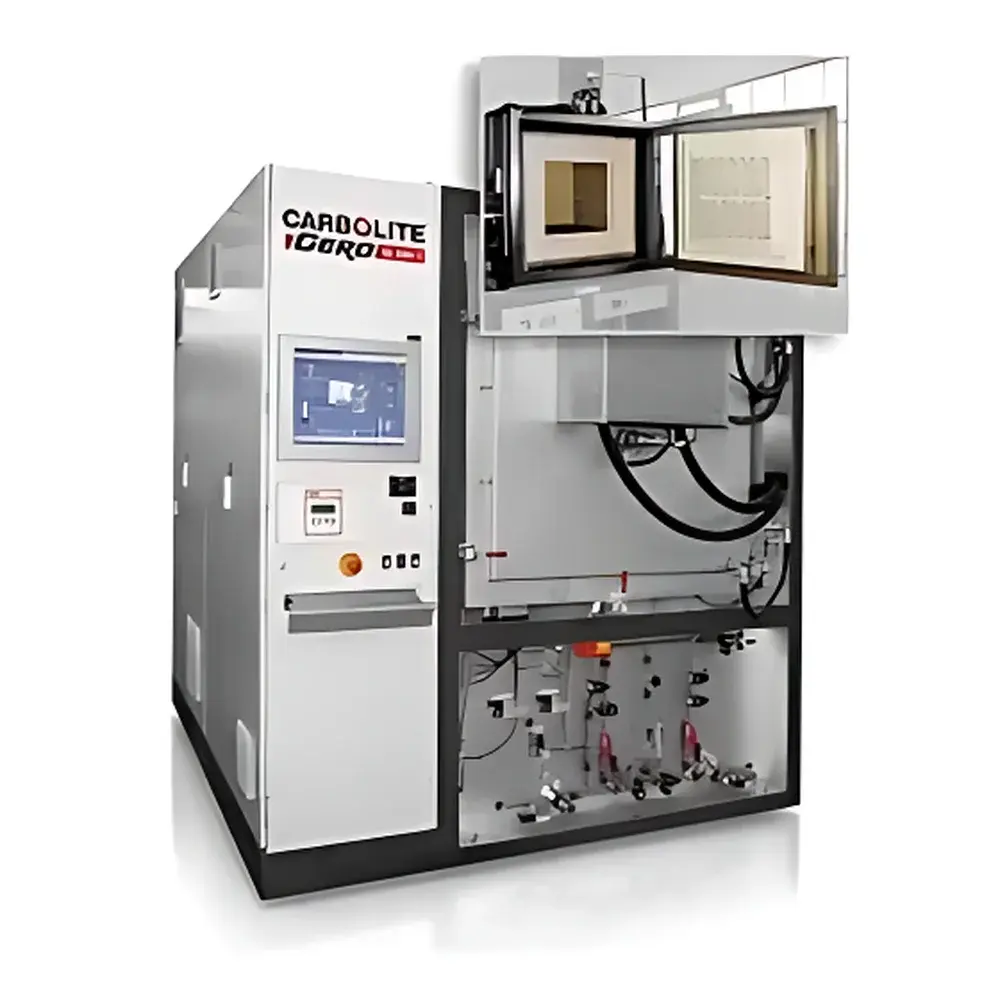
Carbolite Gero HTK KE Ceramic Fiber Box Furnace
| Brand | Carbolite Gero |
|---|---|
| Origin | Germany |
| Model | HTK KE |
| Type | Box-type Muffle Furnace |
| Max Operating Temperature | 1350 °C (with CrFeAl heating elements) |
| Heating Element Options | CrFeAl (up to 1350 °C) or MoSi₂ (up to 1800 °C, optional) |
| Chamber Volume Options | 8 L, 25 L, 80 L, 220 L, 400 L, 600 L |
| Atmosphere Compatibility | Air, 100% O₂, inert gas (low-purity), short-term rough vacuum (10–100 mbar) |
| Door Configuration | Front-opening rectangular chamber |
| Insulation | Low-thermal-mass ceramic fiber |
| Compliance | Designed for GLP-compliant thermal processing |
Overview
The Carbolite Gero HTK KE is a high-performance ceramic fiber box furnace engineered for precision thermal processing in research laboratories, materials development centers, and pilot-scale production environments. Based on the fundamental principle of resistive heating via embedded metallic or refractory heating elements—specifically CrFeAl alloy (standard) or MoSi₂ (optional)—the HTK KE delivers rapid thermal response, exceptional temperature uniformity, and repeatable thermal profiles across its working chamber. Its low-thermal-mass ceramic fiber insulation minimizes energy consumption while enabling fast ramp rates (typically 5–15 °C/min, depending on setpoint and volume) and tight thermal stability (±1 °C at steady state within the specified working zone). Unlike traditional brick-lined muffle furnaces, the HTK KE’s modular fiber architecture reduces thermal inertia, allowing precise control over dwell time, cooling profiles, and multi-step programs—critical for processes such as binder burnout, sintering, ashing, and thermal gravimetric pre-treatment.
Key Features
- Front-opening rectangular chamber design ensures ergonomic sample loading/unloading and full access to the hot zone without compromising thermal integrity.
- Multi-volume configuration: Six standard internal volumes (8 L to 600 L) accommodate applications ranging from small-batch R&D (e.g., 25 L for CIM feedstock debinding) to large-scale process qualification (e.g., 400 L for ceramic component sintering).
- Dual heating element compatibility: Standard CrFeAl elements rated for continuous operation up to 1350 °C; optional MoSi₂ elements support extended-range operation up to 1800 °C under oxidizing atmospheres.
- Atmosphere flexibility: Certified for use in ambient air, controlled oxygen (including 100% O₂), and inert gas environments (N₂, Ar); suitable for low-purity inert conditions where trace oxygen tolerance is acceptable.
- Rough vacuum capability: Short-duration operation down to ~10–100 mbar is feasible, though not intended for high-vacuum or UHV applications due to inherent permeability of ceramic fiber insulation.
- Integrated safety architecture: Includes overtemperature protection (independent thermocouple + cut-off relay), door interlock, and real-time fault logging compliant with IEC 61000-6-2/6-4 EMC standards.
Sample Compatibility & Compliance
The HTK KE supports diverse sample formats—including crucibles (alumina, quartz, graphite), ceramic green bodies, metal powders, polymer composites, and catalyst substrates—without risk of cross-contamination from refractory lining erosion. Its ceramic fiber chamber eliminates the particulate shedding common in traditional firebrick furnaces, making it suitable for ISO Class 5–7 cleanroom-adjacent workflows. The furnace meets key regulatory expectations for thermal process validation: temperature mapping per ASTM E2251, data integrity per FDA 21 CFR Part 11 (when paired with Carbolite Gero’s optional LogTag® software), and documentation readiness for GLP/GMP audits. It is routinely deployed in compliance-critical applications such as USP heavy metal residue testing, ASTM C1171 ceramic densification studies, and ISO 5667-19 solid waste thermal treatment validation.
Software & Data Management
The HTK KE integrates seamlessly with Carbolite Gero’s proprietary Centurion™ control system, offering programmable multi-segment ramps, soak profiles, and cooling rate modulation. Optional Ethernet/RS485 connectivity enables remote monitoring and SCADA integration. When configured with LogTag® data logger firmware, the system provides time-stamped, tamper-evident temperature records with electronic signatures, audit trails, and exportable CSV/Excel reports—fully aligned with 21 CFR Part 11 requirements for electronic records and signatures. All thermal cycles are timestamped, user-ID logged, and stored locally with 32 MB non-volatile memory (expandable via USB).
Applications
- Air sintering of technical ceramics (Al₂O₃, ZrO₂, SiC) and powder metallurgy compacts
- Debinding of ceramic injection molding (CIM) and metal injection molding (MIM) feedstocks under controlled oxygen partial pressure
- Thermal decomposition of organic binders and carbonaceous residues
- Heat treatment of aerospace superalloys and refractory metals in oxidizing atmospheres
- Pre-firing and calcination of battery cathode precursors (e.g., NMC, LFP)
- Residue analysis and ash content determination per AOAC 942.05 and ISO 2171
FAQ
Can the HTK KE operate under hydrogen or reducing atmospheres?
No. Hydrogen service is not permitted due to embrittlement risks with CrFeAl heating elements and potential reaction with ceramic fiber insulation. For H₂-compatible thermal processing, consult Carbolite Gero’s HTM series.
Is the furnace suitable for long-term vacuum operation?
It is not designed for sustained vacuum use. Ceramic fiber insulation is inherently porous; only short-duration rough vacuum (10–100 mbar) is supported for degassing prior to atmosphere introduction.
What calibration documentation is provided?
Each unit ships with a factory-as-tested certificate of conformity, including as-installed temperature uniformity data (per DIN EN 60068-3-5) and thermocouple calibration traceable to UKAS/NIST standards.
How is temperature uniformity verified across chamber sizes?
Uniformity is validated per DIN EN 60068-3-5 using 9-point mapping (center + 8 peripheral locations) at 1000 °C and 1300 °C; typical deviation is ≤ ±3 °C in the usable working zone for all models.
Does the HTK KE support automated sample handling integration?
Yes—via optional 0–10 V analog output and digital I/O ports, enabling synchronization with robotic loaders, conveyor interfaces, or PLC-based batch management systems.



