
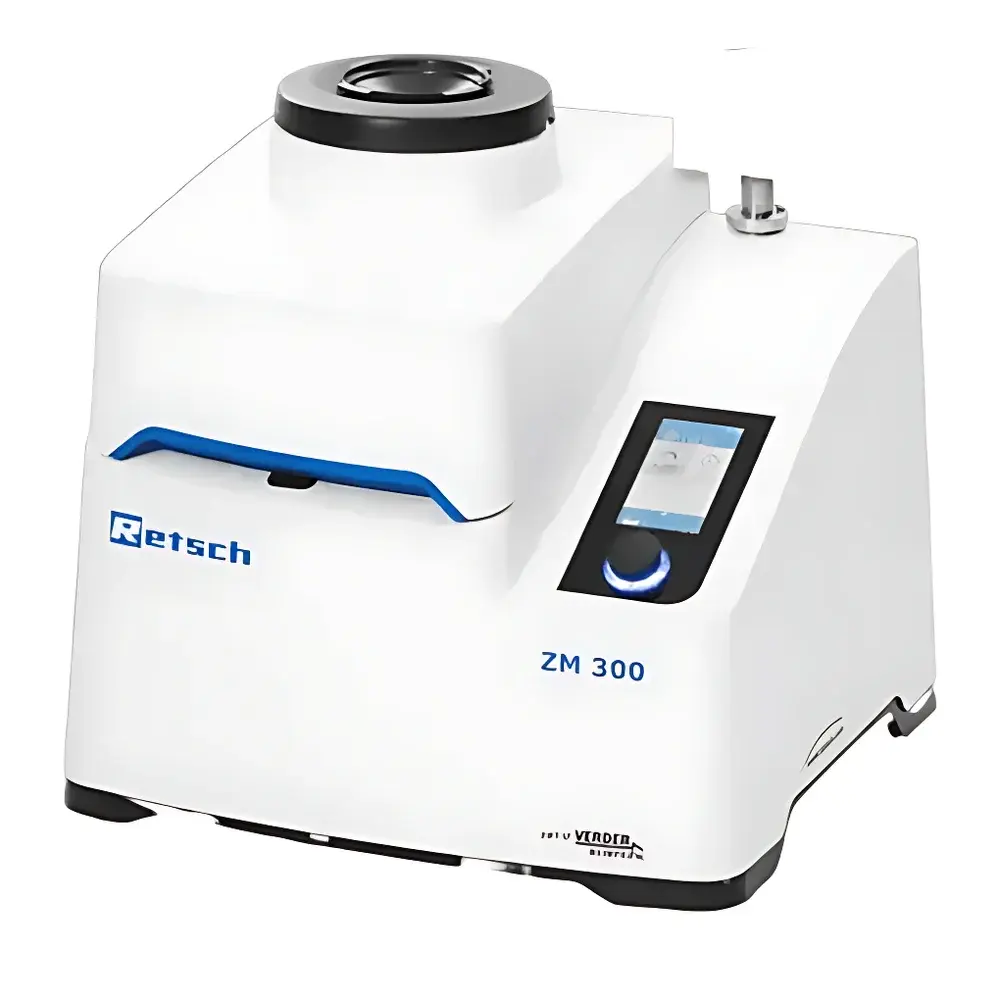
RETSCH ZM 300 Ultra-Centrifugal Grinder
| Brand | RETSCH |
|---|---|
| Origin | Germany |
| Model | ZM 300 |
| Instrument Type | Ultra-centrifugal grinder |
| Sample Type | Soft to fibrous materials |
| Feed Size | < 10 mm |
| Final Particle Size | < 40 µm |
| Rotational Speed Range | 6,000 – 23,000 rpm |
| Sieve Aperture Range | 0.08 – 10 mm |
| Collection Vessel Capacity | 250 mL – 4.5 L |
| Temperature Monitoring | Integrated sensor at collection pan (near sieve ring) |
Overview
The RETSCH ZM 300 Ultra-Centrifugal Grinder is an engineered solution for high-speed, controlled-size reduction of soft, brittle, fibrous, and temperature-sensitive materials in analytical and industrial laboratories. Operating on the principle of ultra-centrifugal impact grinding, the instrument accelerates samples radially outward using a high-velocity rotor, forcing them against a stationary ring sieve where particle size is determined by sieve aperture and kinetic energy transfer. Unlike conventional disc or jaw mills, the ZM 300 achieves fine comminution through precise control of rotational speed (6,000–23,000 rpm), sieve geometry, and thermal management—enabling reproducible sub-40 µm output with minimal heat generation. Its maximum peripheral speed of 118 m/s (at 23,000 rpm) exceeds legacy models such as the ZM 200 (98 m/s), delivering up to 20% finer particles and 15% higher throughput for feedstocks like animal meal, polymers (e.g., POM, PP), and plant biomass. The system is purpose-built for compliance-critical environments, including food safety testing (AOAC, ISO 6497), feed analysis (ISO 6498), and pharmaceutical R&D (USP & EP monographs).
Key Features
- Integrated temperature sensor monitoring collection pan surface near the sieve ring—displayed in real time on the intuitive touch interface to prevent thermal degradation of volatiles or moisture-sensitive analytes
- Wide speed range (6,000–23,000 rpm) enables process optimization: low speeds (6,000–10,000 rpm) suppress dust formation during coarse grinding; high speeds maximize fineness and throughput
- Modular sieve system with interchangeable ring sieves (0.08–10 mm aperture) and rotor options (6-, 12-, or 24-tooth configurations) tailored to material brittleness and desired particle distribution
- Push-fit assembly design eliminates tools for rapid disassembly—rotor, sieve ring, and collection pan are accessible within seconds for cleaning or cross-contamination prevention
- Material-contact components available in multiple grades: stainless steel 1.4404, tungsten carbide-coated, or titanium-niobium coated—ensuring trace-metal-free grinding for elemental analysis (e.g., ICP-MS sample prep)
- Optional DR 100 automatic feeder enables consistent, load-controlled dosing into the grinding chamber—critical for batch reproducibility across multi-gram samples
Sample Compatibility & Compliance
The ZM 300 accommodates diverse matrices without pre-conditioning: animal feed, cereals, dried herbs, polymer granules, pharmaceutical tablets, rubber, wood chips, and even cryogenically embrittled samples (e.g., frozen tissue, thermoplastics). Its design supports both ambient and cryogenic grinding protocols—using liquid nitrogen or dry ice to stabilize heat-labile compounds prior to comminution. All wetted parts comply with FDA 21 CFR Part 11 requirements when paired with RETSCH’s optional software suite, supporting audit trails, electronic signatures, and secure data export. The instrument meets CE marking standards (2014/30/EU EMC Directive, 2014/35/EU Low Voltage Directive) and is routinely validated per GLP/GMP guidelines for QC labs in food, agriculture, and chemical sectors.
Software & Data Management
While the ZM 300 operates standalone via its 5.7-inch TFT touchscreen, it integrates seamlessly with RETSCH’s EASY MILL software (optional) for method storage, parameter logging, and PDF report generation. Each grinding run records timestamp, speed, duration, sieve ID, temperature profile, and load status—exportable as CSV or XML for LIMS ingestion. Full traceability aligns with ISO/IEC 17025:2017 clause 7.7 (result reporting) and supports 21 CFR Part 11-compliant workflows when deployed with user access controls and electronic signature modules.
Applications
- Food & Feed: Homogenization of poultry feed, cereal grains, and pet food for proximate analysis (crude protein, fiber, ash); preparation of reference materials per ISO 6497
- Polymers & Plastics: Cryo-grinding of POM, PP, PET flakes for FTIR, DSC, or rheological characterization
- Agriculture: Rapid milling of straw, hay, and silage for NIRS calibration or nutrient profiling
- Pharmaceuticals: Pre-formulation grinding of APIs and excipients under GMP conditions; low-dust processing of hygroscopic powders
- Environmental: Comminution of soil, compost, or waste plastics prior to heavy metal screening (EPA Method 3050B)
- Research: Particle size distribution studies using laser diffraction (e.g., Mastersizer) where narrow PSD and minimal amorphization are essential
FAQ
What is the smallest achievable particle size with the ZM 300?
Final particle size depends on sieve aperture, material properties, and operational parameters. With a 0.08 mm sieve and optimized speed, median particle size (D50) typically reaches ≤40 µm for brittle organics; sub-20 µm is attainable for select polymers under cryogenic conditions.
Can the ZM 300 be used for cryogenic grinding?
Yes—the instrument is compatible with liquid nitrogen and dry ice pre-cooling protocols. No internal modifications are required; users simply cool samples externally before loading.
How does temperature monitoring improve method reproducibility?
Real-time temperature feedback allows operators to adjust speed or duration to maintain thermal stability—preventing loss of volatiles (e.g., essential oils, fatty acids) and ensuring consistent particle morphology across replicates.
Is the ZM 300 suitable for regulated QC environments?
Yes—when configured with EASY MILL software and validated SOPs, it supports full 21 CFR Part 11 compliance, including audit trails, user authentication, and electronic signatures.
What maintenance is required for long-term performance?
Routine cleaning after each use (all contact parts dishwasher-safe); annual inspection of rotor balance and sieve integrity; calibration of temperature sensor every 12 months per ISO/IEC 17025 recommendations.



