
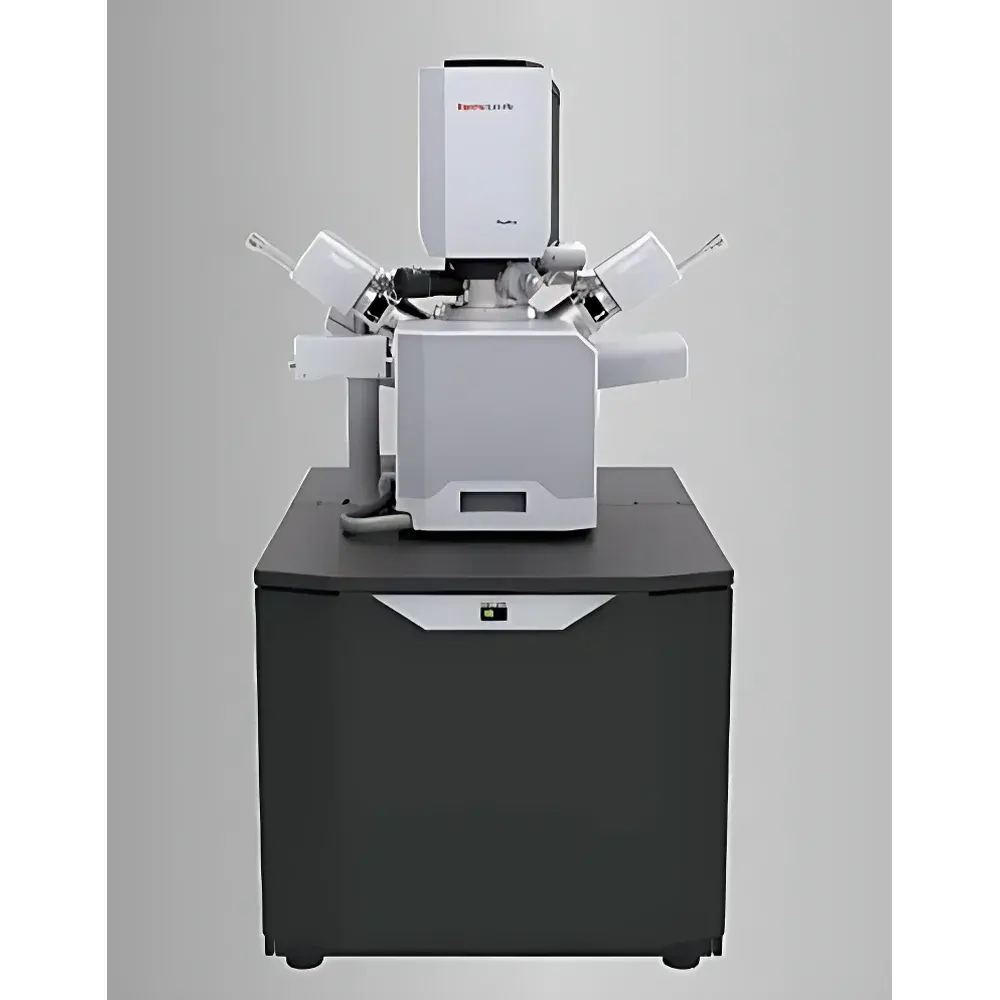
Thermo Scientific™ Quattro ESEM High-Resolution Field-Emission Scanning Electron Microscope
| Brand | Thermo Fisher Scientific |
|---|---|
| Origin | USA |
| Model | Thermo Scientific™ Quattro |
| Electron Source | Cold Field Emission Gun (CFEG) |
| Secondary Electron Imaging Resolution | ≤1.0 nm at 1 kV (Low Vacuum Mode, 200 Pa) |
| Magnification Range | 5× to 1,000,000× |
| Accelerating Voltage | 0.5–30 kV |
| Backscattered Electron Imaging Resolution | <3.0 µm at 0° tilt (in high vacuum, 6×10⁻⁴ Pa) |
| Vacuum Modes | High Vacuum (HV), Low Vacuum (LV), Environmental SEM (ESEM) up to 200 Pa |
| Stage Tilt Range | –10° to +95° (105° total) |
| Detector Configurations | Up to three EDS detectors (two 180° opposed ports), integrated WDS, co-planar EDS/EBSD capability |
| Optional In-Situ Stages | Cryo-stage (–165°C), Peltier-stage, High-Temp Stage (up to 1400°C in ESEM, 1100°C in HV) |
| Software Platform | Thermo Scientific™ Avizo™ and Quattro-specific acquisition suite with Python-based AutoScript API, full undo functionality, guided workflows, and GLP-compliant audit trail |
Overview
The Thermo Scientific™ Quattro ESEM is a high-resolution field-emission scanning electron microscope engineered for advanced materials characterization across diverse vacuum regimes — from ultra-high vacuum (UHV) to environmental conditions up to 200 Pa. Its core architecture integrates a cold field emission gun (CFEG) with a differential pumping system and pressure-limiting apertures, enabling stable electron beam operation under variable gas environments. This design permits direct imaging and microanalysis of uncoated, non-conductive, hydrated, or beam-sensitive specimens without conventional metal sputter coating — a critical advantage for life sciences, geosciences, polymers, and battery research. Unlike conventional SEMs constrained to high vacuum, the Quattro’s Environmental SEM (ESEM) mode leverages gaseous detection devices (GDD) and pressure-controlled specimen chambers to generate high-fidelity secondary electron (SE) contrast while mitigating surface charging. The instrument operates across a broad accelerating voltage range (0.5–30 kV), supporting both surface-sensitive low-kV imaging and deep-penetration high-kV analysis.
Key Features
- Ultra-stable cold field emission electron source delivering sub-nanometer resolution at low landing energies (≤1.0 nm at 1 kV in low-vacuum mode)
- Dual-mode vacuum architecture: seamless switching between high vacuum (≤6×10⁻⁴ Pa), low vacuum (1–100 Pa), and full ESEM (up to 200 Pa) without venting or sample transfer
- Integrated differential pumping system enabling quantitative energy-dispersive X-ray spectroscopy (EDS) and electron backscatter diffraction (EBSD) in low-vacuum and ESEM modes — eliminating charge-induced artifacts on insulators
- Motorized eucentric stage with ±10° to +95° tilt (105° total), 5-axis control (X/Y/Z/tilt/rotation), and sub-micron repeatability for precise crystallographic and topographic correlation
- Multi-detector bay supporting simultaneous acquisition: two opposing EDS detectors (180° separation), wavelength-dispersive spectrometer (WDS), and co-planar EDS/EBSD configuration for phase mapping and strain analysis
- Modular in-situ stage compatibility: cryogenic stage (–165°C), thermoelectric (Peltier) stage, and high-temperature stages (1100°C in HV, 1400°C in ESEM) with real-time thermal feedback and positional stability
Sample Compatibility & Compliance
The Quattro ESEM eliminates traditional sample preparation bottlenecks for challenging specimens — including biological tissues, ceramics, pharmaceutical powders, frozen-hydrated catalysts, and soft polymers. Its ability to image uncoated, non-conductive samples under controlled water vapor or nitrogen atmospheres aligns with ASTM E1508 (Standard Guide for Quantitative Analysis by Energy-Dispersive Spectrometry) and ISO 16700 (Electron probe microanalysis — Quantitative analysis using EDS). The system supports GLP/GMP workflows through configurable audit trails, user access levels, electronic signatures, and full compliance with FDA 21 CFR Part 11 requirements when deployed with validated software configurations. All vacuum and detector parameters are logged with time stamps and operator IDs, ensuring traceability for regulatory submissions and inter-laboratory reproducibility studies.
Software & Data Management
Acquisition and analysis are managed via Thermo Scientific™ Quattro Control Software — a modular, scriptable platform built on Qt and Python 3.8+. It includes guided workflows for routine tasks (e.g., automated grain boundary mapping, particle size distribution, or cross-sectional EBSD indexing), real-time drift correction, and non-destructive undo/redo functionality across all imaging and analytical operations. The AutoScript API provides native Python bindings for custom automation, batch processing, and integration with external data pipelines (e.g., MATLAB, Python Pandas, or LabArchives ELN). Raw data is stored in standardized HDF5 format with embedded metadata (accelerating voltage, working distance, detector geometry, vacuum pressure), ensuring long-term FAIR (Findable, Accessible, Interoperable, Reusable) compliance. Optional Avizo™ Software enables 3D reconstruction from tilt-series, segmentation of multi-modal datasets (SE/BSE/CL/EDS), and quantitative porosity or phase fraction analysis.
Applications
- Materials science: In-situ observation of phase transformations in alloys during heating/cooling cycles; grain growth kinetics in nanoceramics; lithium dendrite propagation in solid-state batteries under humidified argon
- Life sciences: Hydrated biofilm architecture imaging without fixation or dehydration; collagen fibril orientation mapping in native cartilage tissue via EBSD
- Geology & petrology: Pore-network analysis in shale cores under reservoir-relevant humidity; clay mineral identification via combined EDS/WDS quantification
- Electronics: Failure analysis of uncoated PCB traces and solder joints; contamination identification on MEMS devices using low-kV SE imaging and carbon-free EDS
- Pharmaceuticals: Polymorph distribution in tablet coatings; moisture-induced recrystallization of amorphous APIs imaged dynamically in ESEM
FAQ
Can the Quattro perform EDS quantification on uncoated polymer samples in ESEM mode?
Yes — its differential pumping system maintains sufficient vacuum integrity at the detector while permitting up to 200 Pa water vapor or nitrogen in the specimen chamber, enabling high-count-rate, low-noise EDS spectra with minimal carbon contamination and no conductive coating required.
What is the minimum detectable feature size for BSE imaging in high vacuum?
Backscattered electron resolution is specified as <3.0 µm at 0° tilt under high vacuum (6×10⁻⁴ Pa) and 30 kV acceleration, optimized for compositional contrast in bulk metals and geological sections.
Is EBSD indexing possible in low-vacuum mode?
Yes — the Quattro’s co-planar EDS/EBSD configuration and pressure-tolerant phosphor screen allow reliable pattern acquisition down to 10 Pa, with indexing success rates comparable to high-vacuum conditions for crystalline metals and oxides.
How does the “guided workflow” functionality improve lab throughput?
Pre-configured wizards automate repetitive tasks — such as stage calibration, focus/stigmation routines, or EDS map acquisition — reducing operator training time by ~40% and minimizing inter-user variability in daily QC protocols.
Does the system support remote operation and data sharing?
All software modules are compatible with secure VPN-based remote desktop access; raw datasets and processed results can be exported in vendor-neutral formats (HDF5, TIFF, CSV) for integration into institutional LIMS or cloud-based collaboration platforms.



