
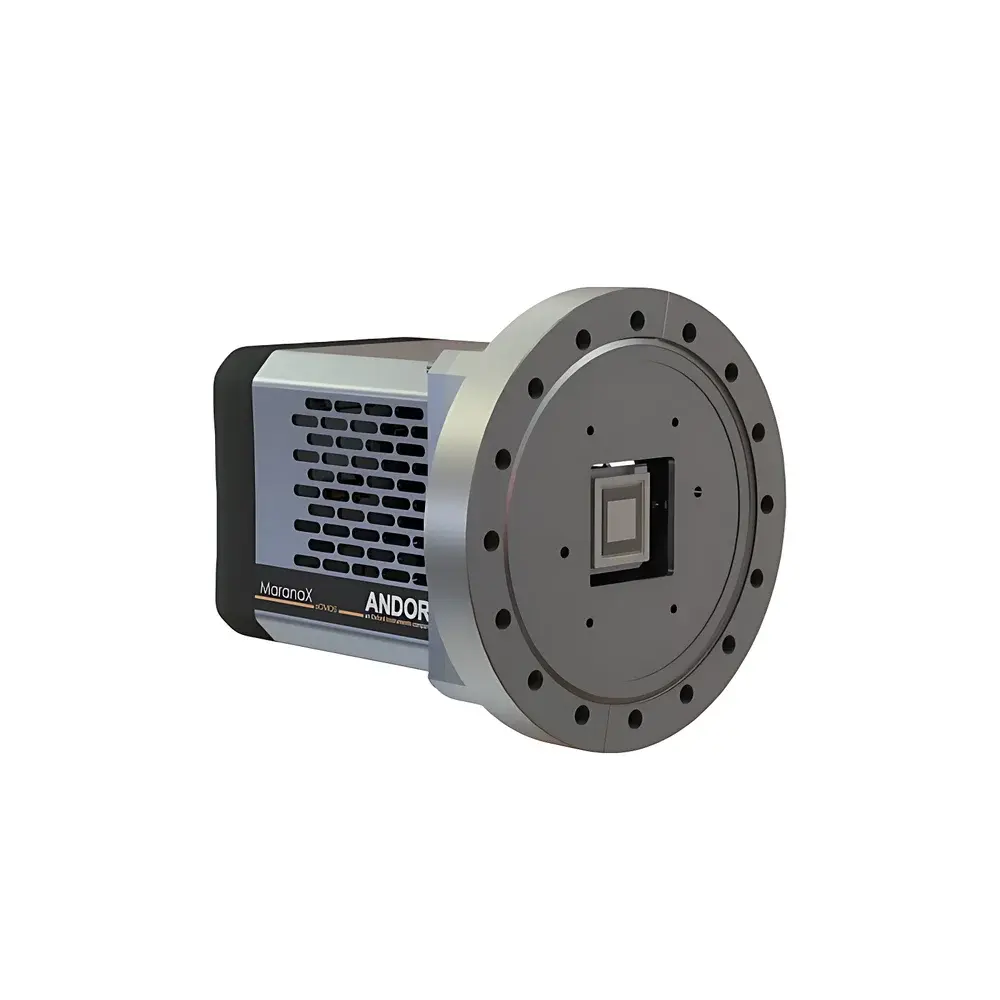
Oxford Instruments Andor Marana 4.2B-6 Back-Illuminated sCMOS Camera for Astronomy and Physical Sciences
| Brand | Oxford Instruments |
|---|---|
| Origin | United Kingdom |
| Manufacturer Type | Authorized Distributor |
| Import Status | Imported |
| Model | Marana 4.2B-6 |
| Image Resolution | 2048 × 2048 |
| Pixel Size | 6.5 µm × 6.5 µm |
| Sensor Active Area | 13.3 mm × 13.3 mm |
| Onboard Memory | 1 GB |
| Readout Speed | 310 MHz |
| Dynamic Range | 34,000:1 |
| Quantum Efficiency | 95% |
| Cooling Temperature | −45 °C |
| Full-Frame Frame Rate | 74 fps |
| ROI (512 × 512) Frame Rate | 397 fps |
| Read Noise | 1.2 e⁻ |
| Vacuum-Sealed Housing | Yes |
| Mechanical Shutter | None |
Overview
The Oxford Instruments Andor Marana 4.2B-6 is a scientific-grade, back-illuminated sCMOS camera engineered specifically for low-light, high-fidelity imaging in demanding applications across astronomy, quantum optics, condensed matter physics, and time-resolved spectroscopy. Leveraging Andor’s proprietary vacuum-sealed packaging—originally developed for EMCCD platforms—the Marana 4.2B-6 achieves exceptional thermal stability and long-term sensor integrity while enabling deep thermoelectric cooling to −45 °C. This architecture suppresses dark current to sub-0.001 e⁻/pix/s levels, preserving signal fidelity during extended exposures. Its 2048 × 2048 pixel sensor features a uniform 6.5 µm pixel pitch and delivers >95% peak quantum efficiency across the visible to near-ultraviolet spectrum (300–1000 nm), maximizing photon capture without compromising spatial resolution. Unlike front-illuminated alternatives, the back-illuminated design eliminates microlens and gate structure absorption losses, ensuring consistent QE response across the full field of view.
Key Features
- Vacuum-sealed, hermetically encapsulated sensor housing for long-term reliability and zero dew formation under cryogenic operation
- Deep thermoelectric cooling to −45 °C with active temperature stabilization (±0.1 °C), enabling ultra-low dark current performance essential for long-exposure astrophotography and single-photon counting regimes
- 1.2 e⁻ read noise at full-frame 74 fps—achieving near-photon-counting sensitivity without electron multiplication or gain-induced excess noise
- 310 MHz parallel readout architecture supporting both full-frame (74 fps) and region-of-interest (ROI) acquisition modes, including 397 fps at 512 × 512 pixels
- No mechanical shutter—eliminating vibration, timing jitter, and maintenance cycles; ideal for adaptive optics loop integration and synchronized pulsed-laser experiments
- Onboard 1 GB frame buffer for real-time buffering during high-speed acquisition sequences, reducing host PC dependency and minimizing data loss during burst capture
- Full compliance with USB 3.2 Gen 1 interface standards, supporting deterministic latency and sustained 350 MB/s throughput
Sample Compatibility & Compliance
The Marana 4.2B-6 is compatible with standard C-mount and F-mount optical interfaces, and integrates seamlessly into vacuum-compatible cryostats, telescope focal planes, and confocal or widefield microscopy platforms. Its compact, low-mass aluminum chassis meets MIL-STD-810G shock and vibration specifications. From a regulatory standpoint, the system conforms to IEC 61326-1 (EMC for laboratory equipment), RoHS 2015/863/EU, and CE marking requirements. Firmware supports audit-trail-enabled acquisition logging aligned with GLP/GMP workflows, and metadata embedding (including exposure time, temperature, gain settings, and timestamped GPS synchronization) satisfies traceability requirements per ISO/IEC 17025 and ASTM E2912-22 for quantitative imaging validation.
Software & Data Management
Andor’s Solis v5.x software provides native support for the Marana platform, offering intuitive acquisition control, real-time histogram analysis, and non-uniformity correction (NUC) with user-definable flat-field and dark-frame referencing. The SDK (Andor SDK 5) enables full API access via C++, Python (PyAndor), MATLAB, and LabVIEW, facilitating integration into custom automation pipelines—including those compliant with FDA 21 CFR Part 11 for electronic records and signatures. Raw image data is saved in industry-standard FITS format (with optional TIFF and HDF5 export), preserving 16-bit linear intensity values, calibrated gain maps, and embedded WCS headers for astronomical coordinate registration. Time-stamped metadata streams are synchronizable with external triggers (TTL, LVDS) and GPS-disciplined clocks for multi-instrument correlation in observatory arrays or quantum interference experiments.
Applications
- Astronomy: Lucky imaging, speckle interferometry, exoplanet transit photometry, and solar granulation studies requiring high dynamic range (>34,000:1) and minimal fixed-pattern noise
- Quantum Optics: Single-atom array imaging, Bose-Einstein condensate detection, and quantum gas microscopy where sub-electron read noise and precise photon statistics are critical
- Materials Science: Time-resolved photoluminescence mapping, cathodoluminescence spectroscopy, and pump-probe diffraction experiments demanding high spatiotemporal fidelity
- Adaptive Optics: Wavefront sensor integration (e.g., Shack-Hartmann) with microsecond-level trigger response and deterministic frame latency
- Hyperspectral Imaging: Coupled with tunable filters or imaging spectrometers for high-throughput spectral cube acquisition across UV-VIS-NIR bands
FAQ
What cooling method does the Marana 4.2B-6 use, and what is its minimum operating temperature?
It employs a three-stage thermoelectric cooler (TEC) with vacuum-sealed heat sinking, achieving stable operation at −45 °C with ±0.1 °C regulation.
Is the sensor sensitive to ultraviolet wavelengths below 350 nm?
Yes—the back-illuminated architecture and optimized anti-reflection coating deliver >80% QE from 300 nm onward, with optional quartz window variants available for enhanced UV transmission.
Does the camera support hardware triggering and external synchronization?
Yes—it accepts TTL/LVDS input triggers with programmable polarity and delay, and supports output strobes for synchronized illumination or laser gating.
Can the Marana 4.2B-6 be operated in vacuum environments?
The vacuum-sealed sensor package allows direct mounting in vacuum chambers down to 10⁻⁶ mbar; however, the electronics housing requires external pressure equalization or venting per Andor’s environmental specification document AN-0027.
How is calibration data (flat field, dark frame) managed and applied during acquisition?
Calibration frames are stored in non-volatile memory and applied in real time via FPGA-based pixel correction; users may load custom reference sets through Solis or the SDK.



