
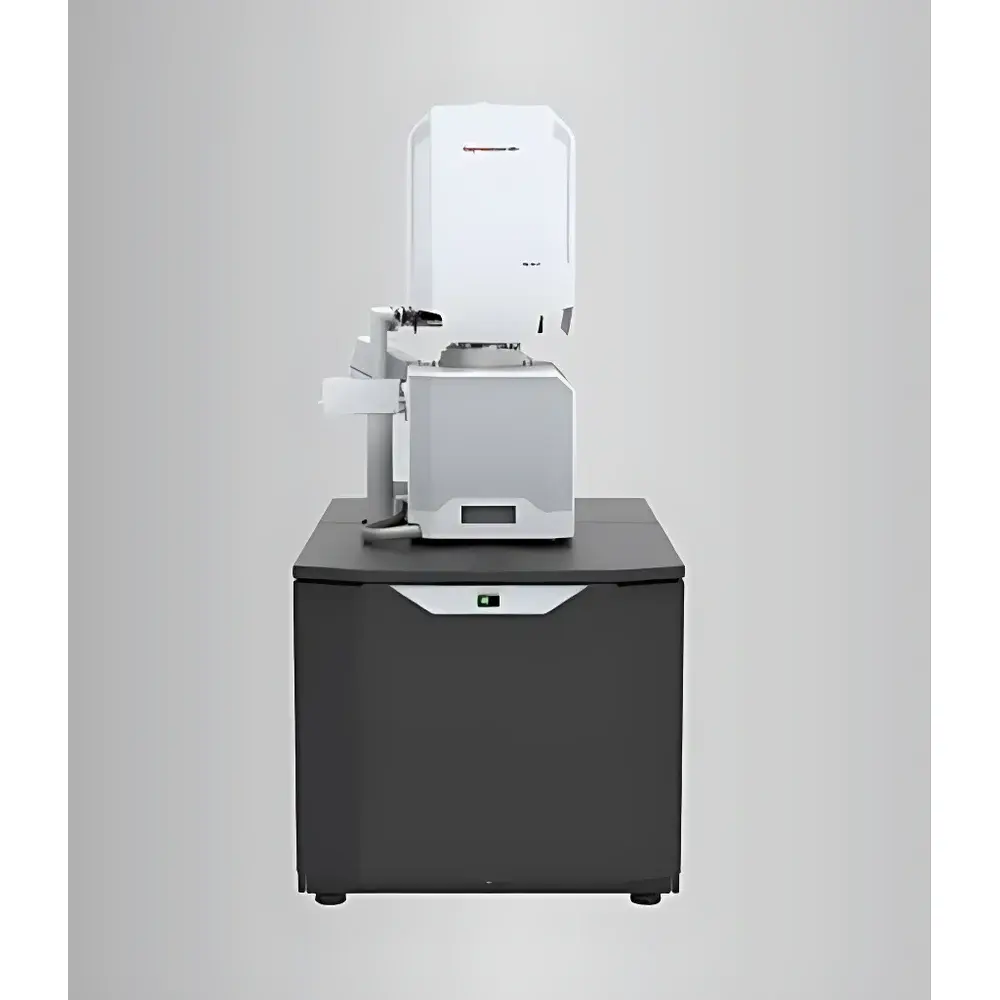
Thermo Scientific™ Apreo Scanning Electron Microscope
| Brand | Thermo Fisher |
|---|---|
| Origin | USA |
| Manufacturer Type | Authorized Distributor |
| Origin Category | Imported |
| Model | Thermo Scientific™ Apreo |
| Electron Gun Type | Cold Field Emission (CFEG) |
| Secondary Electron Resolution | 1.0 nm @ 15 kV (Electrostatic Mode) |
| Magnification Range | 20×–2000× (Low-Mag Mode) |
| Accelerating Voltage | 0.5–30 kV (Standard Mode) |
| Backscattered Electron Resolution | 0.8 nm @ 30 kV (High Vacuum Mode) |
| Chamber Pressure Range | Up to 500 Pa (Low Vacuum Mode) |
| Detector Configuration | Multi-detector architecture with in-lens SE, through-the-lens BSE, and retractable STEM detectors |
| Analytical Compatibility | Supports up to three EDS detectors, co-planar EDS/EBSD integration, and low-vacuum optimized microanalysis |
Overview
The Thermo Scientific™ Apreo Scanning Electron Microscope is a high-performance field emission SEM engineered for nanoscale imaging and microstructural analysis across diverse material classes. Built upon a hybrid electrostatic–magnetic immersion lens architecture, the Apreo delivers exceptional beam control, minimized spherical and chromatic aberrations, and stable probe formation at both high and low accelerating voltages. Its cold field emission electron source ensures high brightness (>1 × 10⁹ A/cm²·sr), long-term emission stability, and sub-nanometer probe convergence—critical for high-resolution topographic, compositional, and crystallographic characterization. Designed for rigorous academic, industrial, and regulatory environments, the Apreo meets the functional demands of advanced materials science, catalysis research, semiconductor metrology, and failure analysis laboratories requiring reproducible, quantitative SEM data under variable vacuum and voltage conditions.
Key Features
- Hybrid electrostatic–magnetic immersion lens system enabling simultaneous optimization of resolution, depth of field, and signal-to-noise ratio across 0.5–30 kV.
- Cold field emission gun (CFEG) with ultra-stable emission current and <1.0 nm secondary electron resolution at 15 kV in electrostatic mode.
- Backscattered electron resolution of 0.8 nm at 30 kV in high vacuum mode, supported by a high-collection-efficiency through-the-lens BSE detector.
- Multi-detector signal integration architecture: in-lens SE, retractable STEM, solid-state BSE, and optional environmental SE detectors allow concurrent acquisition and pixel-synchronized signal fusion.
- Low-vacuum capability up to 500 Pa enables direct imaging of non-conductive, hydrated, or beam-sensitive specimens without sputter coating.
- Integrated analytical chamber accommodating up to three silicon drift detectors (SDD-EDS), co-planar EDS/EBSD configuration, and dedicated low-vacuum microanalysis optics.
- Nav-Cam+ navigation camera with real-time stereoscopic sample positioning and automated stage calibration for repeatable region-of-interest targeting.
Sample Compatibility & Compliance
The Apreo supports broad sample compatibility—from insulating polymers and biological tissues to magnetic alloys and beam-sensitive MOFs—without mandatory conductive coating. Its low-vacuum mode, combined with active charge compensation strategies (e.g., gas ionization, beam deceleration, and bias-controlled sample stages), mitigates charging artifacts across heterogeneous surfaces. The system complies with ISO 16700:2016 (SEM measurement uncertainty guidelines), ASTM E1558 (SEM image quality assessment), and supports GLP/GMP workflows via audit-trail-enabled software logging. Optional FDA 21 CFR Part 11 compliance packages are available for regulated pharmaceutical and medical device QA/QC applications.
Software & Data Management
Operation is managed through Thermo Scientific™ SmartSEM software—a modular, scriptable platform supporting automated acquisition protocols, multi-channel signal correlation, and batch processing. All imaging and analytical metadata—including kV, working distance, dwell time, detector gain, vacuum status, and stage coordinates—are embedded in TIFF and HDF5 file formats. Raw data export adheres to open standards (e.g., EMDB, TIFF-SEM extensions), facilitating integration with third-party quantification tools (e.g., ImageJ/Fiji, MATLAB, Python-based SciPy stacks). Software updates follow a controlled release cycle aligned with IEC 62304 Class B medical device software requirements where applicable.
Applications
- Nanoparticle morphology and size distribution analysis in catalyst development and battery electrode R&D.
- Grain boundary mapping and phase identification in metallurgical alloys using integrated EBSD.
- Sub-10 nm defect inspection on EUV photomasks and advanced packaging substrates.
- In situ observation of thermal or electrical stimulation effects on MEMS devices under controlled vacuum.
- Low-k dielectric film integrity assessment in semiconductor process control.
- Corrosion product layer characterization on nuclear fuel cladding materials under inert gas environments.
FAQ
What vacuum modes does the Apreo support, and how do they affect imaging performance?
The Apreo operates in high vacuum (≤1 × 10⁻⁴ Pa), low vacuum (up to 500 Pa), and environmental SEM (ESEM)-compatible modes. Low vacuum enhances surface charge dissipation for insulators while preserving SE contrast; high vacuum maximizes resolution and analytical sensitivity.
Can the Apreo perform simultaneous EDS and EBSD acquisition?
Yes—the chamber design allows co-planar mounting of EDS and EBSD detectors with synchronized stage tilting and beam rastering, enabling correlative phase/composition mapping without repositioning.
Is remote operation and data sharing supported?
SmartSEM includes secure remote desktop access, role-based user permissions, and cloud-ready DICOM/EMDB-compliant export modules for collaborative review and LIMS integration.
How is beam alignment and calibration maintained over time?
The system employs automated astigmatism correction, stigmator learning algorithms, and daily self-calibration routines traceable to NIST-maintained reference standards.
What training and service options are available post-installation?
Thermo Fisher offers certified operator training (on-site and virtual), preventive maintenance contracts with SLA-backed response times, and application-specific method development support from field application scientists.






