
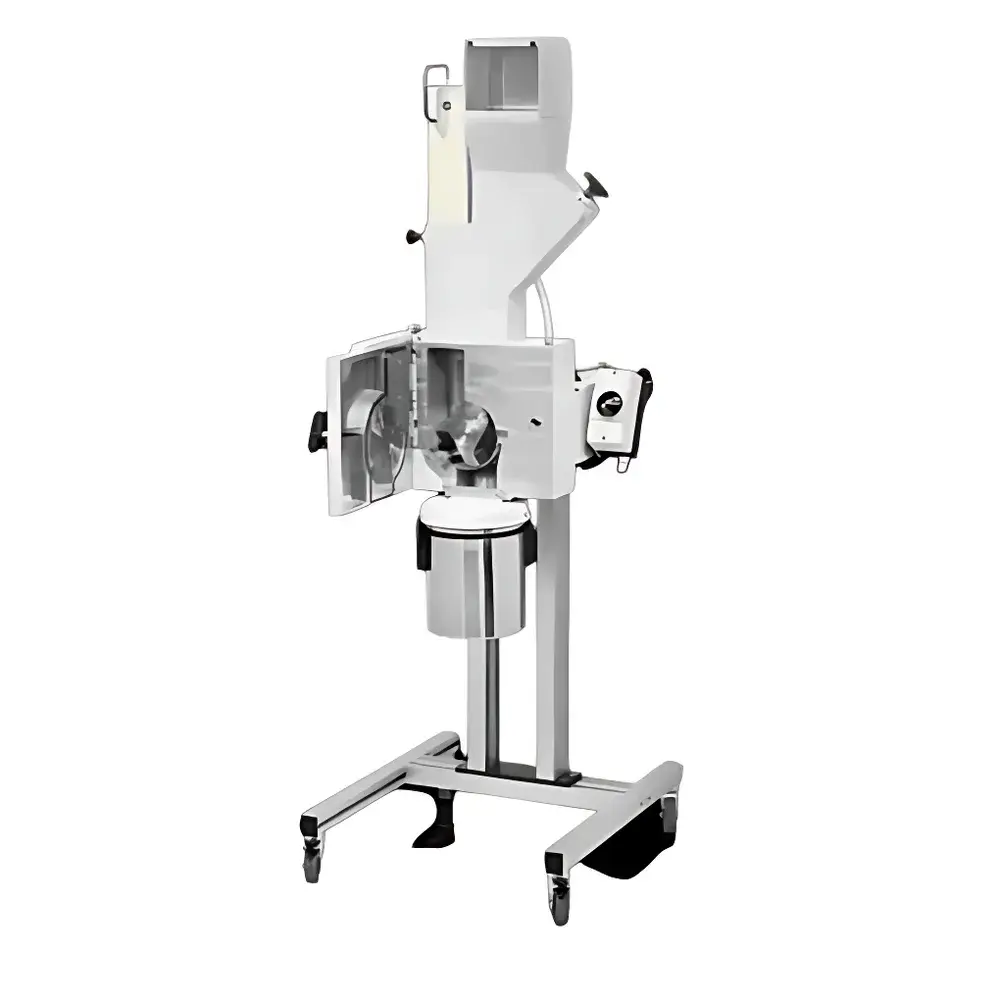
Retsch SM 100 Cutting Mill
| Brand | Retsch |
|---|---|
| Origin | Germany |
| Model | SM 100 |
| Instrument Type | Cutting Mill |
| Sample Feed Size | < 60 × 80 mm |
| Final Particle Size | 0.25 – 20 mm |
| Sample Suitability | Soft to Medium-hard Materials |
| Construction | Stainless Steel Body with Optional Heavy-Metal-Free Components |
| Safety Compliance | CE, EN 61000-6-2/-6-4, EN 61000-6-3 |
Overview
The Retsch SM 100 Cutting Mill is a robust, benchtop cutting mill engineered for reproducible size reduction of soft to medium-hard, fibrous, elastic, or thermally sensitive materials. It operates on the principle of high-speed rotary cutting—where a rotating knife assembly shears material against fixed counter-cutting edges and a perforated bottom sieve—to achieve controlled particle size distribution through mechanical attrition and slicing. Unlike impact or disc mills, the SM 100 minimizes heat generation and sample degradation, making it especially suitable for temperature-sensitive or cohesive samples such as polymers, plant tissues, pharmaceutical intermediates, and foodstuffs. Its modular design allows rapid adaptation to diverse laboratory workflows, supporting both routine QC grinding and method development in regulated environments.
Key Features
- Interchangeable rotor configurations: Parallel-blade rotor and 6-wing rotor for optimized throughput and particle shape control depending on sample elasticity and fiber content.
- Quick-change bottom sieves with square or trapezoidal apertures (0.25–20 mm), available in stainless steel (AISI 304) or heavy-metal-free certified variants (e.g., titanium-coated or PTFE-lined options) to eliminate contamination risks in trace-element analysis or pharmaceutical applications.
- Gravity-fed sample introduction via multiple hopper options—including standard conical hopper and elongated hopper for rod-shaped or filamentous samples (e.g., cables, twigs, PET preforms).
- Tool-free rotor and sieve access with push-in knife assembly, enabling full disassembly and cleaning in under 90 seconds without tools or calibration loss.
- Integrated safety interlock system compliant with EN 61000-6-2 (immunity) and EN 61000-6-4 (emission), including automatic motor shutdown upon lid opening and overload protection.
- Ergonomic collection vessel design with volume options of 0.5 L, 2 L, and 5 L, all featuring anti-static coating and secure bayonet locking.
Sample Compatibility & Compliance
The SM 100 accommodates heterogeneous feed materials up to 60 × 80 mm in dimension, including but not limited to animal feed pellets, leather scraps, rubber compounds, PCBs, textile waste, wood chips, straw bales, medicinal herbs, and polymer granules. Its low-shear cutting mechanism preserves structural integrity of fragile matrices (e.g., starch granules, botanical cells) while delivering consistent size reduction. The instrument meets CE marking requirements and conforms to key international standards applicable to laboratory grinding equipment, including ISO 17025-relevant operational traceability, ASTM D297–22 (rubber grinding), and USP (particle size reduction of pharmaceutical excipients). Optional heavy-metal-free components support compliance with ICH Q3D elemental impurities guidelines and EU Pharmacopoeia 2.9.17.
Software & Data Management
While the SM 100 operates as a standalone mechanical unit without embedded digital controls, its design supports full integration into GLP/GMP-compliant workflows. All critical parameters—including rotor type, sieve aperture, feed rate estimation, and cleaning log—are documented manually or via external LIMS using standardized SOP templates (e.g., Retsch SOP-GRIND-SM100 Rev. 3). Optional accessories include RFID-tagged sieves and rotors for automated component tracking. For audit readiness, maintenance records, calibration certificates (for optional digital tachometer add-ons), and cleaning verification reports can be archived per FDA 21 CFR Part 11 requirements when paired with validated electronic documentation systems.
Applications
The SM 100 serves as a primary size reduction tool across analytical, quality control, and R&D laboratories in industries including food safety (homogenization of composite food matrices prior to metal analysis), environmental testing (grinding of WEEE waste and RDF for leaching studies), clinical research (bone and tissue preparation for ICP-MS), polymer science (pre-grinding of injection-molded parts for FTIR sampling), and agrochemical development (milling of feed blends for mycotoxin extraction). Its ability to process moisture-rich, oily, or sticky samples—without clogging or thermal degradation—distinguishes it from high-energy mills in applications demanding morphological fidelity and minimal oxidation.
FAQ
What types of materials are unsuitable for the SM 100?
Highly abrasive materials (e.g., quartz, ceramics), extremely hard metals (>55 HRC), and viscous pastes or slurries are not recommended due to accelerated wear and potential rotor imbalance.
Can the SM 100 be used for cryogenic grinding?
No—it lacks integrated cooling; however, pre-chilled samples (< −20 °C) may be processed briefly if moisture content remains low and rotor speed is reduced by 20% to limit thermal load.
Is validation support available for regulated labs?
Yes—Retsch provides IQ/OQ documentation templates, risk assessments per ISO 14971, and third-party qualification services compatible with ISO/IEC 17025 accreditation scopes.
How often should the cutting blades be replaced?
Under typical use (≤ 4 h/day, soft-to-medium samples), blade replacement is recommended every 200–300 operating hours or upon visible edge rounding or increased particle size variability.
Does the SM 100 comply with FDA requirements for food contact surfaces?
All wetted parts meet FDA 21 CFR §177.2600 (food-grade plastics) and §178.3570 (stainless steel), with optional electropolished AISI 316L construction available upon request.



